kottke.org posts about obituaries

Sir Patrick Stewart, best known for his role as Captain Jean-Luc Picard on Star Trek: The Next Generation, has died at the age of 86. He passed at home in Los Angeles from Alzheimer’s disease and Lewy body dementia.
He was largely considered an unknown when the “Star Trek” offer came along. At the invitation of a friend, a university professor, Mr. Stewart had been in Los Angeles conducting master classes on Shakespeare when, one evening, he gave a lecture and performed some bits of the plays in a program that was open to the public.
A TV producer who was involved in developing a new “Star Trek” series happened to attend and soon persuaded Mr. Stewart to audition — even though, as Mr. Stewart later wrote, he knew “next to nothing” about the franchise.
Surprised to get the part — the “Star Trek” creator, Gene Roddenberry, who was overseeing the new series, had not been keen to hire him at first — Mr. Stewart expected the project to be a short-term commitment. How, he remembered thinking, could the show possibly succeed with a middle-aged pacifist captain with a French name and a British accent?

This is hard news to take, even though Stewart lived a full and fulfilling life. The Next Generation will always be my favorite Star Trek series and Picard my favorite captain. Stewart got off to a rough start on the series:
So when he was on set shooting the show’s debut season and co-stars like Jonathan Frakes, Denise Crosby and Brent Spiner would tease him or ad-lib a joke or laugh when they flubbed their lines, it would low-key infuriate him.
“I could be a severe bastard,” he writes. “My experiences at the Royal Shakespeare Company and the National Theatre had been intense and serious… On the TNG set, I grew angry with the conduct of my peers, and that’s when I called that meeting in which I lectured the cast for goofing off and responded to Denise Crosby’s, ‘We’ve got to have some fun sometimes, Patrick’ comment by saying, ‘We are not here, Denise, to have fun.’”
“In retrospect,” Stewart continues, “everyone, me included, finds this story hilarious. But in the moment, when the cast erupted in hysterics at my pompous declaration, I didn’t handle it well. I didn’t enjoy being laughed at. I stormed off the set and into my trailer, slamming the door.”
But he found his footing and eventually found meaning in the role of Picard (archive):
Q: There’s a passage where you say that, from your father, “I drew Picard’s stern, intimidating tendencies. But I like to think that my mother is in the captain too, in his moments of warmth and sensitivity.” Do you see Picard as your way of reconciling that conflict between your parents?
A: Very much so, yes. Both Star Trek and therapy have been responsible for that. Having to open the doors into my childhood in order to be an actor became utterly intriguing to me in a way that it never had been before. And I regret that when I look back on some of the roles I played, what I might have brought to them if I just released myself a little bit more.
Might watch an episode or two this evening in remembrance. If you’re not a Trek fan, you can watch Stewart play Macbeth in 2010:
The Night Witches were an all-female Soviet bomber regiment that attacked Nazi forces during World War II.
An attack technique of the night bombers involved idling the engine near the target and gliding to the bomb-release point with only wind noise left to reveal their presence. German soldiers likened the sound to broomsticks and hence named the pilots “Night Witches”.
Some of the aviators were Jewish, like Polina Gelman:
She would be among a half-million Jews who are believed to have served in the Red Army, according to Yad Vashem. They fought not only for the survival of the Soviet Union, but also against the annihilation of their people in Nazi death camps in Poland.
“I have decided to go to the front,” Gelman wrote to her mother, adding, “I am a daughter of the Jewish people” with “a particular account” to settle with Hitler.
The women were barely given proper aircraft — crop dusters! — but they were quiet & maneuverable, ideal for night attacks:
The regiment flew in steel-and-canvas Polikarpov U-2 biplanes, a 1928 design intended for use as training aircraft (hence its original uchebnyy designation prefix of “U-“) and for crop dusting, which also had a special U-2LNB version for the sort of night harassment attack missions flown by the 588th. The plane could carry only 350 kilograms (770 lb) of bombs, so eight or more missions per night were often necessary. Although the aircraft was obsolete and slow, the pilots took advantage of its exceptional maneuverability; it also had a maximum speed that was lower than the stalling speed of both the Messerschmitt Bf 109 and the Focke-Wulf Fw 190, which made it very difficult for German pilots to shoot down…
Using the NY Times Archive API, journalist Ted Alcorn built Below the Fold, a dashboard through which you can explore the last 25 years of Times coverage: 2.2 million articles containing 1.5 billion words. You can slice and dice this data in a bunch of different ways — it’s a fantastic resource.
One of the site’s sections is about obituaries. From that data, Alcorn produced this infographic of whose obits contained the highest word count:
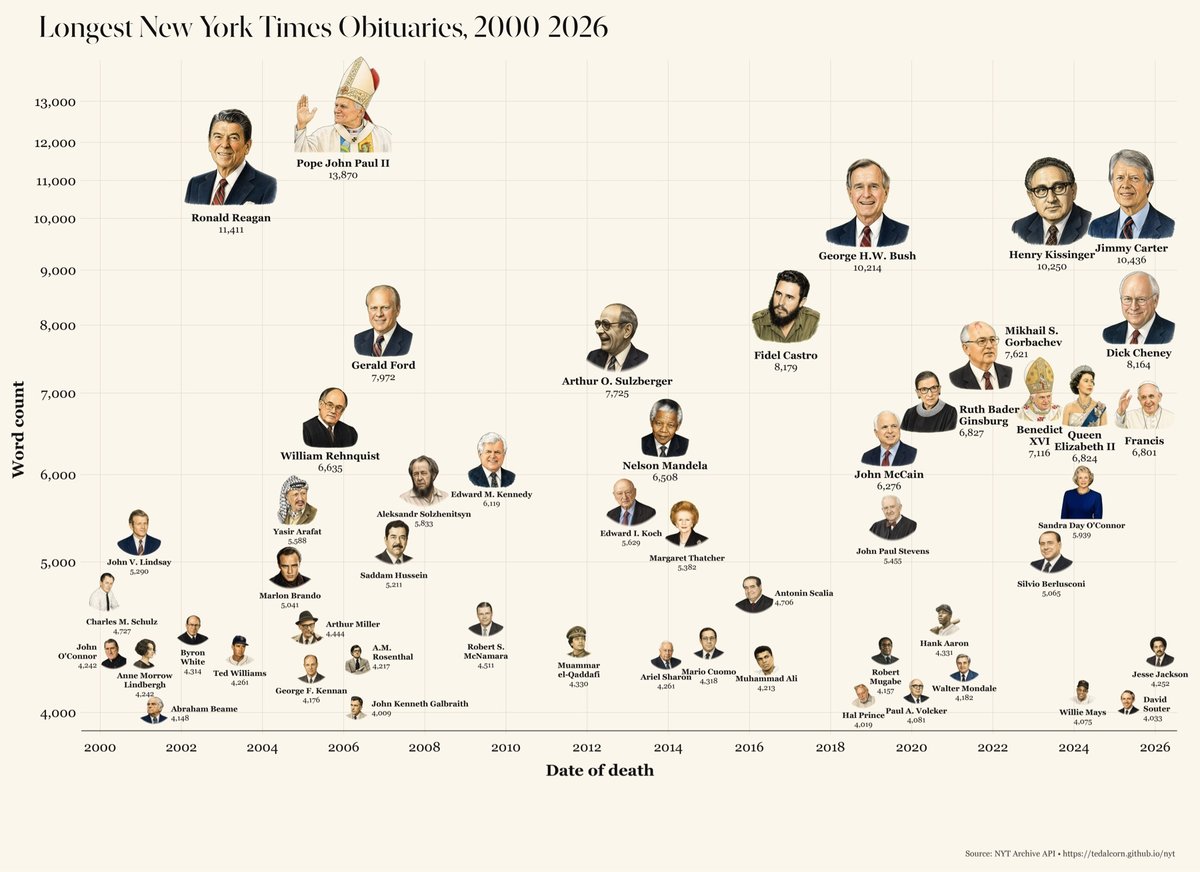
As you can see, it’s a lot of world leaders, religious leaders, politicians, and white men. There only appear to be five women on the list. Notable non-politicians include Aleksandr Solzhenitsyn, Muhammad Ali, and Charles Schulz.
The whole dashboard is fun/enlightening to explore.

The painting above was made in 1945 by self-taught artist Janet Sobel; it’s called Milky Way. Sobel was a Ukrainian-born artist who was a pioneer in abstract expressionist art and in drip painting; her work directly influenced that of Jackson Pollock. From Why This Pioneering Abstract Painter Disappeared From the Art World at the Height of Her Fame:
The next year, Sobel had her first solo show at New York’s Puma Gallery, where the legendary art critic Clement Greenberg visited — with Pollock. In an update to his essay “American-Type Painting,” Greenberg wrote that they “admired these pictures rather furtively,” adding: “Later on, Pollock admitted that these pictures had made an impression on him.”
Here’s one of Sobel’s paintings circa 1946-1948:

Compare that with Pollock’s first drip painting in 1946. Hmm!
Sobel’s “outsider” status, gender, and age, as well as a move away from NYC and the loss of her primary patron, all contributed to her short career, lack of recognition, and limited legacy (for someone who was described in 1946 as an artist who will “eventually be known as one of the important surrealist artists in this country”).
In 2021, Sobel was the subject of a belated obituary in the NYT’s Overlooked series.
How exactly Sobel entered the art world is a bit of folklore. As one story goes, Sobel’s son Sol was an art student who in the late 1930s threatened to quit his studies at the Art Students League, a storied nonprofit school in Manhattan that counts Norman Rockwell, Georgia O’Keeffe and Mark Rothko among its alumni.
According to historians and family members, Sobel criticized one of Sol’s paintings, prompting him to throw down his brush and tell her to take up painting herself instead.
And here’s a MoMA video about Sobel’s Milky Way:
Born in 1790 just a few months after George Washington took office, John Tyler was America’s 10th president, serving from 1841-1845. Harrison Ruffin Tyler, Tyler’s last living grandson, died this past weekend at the age of 96.
As long as he lived, much of the great sweep of American history could be contained in just three generations of memory.
I wrote about Harrison and his brother Lyon Gardiner Tyler Jr. back in 2012 and again in 2020 when Lyon died.
John Tyler was born barely a year into George Washington’s first term and undoubtedly met and even worked with some of the nation’s earliest political figures, including Thomas Jefferson and John Quincy Adams. Amazing to think that just three generations of the same family stretch almost all the way back to the founding of our country. It underscores just how young the United States is — after all, the last person to receive a Civil War pension just died back in June.
You can read more about these sorts of human bucket brigades across time on The Great Span page. (via @jeremywallace.bsky.social)
George Wendt, who played lovable barfly Norm Peterson on Cheers for 11 seasons, died yesterday at the age of 76. Here’s an 18-minute supercut of every time Norm entered the bar. I loved Cheers when I was a kid; I’ve seen every episode multiple times (though not for many years) and of course Norm was a favorite. 🍺💞

Beloved children’s book author Eric Carle died this past weekend at the age of 91 and this is one of the best openings to an obituary I can recall reading:
When a fictional caterpillar chomps through one apple, two pears, three plums, four strawberries, five oranges, one piece of chocolate cake, one ice cream cone, one pickle, one slice of Swiss cheese, one slice of salami, one lollipop, one piece of cherry pie, one sausage, one cupcake and one slice of watermelon, it might get a stomach ache.
But it might also become the star of one of the best-selling children’s books of all time.
Eric Carle, the artist and author who created that creature in his book “The Very Hungry Caterpillar,” a tale that has charmed generations of children and parents alike, died on Sunday at his summer studio in Northampton, Mass. He was 91.
I’ve written about Carle and his most famous creation, The Very Hungry Caterpillar, a couple of times here — I can still remember the first time my son read (or, more likely, recited from memory) the list of everything the caterpillar ate on Saturday, including all of his adorable pronunciations.
The Very Hungry Caterpillar was certainly one of my favorite books as a kid — along with Cloudy With a Chance of Meatballs, Richard Scarry’s Busy, Busy Town & Cars and Trucks and Things That Go, and the Frog & Toad books — and it was one of the first books we read to our kids. I remember very clearly loving the partial pages and the holes. Holes! In a book! Right in the middle of the page! It felt transgressive. Like, what else is possible in this world if you can do such a thing?
You can see Carle at work in his workshop from an episode of Mister Rogers’ Neighborhood in 1998. I particularly appreciated this short exchange:
Rogers: In this, there’s just no mistakes, is there?
Carle: No, you can’t make mistakes really.
On December 16, 2020, Helen Viola Jackson died in Marshfield, Missouri at the age of 101. She was the last known widow of a Civil War veteran, marrying 93-year-old James Bolin in 1936 at the age of 17.
James Bolin was a 93-year-old widower when Jackson’s father volunteered her to stop by his house each day and assist him with chores as she headed home from school.
Bolin, who was a private in the 14th Missouri Cavalry and served until the end of the war in Co. F, did not believe in accepting charity and after a lengthy period of time asked Jackson for her hand in marriage as a way to provide for her future.
“He said that he would leave me his Union pension,” Jackson explained in an interview with Historian Hamilton C. Clark. “It was during the depression and times were hard. He said that it might be my only way of leaving the farm.”
Jackson didn’t talk publicly about her marriage until the last few years and never applied for the pension — the last person receiving a Civil War pension from the US government died in mid-2020. As I wrote then, about the Great Span:
This is a great example of the Great Span, the link across large periods of history by individual humans. But it’s also a reminder that, as William Faulkner wrote: “The past is never dead. It’s not even past.” Until this week, US taxpayers were literally and directly paying for the Civil War, a conflict whose origins stretch back to the earliest days of the American colonies and continues today on the streets of our cities and towns.
(via @jerometenk)
Last weekend, Lyon Gardiner Tyler Jr. died at the age of 95. Remarkably, Lyon was the grandson of John Tyler, the 10th President of the United States. His brother Harrison Ruffin Tyler is still alive. Here’s what I wrote about the Tylers back in 2012:
John Tyler was the 10th President of the United States. He was born in 1790 and took office in 1841. His son, Lyon Gardiner Tyler, was born in 1853, when Tyler was 63 years old. In turn, Lyon had six children with two different wives, two of whom were Lyon Gardiner Tyler, Jr. and Harrison Ruffin Tyler (born 1924 & 1928 respectively, when Lyon Sr. was in his 70s).
John Tyler was born barely a year into George Washington’s first term and undoubtably met and even worked with some of the nation’s earliest political figures, including Thomas Jefferson and John Quincy Adams. Amazing to think that just three generations of the same family stretch almost all the way back to the founding of our country. It underscores just how young the United States is — after all, the last person to receive a Civil War pension just died back in June. You can check out more examples of The Great Span phenomenon here.

That’s the front page of the NY Times today, listing the names of hundreds of the nearly 100,000 Americans who have died from Covid-19 (the full listing is of ~1000 names and continues inside the paper).

Here’s a more readable PDF version and an online version that scrolls and scrolls and scrolls. They compiled the list by going through obituaries from local newspapers from around the countries.
Putting 100,000 dots or stick figures on a page “doesn’t really tell you very much about who these people were, the lives that they lived, what it means for us as a country,” Ms. Landon said. So, she came up with the idea of compiling obituaries and death notices of Covid-19 victims from newspapers large and small across the country, and culling vivid passages from them.
Alain Delaquérière, a researcher, combed through various sources online for obituaries and death notices with Covid-19 written as the cause of death. He compiled a list of nearly a thousand names from hundreds of newspapers. A team of editors from across the newsroom, in addition to three graduate student journalists, read them and gleaned phrases that depicted the uniqueness of each life lost:
“Alan Lund, 81, Washington, conductor with ‘the most amazing ear’ … “
“Theresa Elloie, 63, New Orleans, renowned for her business making detailed pins and corsages … “
“Florencio Almazo Morán, 65, New York City, one-man army … “
“Coby Adolph, 44, Chicago, entrepreneur and adventurer … “
Every one of these names was a person with a whole life behind them and so much more to come. Each has a family and friends who are mourning them. Here are a few more of their names and short stories:
Romi Cohn, 91, New York City, saved 56 Jewish families from the Gestapo.
Jermaine Ferro, 77, Lee County, Fla., wife with little time to enjoy a new marriage.
Julian Anguiano-Maya, 51, Chicago, life of the party.
Alan Merrill, 69, New York City, songwriter of “I Love Rock ‘n’ Roll.”
Lakisha Willis White, 45, Orlando, Fla., was helping to raise some of her dozen grandchildren.
In the past five months, more Americans have died from Covid-19 than in the decade-plus of the Vietnam War and the death toll is a third of the number of Americans who died in World War II. When this is over (whatever that means), the one thing we cannot do is forget all of these people. And we owe to them to make this mean something.

This animated gif from XKCD is the pitch perfect tribute to John Conway, who died of Covid-19 at the age of 82. Conway was the inventor of the Game of Life and an all-around brilliant and creative person.
Sad news from Sesame Street: Carroll Spinney, the puppeteer who played Big Bird and Oscar the Grouch for almost 50 years, died today at age 85.
Caroll was an artistic genius whose kind and loving view of the world helped shape and define Sesame Street from its earliest days in 1969 through five decades, and his legacy here at Sesame Workshop and in the cultural firmament will be unending. His enormous talent and outsized heart were perfectly suited to playing the larger-than-life yellow bird who brought joy to generations of children and countless fans of all ages around the world, and his lovably cantankerous grouch gave us all permission to be cranky once in a while.
Spinney had retired from the show last year, citing health concerns. Here’s a look at how he operated the Big Bird puppet (more here):

Spinney came out with a book in 2003 called The Wisdom of Big Bird (and the Dark Genius of Oscar the Grouch): Lessons from a Life in Feathers and was the subject of a 2015 documentary called I Am Big Bird. Here’s a trailer:
At Sesame Street creator Jim Henson’s memorial service at Cathedral of St. John the Divine after his unexpected death in 1990, Spinney walked out and, in full Big Bird costume, sang “It Ain’t Easy Being Green” in tribute to his friend:
Total silence after he finished…I can’t imagine there was a dry eye in the house after that. Rest in peace, gentle men.
Writer Rachel Monroe recently shared a bunch of “odd synonyms for ‘died’” that her mother collects from obituaries. Here’s an excerpt from her charmingly handwritten notes:

Among the highlights:
- snuck out of this world
- welcomed as Heaven’s newest biker angel
- entered into eternal celebration
- is joyfully singing with Jesus
- finished with gratitude her human experience
(via @tedgioia)
Ricky Jay died yesterday, aged 72. He was a master magician with a deck of cards, an actor, writer, and historian. The definitive profile of Jay was written by Mark Singer in 1993 for The New Yorker. It begins like this…just try not to read the whole thing:
The playwright David Mamet and the theatre director Gregory Mosher affirm that some years ago, late one night in the bar of the Ritz-Carlton Hotel in Chicago, this happened:
Ricky Jay, who is perhaps the most gifted sleight-of-hand artist alive, was performing magic with a deck of cards. Also present was a friend of Mamet and Mosher’s named Christ Nogulich, the director of food and beverage at the hotel. After twenty minutes of disbelief-suspending manipulations, Jay spread the deck face up on the bar counter and asked Nogulich to concentrate on a specific card but not to reveal it. Jay then assembled the deck face down, shuffled, cut it into two piles, and asked Nogulich to point to one of the piles and name his card.
“Three of clubs,” Nogulich said, and he was then instructed to turn over the top card.
He turned over the three of clubs.
Mosher, in what could be interpreted as a passive-aggressive act, quietly announced, “Ricky, you know, I also concentrated on a card.”
After an interval of silence, Jay said, “That’s interesting, Gregory, but I only do this for one person at a time.”
Mosher persisted: “Well, Ricky, I really was thinking of a card.”
Jay paused, frowned, stared at Mosher, and said, “This is a distinct change of procedure.” A longer pause. “All right-what was the card?”
“Two of spades.”
Jay nodded, and gestured toward the other pile, and Mosher turned over its top card.
The deuce of spades.
A small riot ensued.
Magic aside, Jay’s performances were master classes in how to entertain. Even in grainy YouTube videos, it is impossible to look away:
In 2002, he threw playing cards at Jackie Chan, Conan O’Brien, and a watermelon on television:
When asked about “a world without lying” by Errol Morris in 2009, Jay replied:
When you’re talking about Kant and trust, it made me think of one of the ways I tell people about the con game. I say, “You wouldn’t want to live in a world where you can’t be conned, because if you were, you would be living in a world with no trust. That’s the price you pay for trust, is being conned.”
The 2012 documentary film about Jay, Deceptive Practices, is streaming for free on Amazon Prime Video…I know what I’m watching tonight. Here’s the trailer to pique your interest:
Update: A poetic remembrance of Jay from his friend David Mamet.
Our great sage Johnny Mercer wrote, “Go out and try your luck / You might be Donald Duck / Hooray for Hollywood.” But Ricky, as the Stoics taught, did not enter that race. He achieved fame and adulation, but like the warrior monk or the Hasidic master, he sought perfection.
He spent five or six hours a day practicing. He did it for 60 years. And, like all great preceptors, he was, primarily, a student. His study was the metaphysical idea of Magic, which found expression not only in performance, but in practice, commentary, design and contemplation. They were all, and equally to him, but expressions of an ideal.
Film & design legend Pablo Ferro died this weekend at the age of 83. Ferro was known for designing the iconic opening title sequences for Dr. Strangelove and Bullitt (among others).
He also designed what is probably my favorite movie trailer, for A Clockwork Orange:
I wrote about Ferro’s work with Stanley Kubrick in this post 10 years ago. From a piece by Steven Heller that I linked to in the post:
Kubrick wanted to film it all using small airplane models (doubtless prefiguring his classic space ship ballet in 2001: A Space Odyssey). Ferro dissuaded him and located the official stock footage that they used instead. Ferro further conceived the idea to fill the entire screen with lettering (which incidentally had never been done before), requiring the setting of credits at different sizes and weights, which potentially ran counter to legal contractual obligations. But Kubrick supported it regardless. On the other hand, Ferro was prepared to have the titles refined by a lettering artist, but Kubrick correctly felt that the rough hewn quality of the hand-drawn comp was more effective. So he carefully lettered the entire thing himself with a thin pen.
The Art of the Title also interviewed Ferro about the Strangelove opening credits.
The titles for Strangelove were last-minute; I didn’t have much time to produce it. It came up because of a conversation between Stanley and I. Two weeks after I finished with everything, he and I were talking. He asked me what I thought about human beings. I said one thing about human beings is that everything that is mechanical, that is invented, is very sexual. We looked at each other and realized — the B-52, refueling in mid-air, of course, how much more sexual can you get?! He loved the idea. He wanted to shoot it with models we had, but I said let me take a look at the stock footage, I am sure that [the makers of those planes] are very proud of what they did and, sure enough, they had shot the plane from every possible angle.
Update: The Art of the Title also did a huge three-part interview with Ferro as a career retrospective. Great deep dive into a substantial career.
Older posts





Socials & More