kottke.org posts about medicine
Merck is working on a new insomnia drug that they claim has few of the sometimes nasty side effects of other drugs like Ambien. Ian Parker reports for the New Yorker.
If the Merck scientists succeeded at the F.D.A., they would be the first to bring an orexin-related drug to market. “It’s an amazing achievement,” Richard Hargreaves, the fourth colleague at the Hilton, said. “Everyone should be really proud.” But, he added, “my worry is that a new mechanism is being evaluated on the science of an old mechanism.”
“With Ambien, you’ve got a drug that’s got basically only onset,” Renger said, dismissively. That is, it sends you to sleep but might not keep you asleep. “Suvorexant has the onset, but it has the great maintenance, especially in the last third of the night, where other drugs fail.” And even though suvorexant keeps working longer than Ambien, suvorexant patients don’t feel groggier afterward, as you might expect. Impassioned, Renger imagined himself addressing the F.D.A.: “Why aren’t you giving this a chance?”
“Drugs usually have some side effects,” Schoepp said. “It’s all benefit-risk.” He added, “There is some dose where suvorexant will be ultimately safe-because nothing will happen. If you go low enough, it becomes homeopathic.”
They stood to go to their rooms. Schoepp murmured, “I’d love to take it right now.”
From Wired’s Matthieu Aikins: The Surge.
In 1988 there were 350,000 cases of polio worldwide. Last year there were 223. But getting all the way to zero will mean spending billions of dollars, penetrating the most remote regions of the globe, and facing down Taliban militants to get to the last unprotected children on earth.
See also: Imagining a post-antibiotics future.
Hall of Famer Tony Dorsett is among a growing group of former NFL players who have been diagnosed with diseases caused by years of head trauma and other injuries.
The former Cowboys running back, now 59, said that when he took his Oct. 21 flight from Dallas to Los Angeles for testing, he repeatedly struggled to remember why he was aboard the plane and where he was going. Such episodes, he said, are commonplace when he travels.
Dorsett said he also gets lost when he drives his two youngest daughters, ages 15 and 10, to their soccer and volleyball games.
“I’ve got to take them to places that I’ve been going to for many, many, many years, and then I don’t know how to get there,” he said.
The 1976 Heisman Trophy winner and eighth all-time leading NFL rusher said he has trouble controlling his emotions and is prone to outbursts at his wife and daughters.
“It’s painful, man, for my daughters to say they’re scared of me.” After a long pause, he tearfully reiterated, “It’s painful.”
And I missed this last year, but former Bears QB Jim McMahon is suffering from early-stage dementia.
In an interview with Fox affiliate WFLD-TV, aired Wednesday, the 53-year-old McMahon says he knows where he’s going when in an airport. But when he meets people, “I’m asking two minutes later, ‘Who was that?’
“When my friends call and leave me a message … I’ll read it and delete it before I respond and then I forget who called and left me a message.”
McMahon says he is not worried about his mind withering away. He says he still reads a lot and is doing other things to keep his mind active. However, he said he doesn’t know whether he is getting worse.
These stories are just going to keep coming. Perhaps a true tipping point will come when one of the league’s past megastars is dianosed with CTE…if Brett Favre or Dan Marino or John Elway or Troy Aikman or Ray Lewis or any of the other former players that appear regularly on NFL game broadcasts announces he has CTE or dementia, maybe then the league will take real action? Or not? (via df)
Update: Former NFL player Kevin Turner died at 46 in March and his doctors say he had “advanced CTE” from repeated head trauma.
“This is not ALS; this is CTE,” McKee said. “The severity of Mr. Turner’s CTE was extraordinary and unprecedented for an athlete who died in his 40s.”
Turner died in March at age 46. He had spoken of his certainty that his declining physical state leading to his death was due to his football career. Doctors said they believed he had such advanced CTE because he endured decades of head traumas while playing football.
In an interview accompanying a Frontline episode on drug-resistant bacteria, an associate director for the CDC, Dr. Arjun Srinivasan, says that “we’re in the post-antibiotic era”.
The more you use an antibiotic, the more you expose a bacteria to an antibiotic, the greater the likelihood that resistance to that antibiotic is going to develop. So the more antibiotics we put into people, we put into the environment, we put into livestock, the more opportunities we create for these bacteria to become resistant. …We also know that we’ve greatly overused antibiotics and in overusing these antibiotics, we have set ourselves up for the scenario that we find ourselves in now, where we’re running out of antibiotics.
We are quickly running out of therapies to treat some of these infections that previously had been eminently treatable. There are bacteria that we encounter, particularly in health-care settings, that are resistant to nearly all — or, in some cases, all — the antibiotics that we have available to us, and we are thus entering an era that people have talked about for a long time.
For a long time, there have been newspaper stories and covers of magazines that talked about “The end of antibiotics, question mark?” Well, now I would say you can change the title to “The end of antibiotics, period.”
We’re here. We’re in the post-antibiotic era. There are patients for whom we have no therapy, and we are literally in a position of having a patient in a bed who has an infection, something that five years ago even we could have treated, but now we can’t.
You know how when you first hear a joke it’s the funniest thing ever and then you hear it a second time and it’s less funny and then a third, fourth, and fifth times and it just keeps getting less and less funny until you’re not laughing at all and it actually becomes annoying? That’s how antibiotics work across the entire human population. And if Dr. Srinivasan is correct, we’re transitioning into the not laughing stage and the annoying stage where lots of people start dying can’t be far behind (unless we get some new jokes/treatments).
Yesterday, Mark Sample tweeted about disasters, low-points, and chronic trauma:
“Low point” is the term for when the worst part of a disaster has come to pass. Our disasters increasingly have no low point.
After the low point of a disaster is reached, things begin to get better. When there is no clear low point, society endures chronic trauma.
Disasters with no clear low point: global warming, mass extinction, colony collapse disorder, ocean acidification, Fukushima.
To which I would add: drug-resistant infectious diseases. (via digg)
League of Denial, the Frontline documentary on the NFL and concussions, is available online for anyone to watch for free.
According to an upcoming book by ESPN reporters Mark Fainaru-Wada and Steve Fainaru, the NFL “conducted a two-decade campaign to deny a growing body of scientific research that showed a link between playing football and brain damage”.
Excerpts published Wednesday by ESPN The Magazine and Sports Illustrated from the book, “League of Denial: The NFL, Concussions and the Battle for Truth,” report that the NFL used its power and resources to discredit independent scientists and their work; that the league cited research data that minimized the dangers of concussions while emphasizing the league’s own flawed research; and that league executives employed an aggressive public relations strategy designed to keep the public unaware of what league executives really knew about the effects of playing the game.
Excerpts of the book are available from ESPN The Magazine and Sports Illustrated. An episode of Frontline based in part on the book airs next week. Interestingly, ESPN was collaborating with Frontline on this program, but they pulled out of it in August.
What if there were a new class of wonder drugs for children that prevented some of the worst diseases in history with very limited side effects…would you take them? Some people don’t “trust” that wacky “science” though.
What’s so confounding is that many of the parents requesting exemptions for their children cite specious, disproven fears — such as that the vaccine could cause autism — many of which were based on a fraudulent, retracted study or fringe research published in non-peer-reviewed journals. And the rest of the country hasn’t been as successful as Massachusetts in containing measles infections. Earlier this year, an intentionally unvaccinated 17-year-old from Brooklyn, New York, was infected with measles while on a trip to the United Kingdom. Because he lived in a community with a large number of other deliberately unvaccinated children, the virus quickly spread. By the time the outbreak was contained, 58 people had been infected — making it the largest outbreak in the country in more than 15 years. Nationwide, the Centers for Disease Control and Prevention reported 159 total cases between January and August, which puts 2013 on track to record the most domestic measles infections since the disease was declared eliminated from the United States in 2000.
Declared eliminated! [Hair-tearing-out noise]
In the 1980s, Charles Ehret developed an antidote to jet lag called The Argonne Anti-Jet-Lag-Diet.
After experimenting on protozoa, rats, and his eight children, Ehret recommended that the international traveler, in the several days before his flight, alternate days of feasting with days of very light eating. Come the flight, the traveler would nibble sparsely until eating a big breakfast at about 7:30 a.m. in his new time zone — no matter that it was still 1:30 a.m. in the old time zone or that the airline wasn’t serving breakfast until 10:00 a.m. His reward would be little or no jet lag.
The diet was adopted by US government agencies and other groups as well as Ronald Reagan, but it difficult to stick to. Recently, researchers in Boston have devised a simpler anti-jet lag remedy:
The international traveler, they counsel, can avoid jet lag by simply not eating for twelve to sixteen hours before breakfast time in the new time zone-at which point, as in Ehret’s diet, he should break his fast. Since most of us go twelve to sixteen hours between dinner and breakfast anyway, the abstention is a small hardship.
According to the Harvard team, the fast works because our bodies have, in addition to our circadian clock, a second clock that might be thought of as a food clock or, perhaps better, a master clock. When food is scarce, this master clock suspends the circadian clock and commands the body to sleep much less than normally. Only after the body starts eating again does the master clock switch the circadian clock back on.
Totally trying this the next time I have to travel, although the Advil PM/melatonin combination my doctor suggested worked really well for me on my trip to New Zealand. (via @genmon)
A Texas man was getting drunk without drinking alcohol and his doctors think they figured out why: brewer’s yeast in his in gut was brewing beer and making the man intoxicated.
The patient had an infection with Saccharomyces cerevisiae, Cordell says. So when he ate or drank a bunch of starch — a bagel, pasta or even a soda — the yeast fermented the sugars into ethanol, and he would get drunk. Essentially, he was brewing beer in his own gut. Cordell and McCarthy reported the case of “auto-brewery syndrome” a few months ago in the International Journal of Clinical Medicine.
Some clever entrepreneur will undoubtedly turn this syndrome into a product…the market opportunity for a pill that allows you to get drunk on spaghetti *and* be the owner/operator of your own microbrewery is too large to ignore. (via ★interesting)
Using a pair of medical innovations as an example, Atul Gawande writes about why different kinds of innovations spread at different speeds and how you might be able to speed up the “slow ideas”.
This has been the pattern of many important but stalled ideas. They attack problems that are big but, to most people, invisible; and making them work can be tedious, if not outright painful. The global destruction wrought by a warming climate, the health damage from our over-sugared modern diet, the economic and social disaster of our trillion dollars in unpaid student debt-these things worsen imperceptibly every day. Meanwhile, the carbolic-acid remedies to them, all requiring individual sacrifice of one kind or another, struggle to get anywhere.
The global problem of death in childbirth is a pressing example. Every year, three hundred thousand mothers and more than six million children die around the time of birth, largely in poorer countries. Most of these deaths are due to events that occur during or shortly after delivery. A mother may hemorrhage. She or her baby may suffer an infection. Many babies can’t take their first breath without assistance, and newborns, especially those born small, have trouble regulating their body temperature after birth. Simple, lifesaving solutions have been known for decades. They just haven’t spread.
If you’re interested, Gawande wrote extensively on anesthesia and antiseptics in The New England Journal of Medicine.
Or rather, protozoan? Toxoplasma gondii is a protozoan parasite which is transmitted from rodents to cats through a crafty mechanism…it makes mice attracted to the smell of cat urine. Mouse goes near cat, cat eats mouse, T. gondii has a new host. From cats, the parasite can jump into humans, where it may be responsible for all sorts of nastiness:
Well, the behavioral influence plays out in a number of strange ways. Toxoplasma infection in humans has been associated with everything from slowed reaction times to a fondness toward cat urine — to more extreme behaviors such as depression and even schizophrenia. And here’s the kicker: Two different research groups have independently shown that Toxo-infected individuals are three to four times as likely of being killed in car accidents due to reckless driving.
And maybe makes us want to invent networking technology and share cool links? In this five-minute talk, Kevin Slavin cleverly connects viral media with T. gondii:
That video was so good, I watched the whole thing twice.
Here’s a watercolor drawing by Wolfgang Amadeus Mozart of his ear compared to an ordinary ear1:
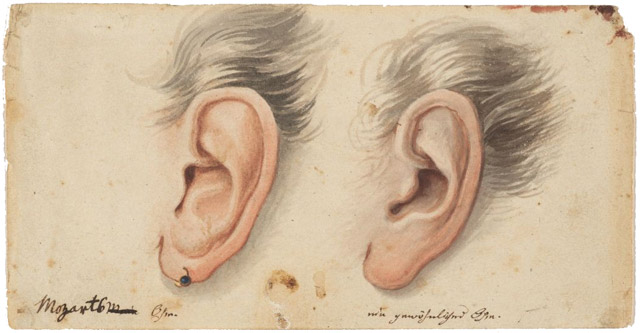
“Mozart Ear” has become a medical catch-all term for deformed ears (for instance). Deformed or not2, the ear clearly didn’t have any negative effect on his musical ear. (via @DavidGrann)
[1] The note accompanying the drawing at Harvard’s Houghton Library reads:
Mozart, Wolfgang Amadeus, 1756-1791. Mein Ohr [und] ein gewöhnliches Ohr [My ear and an ordinary ear] : drawing, [n.p., n.d.] Water-color drawing; [n.p, n.d] 1 drawing : watercolor on paper
The “mein” is crossed out and “Mozart” is written in its place in another hand. With this is Fr. Jelinck’s A.D.s., Salzburg, 1879 Sept. 19, certifying that this is by Mozart.
↩
[2] It’s stated elsewhere that the ear is actually that of Mozart’s son, which would be slightly more plausible than Mozart drawing his own ear. ↩
Yes, and there’s also $20 over-the-counter test for HIV that gives results in 20 minutes.
Two recent developments could make these conversations less awkward, or even render them moot. But they also raise troubling questions about promiscuity and responsibility that are reminiscent of debates from the 1980s.
The first development was the approval, last summer, by the Food and Drug Administration of an over-the-counter rapid-response at-home H.I.V. test kit. The test, called OraQuick and available nationwide since October, gives results 20 minutes after a cheek swab. The second is the increasing availability of PEP and of pre-exposure prophylaxis, or PrEP.
PEP - the medication I am taking - has been called the H.I.V. morning-after pill, and PrEP, to follow the analogy, is akin to birth control. A study in the British medical journal The Lancet this month found that drug-injecting addicts who took PrEP were half as likely to become infected with H.I.V. as those who did not; other studies have shown that the drug reduces transmission of the virus from mother to child, and transmission among both gay men and heterosexuals.
For his first piece written as a staff writer for GQ in 1995, the magazine’s editor urged Andrew Corsello to write about the time he almost died of a mysterious liver failure.
Wednesday, August 31, the next day. Sicker, bewildered. In my office chair quaking with exertion, like a car with its accelerator and brake simultaneously floored. My breathing’s all wrong-the sharp, uneven gasps of an overworked dog. When I lumber off to the can, the urine is purple and oily looking. At three minutes after one, Doc Mike calls with the blood results. “Stop whatever you’re doing,” he orders. “Get in here now.”
Corsello won the 2007 National Magazine Award for his story, The Other Side of Hate.
For The Verge, Russell Brandom writes about the increasing use of neural implants to control the symptoms of a variety of diseases, from depression to Parkinson’s to dystonia.
The results are as reliable as flipping a light switch, but even after decades of testing, no one knows exactly why it works. Dr. Kaplitt, the surgeon who installed Rebecca Serdans’ implant, explains it by likening the brain to a collection of electrical circuits. A disorder like dystonia is a failure of those circuits. When you install a brain stimulation device, “it’s presumably blocking abnormal information from getting from one part of the brain to another, or normalizing that information.” But Kaplitt is the first to acknowledge that this is just a theory. “The mechanism by which brain stimulation works is still somewhat unclear and controversial.”
But the lingering questions haven’t slowed down research. There are already patents that would use brain stimulation implants to enhance memory or prevent stuttering, to cure anorexia or bring a person to orgasm. Experimental studies use the device to treat Alzheimer’s disease and drug addiction. Those circuits aren’t as well understood as the circuits governing movement disorders, but the principle is no different. Once you’ve got a line into the circuitry of the brain, Parkinson’s is just the beginning.
Last week I featured a video of a man with Parkinson’s who has a brain pacemaker that allows him to function normally.
Newer posts
Older posts





Socials & More