kottke.org posts about medicine
Nicola Twilley reports on a relatively new technique being used in a Baltimore trauma center: freezing trauma victims to give the doctors working on them more time to save their lives.
When this patient loses his pulse, the attending surgeon will, as usual, crack his chest open and clamp the descending aorta. But then, instead of trying to coax the heart back into activity, the surgeon will start pumping the body full of ice-cold saline at a rate of at least a gallon a minute. Within twenty minutes (depending on the size of the patient, the number of wounds, and the amount of blood lost), the patient’s brain temperature, measured using a probe in the ear or nose, will sink to somewhere in the low fifties Fahrenheit.
At this point, the patient, his circulatory system filled with icy salt water, will have no blood, no pulse, and no brain activity. He will remain in this state of suspended animation for up to an hour, while surgeons locate the bullet holes or stab wounds and sew them up. Then, after as much as sixty minutes without a heartbeat or a breath, the patient will be resuscitated.
Brain damage is a risk — as is, you know, dying from hypothermia — but there are many instances of people surviving even after their hearts stop for an hour or two.
Some recent genetic testing of the blood of AIDS patients has determined that the strain of HIV responsible for the majority of the AIDS cases in the US spread from Zaire to Haiti around 1967, from Haiti to NYC around 1971, and from there to San Francisco around 1976 and that Gaétan Dugas (aka Patient Zero) was not responsible for setting the epidemic in motion.
The strain of H.I.V. responsible for almost all AIDS cases in the United States, which was carried from Zaire to Haiti around 1967, spread from there to New York City around 1971, researchers concluded in the journal Nature. From New York, it spread to San Francisco around 1976.
The new analysis shows that Mr. Dugas’s blood, sampled in 1983, contained a viral strain already infecting men in New York before he began visiting gay bars in the city after being hired by Air Canada in 1974.
The researchers also reported that originally, Mr. Dugas was not even called Patient Zero — in an early epidemiological study of cases, he was designated Patient O, for “outside Southern California,” where the study began. The ambiguous circular symbol on a chart was later read as a zero, stoking the notion that blame for the epidemic could be placed on one man.
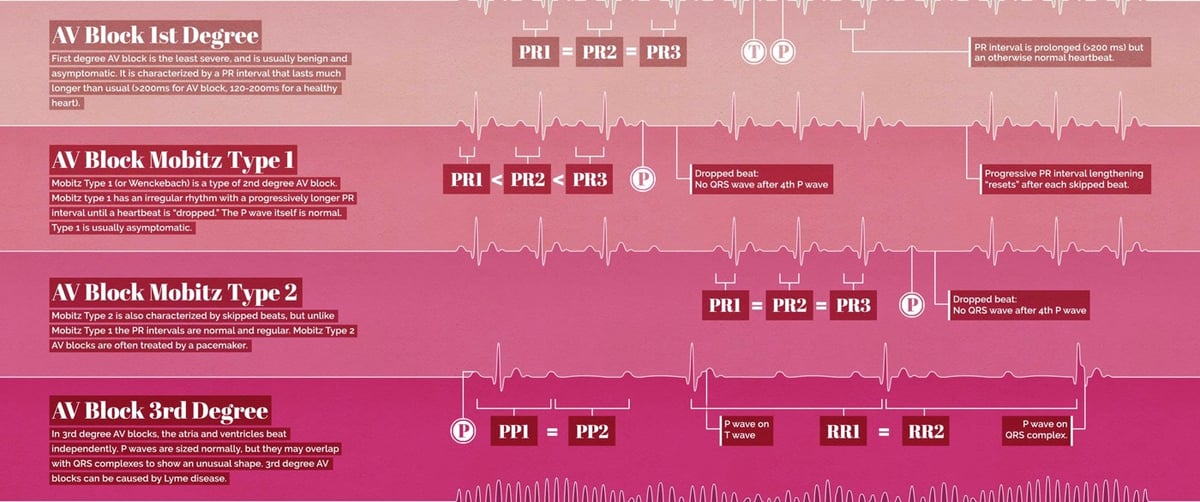
This is a lovely infographic from Eleanor Lutz of a bunch of different heartbeat EKG waves, from a normal heartbeat to a flatline to ventricular fibrillation (“must be treated immediately with CPR and defibrillation”.) Prints are available.
Thousands of people die every day from malaria, a disease that is transmitted to humans solely through mosquitoes. With CRISPR, scientists can easily genetically engineer mosquitoes incapable of transmitting malaria and using a technique called gene drive, they can force that genetic change into the native mosquito population. So, should we do it?
From the School of Public Health at Johns Hopkins comes this list of 100 things that have “made their mark on public health”, good and bad. Here’s a sampling of the objects:
Horseshoe crab. We all owe a debt of gratitude to the helmet-shaped horseshoe crab, whose ancestors date back 450 million years. From vaccines to needles to pacemakers, any IV drug or medical equipment that will come in contact with the human body must first be safety-checked using a test that comes from a clotting compound in the crab’s blood. This compound can detect even the smallest amount of deadly bacteria and is sensitive enough to isolate a threat equivalent to the size of a grain of sand in a swimming pool.
Vaccines. Immunization is one of the most important public health achievements in human history. Vaccines helped eradicate smallpox globally and eliminate polio in the United States. The introduction of effective vaccines has also drastically reduced deaths from measles, diphtheria, rubella, pertussis (“whooping cough”) and other diseases that sickened hundreds of thousands of Americans in the early 20th century.
American Cheese. Food processing was actually developed to make food safer. Milk is pasteurized to kill harmful organisms, and canning and freezing foods such as meats, fruits and vegetables helps them last longer. But the food industry has taken processing well beyond these early origins. Often, to extend a food’s shelf life, manufacturers increase fats, sugars, and salt and add in chemical flavorings, emulsifiers, and other additives — taking foods that could have been healthy and making them much less so.
Pap smear. Since its introduction in 1955, the Pap smear has reduced death from cervical cancer by more than 60 percent. Invented by Dr. Georgios Papanikolaou, the Pap smear is a diagnostic procedure in which a health-care professional swabs a cell sample from the cervix and sends it to a lab to see if any of the cells are malignant. Before the invention of the Pap smear, cervical cancer was one of the leading causes of death for women of childbearing age in the United States. Today, it comes in at number 14 on the list of cancers found in women.
Spittoons. Spittoons were developed centuries ago as receptacles for spitting — think ashtrays for saliva. These brass or even porcelain repositories were everywhere: In homes, train stations, saloons and even the U.S. Congress. They were meant for men to dispose their chewing tobacco and the abundant phlegm that accompanied the habit. Convenience turned to concern in the late 19th century when a global tuberculosis epidemic took hold and scientists realized that spittoons might actually spread diseases. Some argued that when people spat in the general direction of a spittoon and missed the target, they caused a greater health threat than if the spittoon hadn’t been there at all.
Vaccines. And now my kids don’t die.
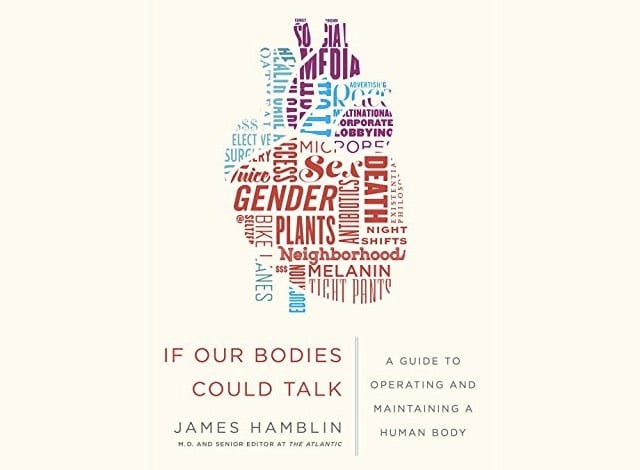
James Hamblin, the dishy brainiac doctor who does those entertaining and informative videos for The Atlantic, is coming out with a book in December called If Our Bodies Could Talk. He calls it “a FAQ about human bodies”.
Now, in this original and entertaining book, Hamblin explores the stories behind health questions that never seem to go away — and which tend to be mischaracterized and oversimplified by marketing and news media. He covers topics such as sleep, aging, diet, and much more:
Can I “boost” my immune system?
Does caffeine make me live longer?
Do we still not know if cell phones cause cancer?
How much sleep do I actually need?
Is there any harm in taking a multivitamin?
Is life long enough?
Perfect eyesight. Curing cancer. Designer babies. Super-soldiers. Because of CRISPR, genetic engineering might make tinkering with life as easy as playing with Lego.
Imagine you were alive back in the 1980’s, and were told that computers would soon take over everything — from shopping, to dating, and the stock market, that billions of people would be connected via a kind of web, that you would own a handheld device orders of magnitudes more powerful than supercomputers.
It would seem absurd, but then all of it happened. Science fiction became our reality and we don’t even think about it. We’re at a similar point today with genetic engineering. So let’s talk about it.
Relatedly, I’m finishing up Neal Stephenson’s Seveneves right now and while it starts out as space science fiction, much of the book is concerned with the sort of genetic engineering issues discussed in the video.
After The Man freaked out back in the 60s, LSD and other psychedelics were banned and criminalized. But slowly, scientists are experimenting with psychedelics to treat depression, anxiety, and other ailments.
In the 1960s, a psychologist and former Harvard teacher named Timothy Leary coined the phrase ‘Turn on. Tune in. Drop out.’ The slogan was inspired by advertising jingles, but Leary wasn’t pushing a product, he was promoting a drug: LSD.
But today, scientists are studying psychedelics once again, in the latest twist in the long, strange story of LSD.
Even outside of a therapeutic setting, many people extolled the beneficial effects of psychedelics. Former Apple CEO Steve Jobs recalled in his biography by Walter Isaacson:
Taking LSD was a profound experience, one of the most important things in my life. LSD shows you that there’s another side to the coin, and you can’t remember it when it wears off, but you know it. It reinforced my sense of what was important — creating great things instead of making money, putting things back into the stream of history and of human consciousness as much as I could.
Check out the NY Times companion piece and the archival footage of LSD experiments on cats, spiders, and goats.
Errol Morris has made a short film about the world’s remaining stocks of smallpox virus and the debate between those who want to eliminate the virus forever and those who want to keep it around.
In the story from classical Greece, Pandora was warned: Don’t open the box. She opens it anyway. The various pestilences are unleashed on the world but Hope remains at the very bottom of the box. Today there are microbiologists who want to continue to research smallpox. If they are given a free hand, what might they unleash?
There are those who insist that these residual stocks of smallpox should not be destroyed because some ruthless super-criminal or rogue government might be working on a new smallpox, even more virulent than existing strains of the virus. We may need existing stocks to produce new vaccines to counteract the new viruses. New viruses, new vaccines. New vaccines, new viruses. An escalating arms race with germs.
Keep this video in mind when you read about the latest advances with CRISPR.
The latest video from Kurzgesagt is an explainer on antibiotics and superbugs (drug resistant bacteria).
What would you say if we told you that humanity is currently making a collaborative effort to engineer the perfect superbug, a bug that could kill hundreds of millions of people?

Amos Dudley wanted to improve his smile but didn’t want to pay thousands of dollars for Invisalign, so he 3D printed his own orthodontic aligners.
I took a mold of my teeth with some cheap alginate powder, Permastone, and a 3d printed impression tray, to get a better picture of what was really going on. Notice LI-r (right lateral incisor) projected outward, and CI-r (right central incisor) depressed inward and overlapping.
At the time of writing this, I’m an undergrad, which means that a) I’m broke, and b) I have access to expensive digital fabrication tools - definitely an unusual dichotomy. I was researching [name brand clear-aligner treatment], and I ran across a photo that caught my eye.
Those look like the layer striations from a 3D print!
What is to stop someone, who has access to a 3D printer, from making their own orthodontic aligners?
Update: Unsurprisingly, orthodontists feel that DIY dentistry is not such a great idea.
Belli notes, “He moved these teeth in only 16 weeks. You can cause a lot of problems with that. If you move a tooth too fast, you can actually cause damage to the bone and gums. And if you don’t put the tooth in the right position, you could throw off your bite,” leading to additional damage and wear on the teeth.
John Hofsess helped eight people die and just before he died late last month at an assisted death facility in Switzerland, he wrote this piece.
I was horrified anew in 1999 when the gifted conductor Georg Tintner, who was dying from a rare form of melanoma, jumped from the balcony of his 11th-floor apartment in Halifax to end his agony. Many Canadians would hear such news, shake their heads, utter a few sympathetic platitudes and move on. But I couldn’t just sit back and wring my hands. That year, I went from advocating for assisted suicides to facilitating them. Let’s not mince words: I killed people who wanted to die.
(via nextdraft)
On the most recent episode of Last Week Tonight, John Oliver argues against many US states’ anti-abortion laws. This was super funny and also made me really angry.
In an all-white room, mosquitoes are mated and the resulting larvae divided by sex. Workers whisk at stray mosquitoes with electrified tennis rackets — the kind you see in novelty stores, but which have sold out in mosquito-obsessed Brazil.
MIT Tech Review takes you inside the mosquito factory that could stop Zika and other diseases. (Add “working in a mosquito factory” to the list of jobs I’m glad I don’t have…)
For an episode called The Fix, Radiolab explores what anti-addiction drugs are available and why they aren’t more widely known and used to treat alcoholism and drug addiction.
Reporter Amy O’Leary was fed up with her ex-boyfriend’s hard-drinking, when she discovered a French doctor’s memoir titled The End of My Addiction. The fix that he proposed seemed too good to be true. But her phone call with the doctor left her, and us, even more intrigued. Could this malady — so often seen as moral and spiritual — really be beaten back with a pill?
We talk to addiction researcher Dr. Anna Rose Childress, addiction psychologist Dr. Mark Willenbring, journalist Gabrielle Glaser, The National Institute of Health’s Dr. Nora Volkow, and scores of people dealing with substance abuse as we try to figure out whether we’re in the midst of a sea change in how we think about addiction.
Newer posts
Older posts





Socials & More