kottke.org posts about crime
Fascinating article about what it’s like to buy heroin on the west side of Chicago. The ritual of buying is just as exciting as the shooting up.
The fact is, and I don’t care who tries to dispute this, that a majority of the people who make the daily migration to the West Side to cop blows are as addicted to the ritual of copping dope as they are to the dope itself. It is an adrenaline rush no different than those achieved by people who jump out of airplanes. And dope fiends get to experience it every day.
(via @torrez)
In New York Magazine this week, Mike Tyson writes about growing up in Brooklyn and his discovery of boxing as a way out and up.
Having to wear glasses in the first grade was a real turning point in my life. My mother had me tested, and it turned out I was nearsighted, so she made me get glasses. They were so bad. One day I was leaving school at lunchtime to go home and I had some meatballs from the cafeteria wrapped up in aluminum to keep them hot. This guy came up to me and said, “Hey, you got any money?” I said, “No.” He started picking my pockets and searching me, and he tried to take my fucking meatballs. I was resisting, going, “No, no, no!” I would let the bullies take my money, but I never let them take my food. I was hunched over like a human shield, protecting my meatballs. So he started hitting me in the head and then took my glasses and put them down the gas tank of a truck. I ran home, but he didn’t get my meatballs. I still feel like a coward to this day because of that bullying. That’s a wild feeling, being that helpless. You never ever forget that feeling. That was the last day I went to school. I was 7 years old, and I just never went back to class.
The piece is adapted from Tyson’s upcoming memoir, Undisputed Truth. Tyson wrote the book with Larry Sloman, author of Reefer Madness who has also ghostwritten for Howard Stern, Anthony Kiedis, and KISS’s Peter Criss.
Update: Spike Lee directed a documentary version of Undisputed Truth; it’ll air on HBO on November 16. Here’s the trailer:
With Silk Road kingpin Ross Ulbricht in custody, one imagines that a whole lot of his former customers are feeling a bit nervous right about now. And they should be. Buyers and sellers are starting to get arrested.
Charles Thompson might be a little nervous as well. As he explains:
In February of 2013, I decided to order one gram of MDMA from Silk Road because I wanted to write an essay on whether it really was that easy to click a few buttons and have a package of Schedule I substances arrive at your door a week later.
It was that easy. And that’s the bad news. From The Morning News: My Brief, Binding Road.
For the past few years, UK police have used a secret network of fully furnished fake houses to snare burglars. They’re called capture houses.
Based in the city of Rotherham, Stopford explained to me the hit-and-miss nature of a capture house. Some of the fake apartments have been open for as little for one day before being hit by burglars, and as long as nearly a year without being broken into even once. As Stopford went on to describe, these otherwise uninhabited residences are fully stocked, complete with electronic equipment, lights on timers, and bare but functional furniture, and they tend to be small apartments located in multi-unit housing blocks.
That apartment you pass everyday on the fourth floor, in other words, might not be an apartment at all, really, but an elaborate trap run by the police, bristling inside with tiny surveillance cameras and ready to spray invisible chemical markings onto anyone who steps inside-or slips in through the window, as the case may be.
See also bait cars and honeypots.
This is powerful and amazing (and upsetting): Project Unbreakable is a photography project that features images of sexual assault survivors holding signs showing what others (attackers, family members, cops, etc.) said to them about the assaults.
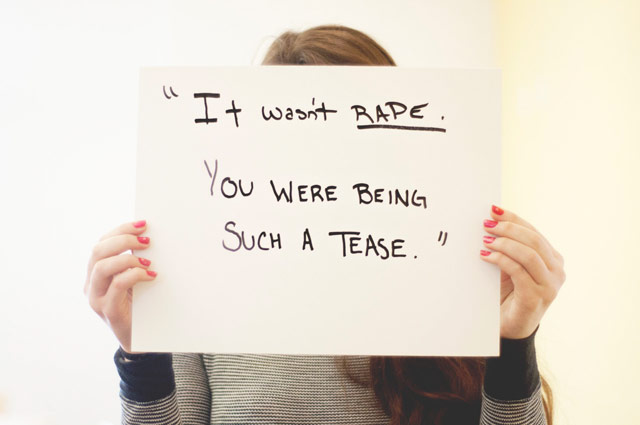
It’s difficult to pick the yuckiest bottom-of-the-barrel sludge here, but the comments from the police officers really get my dander up.
“If you were my daughter I would have killed you.” - Lady police officer while being interrogated
“If you don’t tell us how many people you’ve slept with, the ADA won’t even consider your case.” - Interviewing Dectective
“This is why we have underage drinking laws! THIS IS YOUR FAULT! If you hadn’t been drinking this wouldn’t have happened to you!” - St. Petersburg police when I tried to press charges
Sickening, sickening. The police are supposed to protect the vulnerable, not persecute them. (via @rebeccablood)
Hanna Rosin writes about Murder by Craigslist, the story of a killer who advertised for victims on Craigslist in order to steal their possessions.
Davis wasn’t the only person to answer the Craigslist ad. More than 100 people applied for the caretaker job — a fact that Jack was careful to cite in his e-mails back to the applicants. He wanted to make sure that they knew the position was highly sought-after. Jack had a specific type of candidate in mind: a middle-aged man who had never been married or was recently divorced, and who had no strong family connections. Someone who had a life he could easily walk away from. “If picked I will need you to start quickly,” he would write in his e-mails.
Jack painstakingly designed the ad to conjure a very particular male fantasy: the cowboy or rancher, out in the open country, herding cattle, mending fences, hunting game — living a dream that could transform a post-recession drifter into a timeless American icon. From the many discarded drafts of the ad that investigators later found, it was clear that Jack was searching for just the right pitch to catch a certain kind of man’s eye. He tinkered with details-the number of acres on the property, the idea of a yearly bonus and paid utilities-before settling on his final language: “hilly,” “secluded,” “job of a lifetime.” If a woman applied for the job, Jack wouldn’t bother responding. If a man applied, he would ask for the critical information right off the bat: How old are you? Do you have a criminal record? Are you married?
Jack seemed drawn to applicants who were less formal in their e-mail replies, those who betrayed excitement, and with it, vulnerability. “I was raised on a farm as a boy and have raised some of my own cattle and horses as well,” wrote one. “I’m still in good shape and not afraid of hard work! I really hope you can give me a chance. If for some reason I wouldn’t work out for you no hard feelings at all. I would stick with you until you found help. Thank you very much, George.”
This was your standard well-written crime story until about 2/3rds of the way through when Rosin highlights a societal trend that more deeply connects the victims with their killer.
I was initially drawn to the story of the Beasley murders because I thought it would illuminate the isolation and vulnerability of so many working-class men, who have been pushed by the faltering economy from one way of life — a nine-to-five job, a wife, children — into another, far more precarious one: unemployed or underemployed, single or divorced, crashing on relatives’ spare beds or in the backseats of cars. At what other moment in history would it have been plausible for a serial killer to identify middle-aged white men as his most vulnerable targets?
But what I discovered in the course of my reporting was something quite different. As traditional family structures are falling apart for working-class men, many of them are forging new kinds of relationships: two old high-school friends who chat so many times a day that they need to buy themselves walkie-talkies; a father who texts his almost-grown sons as he goes to bed at night and as he wakes up in the morning.
There’s a bit more to it than but I don’t want to spoil it for you…the entire piece is worth a read.
Sabine Heinlein follows several people through a post-prison jobs program to see how ex-convicts prepare for re-entry into the workforce.
In prison Angel thought that it wouldn’t be too hard to find a job once he got out. He believed he had come a long way. At eighteen he hadn’t been able to read or write. He wet his bed and suffered from uncontrollable outbursts of anger. At forty-seven he had studied at the college level. He told me he had read several thousand books. He earned numerous certificates while incarcerated — a Vocational Appliance Repair Certificate, a Certificate of Proficiency of Computer Operator, a Certificate in Library Training, an IPA (Inmate Program Assistant) II Training Certificate, and several welding certifications — but in the outside world these credentials counted for little.
“Irrelevant,” Angel said. “They might as well be toilet paper.”
This piece is the seventh chapter from Heinlein’s book, Among Murderers: Life After Prison.
In 2009, Dave Eggers published a book called Zeitoun, the story of a man and his family experiencing Hurricane Katrina and its aftermath.
Through the story of one man’s experience after Hurricane Katrina, Eggers draws an indelible picture of Bush-era crisis management. Abdulrahman Zeitoun, a successful Syrian-born painting contractor, decides to stay in New Orleans and protect his property while his family flees. After the levees break, he uses a small canoe to rescue people, before being arrested by an armed squad and swept powerlessly into a vortex of bureaucratic brutality. When a guard accuses him of being a member of Al Qaeda, he sees that race and culture may explain his predicament.
The story has taken an unexpected turn since its publication. The protagonist of the story, Abdulrahman Zeitoun, is currently on trial for the attempted first-degree murder of his wife.
Zeitoun made an offer: $20,000 to kill his ex-wife, Kathy, according to Pugh’s testimony. Zeitoun instructed Pugh, who was to be released soon from jail, to call Kathy Zeitoun — Zeitoun allegedly wrote her phone number on an envelope, which was introduced as evidence — and ask to see one of the family’s rental properties. When she took him to a certain property in Algiers, he could kill her there, he allegedly said. Zeitoun also allegedly told Pugh to buy a “throwaway phone” and take pictures to confirm she was dead.
(via digg)
Update: Zeitoun was found not guilty.
Abdulrahman Zeitoun was found not guilty Tuesday of trying to hire a hitman to kill his wife.
The verdict came from Orleans Parish Criminal District Court Judge Frank Marullo. Zeitoun, 55, had waived his right to a jury trial. He had been charged with solicitation of first-degree murder and attempted first-degree murder of his ex-wife. He was acquitted on both counts.
(thx, mike)
Denise Noe wrote an article in 2004 about how Charles Manson was more pathetic than mesmerizing or messianic. She sent the article to Manson and the two became pen/phone pals.
Over the past two years, we have spoken many times. Talking with him was spooky at first but soon lost that eerie sense. Describing our conversations can be difficult as his diction consists of a motley mix of allegory, parable, hyperbole, fantasy, and metaphor. He habitually jumps from subject to subject and from one mode to another. Many listeners would call his conversations “crazy.” My take is that he is not psychotic but deliberately refuses to humor his listeners by settling down to a subject or mode when he talks. He enjoys free-associating.
His often muses about George Washington and Abraham Lincoln. They are probably the two most famous American presidents with one tied to the country’s founding and the other to its continued unity despite its Civil War. For reasons I don’t quite understand, Manson tends to be positive on Washington and negative on Lincoln.
Part of the reason he tends to talk in a kind of free floating manner may be the particular effect on him of so much time behind bars. It has necessitated a lot of time spent simply in his own head. He is locked down rather tightly, primarily for his own protection. He told me that he is allowed to play his guitar in his cell. He has always enjoyed music although the Beatles obsession is probably just myth. The music he makes tends to be country and folk with some rock flavor and shows little Beatles influence.
He also spends quite a bit of time watching television.
Back in November, I posted about the effort of the filmmakers of Capturing the Friedmans to prove the innocence of one of the film’s subjects, Jesse Friedman. On Monday, a 168-page report released by the Nassau County District Attorney’s office found that there was enough evidence to charge and convict Friedman of sexual molestation of minors.
Friedman, his supporters and the makers of the Academy Award-nominated documentary have long maintained he was railroaded into pleading guilty to charges he molested 13 kids in the late 1980s, and were expecting the report to exonerate him.
It did the opposite.
Friedman, they found, was labeled a “psychopathic deviant” by his own shrink, and had actually sexually abused a total of 17 children.
“The District Attorney concludes that Jesse Friedman was not wrongfully convicted,” the blistering 172-page report says.
“In fact, by any impartial analysis, the investigation process prompted by Jesse Friedman … has only increased confidence in the integrity of Jesse Friedman’s guilty plea adjudication as a sex offender.”
The panel said it interviewed three of Friedman’s now-adult victims. “Each confirmed that he was sexually abused by Jesse Friedman. Each told their separate story, marked by pain and recovery,” and “recounted years of shame and humiliation,” the report said.
The Washington Post has more. (via @DavidGrann)
Executive produced by Errol Morris and Werner Herzog, The Act of Killing is a documentary directed by Joshua Oppenheimer about a group of Indonesian mass murderers.
In The Act of Killing, Anwar and his friends agree to tell us the story of the killings. But their idea of being in a movie is not to provide testimony for a documentary: they want to star in the kind of films they most love from their days scalping tickets at the cinemas. We seize this opportunity to expose how a regime that was founded on crimes against humanity, yet has never been held accountable, would project itself into history.
And so we challenge Anwar and his friends to develop fiction scenes about their experience of the killings, adapted to their favorite film genres — gangster, western, musical. They write the scripts. They play themselves. And they play their victims.
Wow. (via @aaroncoleman0)
Update: It expires today, but The Act of Killing is available to watch for free on PBS. After today, try Amazon.
The national rates of gun violence and homicide in the US have fallen significantly in past 20 years, but most people are unaware. From a recently released Pew Research report:
Nearly all the decline in the firearm homicide rate took place in the 1990s; the downward trend stopped in 2001 and resumed slowly in 2007. The victimization rate for other gun crimes plunged in the 1990s, then declined more slowly from 2000 to 2008. The rate appears to be higher in 2011 compared with 2008, but the increase is not statistically significant. Violent non-fatal crime victimization overall also dropped in the 1990s before declining more slowly from 2000 to 2010, then ticked up in 2011.
Despite national attention to the issue of firearm violence, most Americans are unaware that gun crime is lower today than it was two decades ago. According to a new Pew Research Center survey, today 56% of Americans believe gun crime is higher than 20 years ago and only 12% think it is lower.
The whys behind the drop in gun violence (and in crime in general) are more difficult to come by:
There is consensus that demographics played some role: The outsized post-World War II baby boom, which produced a large number of people in the high-crime ages of 15 to 20 in the 1960s and 1970s, helped drive crime up in those years.
A review by the National Academy of Sciences of factors driving recent crime trends (Blumstein and Rosenfeld, 2008) cited a decline in rates in the early 1980s as the young boomers got older, then a flare-up by mid-decade in conjunction with a rising street market for crack cocaine, especially in big cities. It noted recruitment of a younger cohort of drug seller with greater willingness to use guns. By the early 1990s, crack markets withered in part because of lessened demand, and the vibrant national economy made it easier for even low-skilled young people to find jobs rather than get involved in crime.
At the same time, a rising number of people ages 30 and older were incarcerated, due in part to stricter laws, which helped restrain violence among this age group. It is less clear, researchers say, that innovative policing strategies and police crackdowns on use of guns by younger adults played a significant role in reducing crime.
(via hacker news)
In a piece published by the Southern Poverty Law Center, David Arenberg describes his experience as one of the very few Jews in the state prison in which he’s currently incarcerated.
I am always the last person to eat. It’s part of a compromise I worked out with the skinheads who run the western state prison complex where I am incarcerated. Under this compromise, I’m allowed to sit at the whites’ tables, but only after the “heads,” and then the “woods,” and then the “lames” have eaten. I am lower on the totem pole than all of them, the untouchable. I should feel lucky I’m allowed to eat at the whites’ tables at all.
Not that there’s anywhere else I could eat. The prison yard is broken down into five distinct racial categories and segregation is strictly enforced. There are the “woods” (short for peckerwoods) that encompass the whites, the “kinfolk” (blacks), the “Raza” (American-born people of Mexican descent), the “paisas” (Mexico-born Mexicans), and the “chiefs” (American Indians). Under the strict rules that govern interracial relations, different races are allowed to play on the same sports teams but not play individual games (e.g., chess) together; they may be in each others’ cubicles together if the situation warrants but not sit on each others’ beds or watch each others’ televisions. They may go to the same church services but not pray together. But if you accidentally break one of these rules, the consequences are usually pretty mild: you might get a talking to by one of the heads (who, of course, claims exemption from this rule himself), or at worst, a “chin check.”
Eating with another race, however, is a different story. It is an inviolate rule that different races may not break bread together under any circumstances. Violating this rule leads to harsh consequences. If you eat at the same table as another race, you’ll get beaten down. If you eat from the same tray as another race, you’ll be put in the hospital. And if you eat from the same food item as another race, that is, after another race has already taken a bite of it, you can get killed. This is one area where even the heads don’t have any play.
James Surowiecki, the author of The Wisdom of Crowds, wrote about what was right and wrong about Reddit’s crowdsourced hunt for the Boston bombing suspects.
The truth is that if Reddit is actually interested in using the power of its crowd to help the authorities, it needs to dramatically rethink its approach, because the process it used to try to find the bombers wasn’t actually tapping the wisdom of crowds at all — at least not as I would define that wisdom. For a crowd to be smart, the people in it need to be not only diverse in their perspectives but also, relatively speaking, independent of each other. In other words, you need people to be thinking for themselves, rather than following the lead of those around them.
When the book came out in 2004, I wrote a short post that summarizes the four main conditions you need for a wise crowd. What’s striking about most social media and software, as Surowiecki notes in the case of Reddit, is how most of these conditions are not satisfied. There’s little diversity and independence: Twitter and Facebook mostly show you people who are like you and things your social group is into. And social media is becoming ever more centralized: Facebook, Twitter, Tumblr, Medium, Pinterest, etc. instead of a decentralized network of independent blogs. In fact, the nature of social media is to be centralized, peer-dependent, and homogeneous because that’s how people naturally group themselves together. It’s a wonder the social media crowd ever gets anything right.
UMass Dartmouth is reporting that “a person being sought in connection with the Boston Marathon bombing has been identified as a student registered at UMass Dartmouth”:

I don’t know that there’s any verified report that registered student is bombing suspect Dzhokhar Tsarnaev, but I found a blog post from August 2011 that suggests that Tsarnaev was participating in the school’s summer reading program for incoming first-year students. The students were participating in a group discussion blog while reading Malcolm Gladwell’s Blink: The Power of Thinking Without Thinking. The post in question was written by UMass Dartmouth English teacher Shelagh Smith on the concept of thin-slicing as it pertained to the case of the West Memphis Three. The post reads, in part:
I believe that thin slicing put them in jail. It helped an entire community make a rash decision and justify their actions in convicting three teens of murder. Once the town was able to identify the bogeyman, they could rest easy again.
But it all went horribly wrong. The real murderers were never found. These young men went into prison at 18 years old. Today, they walked out at 36 years old.
Being different - being unique - is a right we’re supposed to enjoy in this country. But what we can’t control is how people view us.
So what do we do about that? Is there anything we can do about it?
In response, a commenter listing his name as “Dzhokhar Tsarnaev” posted the following about a week and a half after the original posting:
In this case it would have been hard to protect or defend these young boys if the whole town exclaimed in happiness at the arrest. Also, to go against the authorities isn’t the easiest thing to do. Don’t get me wrong though, I am appalled at the situation but I think that the town was scared and desperate to blame someone. It’s because of stories like this and such occurrences that make a positive change in this world. I’m pretty sure there won’t be anymore similar tales like this. In any case, if they do, people won’t stand quiet, i hope.
Tsarnaev also made another comment in another thread on the blog a few minutes earlier in which he offered a critique of Gladwell’s book:
While I understand and agree with most of the concepts that Gladwell explained in his book, there are several ideas of his that I cannot fathom or just choose not to believe. Yes, this book was very interesting but the idea that a person can predict whether you and your partner are going to be together in the future is honestly a little hard to believe. Sure, if you put two obvious celebrities in a room talking about how they’re going to adopt six children, that’s just not going to work out. And the idea that a more experienced doctor is more likely to be sued is likely to happen because they would have way more patients and more time in the work force. “Thin-slicing” and other concepts made me want to keep reading.
Newer posts
Older posts





Socials & More