




Advertise here with Carbon Ads

This site is made possible by member support. 💞

Big thanks to Arcustech for hosting the site and offering amazing tech support.

When you buy through links on kottke.org, I may earn an affiliate commission. Thanks for supporting the site!

kottke.org. home of fine hypertext products since 1998.

Beloved by 86.47% of the web.

🍔  💀  📸  😭  🕳️  🤠  🎬  🥔

kottke.org posts about cars

Why GM failed

GM declared bankruptcy yesterday and the rush is on to explain what went wrong. Here are a few explanations I found, along with some possible solutions.

After 101 years, why GM failed, Peter Cohan, DailyFinance:

4. Failure to innovate. Since GM was focused on profiting from finance, it did not really care that much about building better vehicles. GM’s management failed to adapt GM to changes in customer needs, upstart competitors, and new technologies.

Seven reasons GM is headed to bankruptcy, Sharon Silke Carty, USA Today:

When GM realized how fast 1990s buyers were switching to trucks as personal transportation, it overreacted, pouring time and money into SUVs and pickups at the expense of car development. The result: As long ago as 2000, Wall Street was warning that GM could be overcommitted to trucks and wind up out of phase if the pendulum of buyer preference swung back to cars. Once consumer tastes began changing, the market was awash in new truck models, and profits were sapped by discounts needed to keep sales boiling.

Goodbye, GM, Michael Moore:

The products built in the factories of GM, Ford and Chrysler are some of the greatest weapons of mass destruction responsible for global warming and the melting of our polar icecaps. The things we call “cars” may have been fun to drive, but they are like a million daggers into the heart of Mother Nature. To continue to build them would only lead to the ruin of our species and much of the planet.

G.M.’s Road From Prosperity to Crisis, NY Times:

The company reached a deal with Saab to expand its European presence. Having an extensive brand lineup had been a primary strategy at G.M. since its creation in 1908. But this tactic eventually became costly, as brands overlapped and competed for business and money.

GM Reinvention, GM. Twitter, Flickr, Facebook, it’s all there. Oy.

Ten Vehicles That Bankrupted GM, Matt Hardigree, Jalopnik:

The Pontiac Aztec was one of the first major crossover vehicles brought to market in the U.S. [It was] combination of car-like handling and fuel economy with SUV-like space and aggressive appearance. The concept was a hit and now most automakers are shifting towards crossover. The Aztec was a massive failure. It was an attractive idea in an amazingly unattractive shell. It failed almost entirely based upon its appearance.

Who’s to Blame for GM’s Bankruptcy?, William J. Holstein, BusinessWeek:

GM simply was not ready to respond to Toyota Motor and other Japanese manufacturers when they began to gain serious ground in the early 1980s. Toyota, in particular, had developed a lean manufacturing system that was completely different from the mass-assembly-line techniques GM was still using, many decades after Henry Ford perfected them. GM’s fractured structure meant that each division had its own manufacturing processes, its own parts, its own engineering, and its own stamping plants.

How GM Lost Its Way, Paul Ingrassia, WSJ:

The picture of a heedless union and a feckless management says a lot about what went wrong at GM. There were many more mistakes, of course — look-alike cars, lapses in quality, misguided acquisitions, and betting on big SUVs just before gas prices soared. They were all born of a uniquely insular corporate culture.

The Quagmire Ahead, David Brooks, NY Times:

Over the last five decades, this company has progressively lost touch with car buyers, especially the educated car buyers who flock to European and Japanese brands. Over five decades, this company has tolerated labor practices that seem insane to outsiders. Over these decades, it has tolerated bureaucratic structures that repel top talent. It has evaded the relentless quality focus that has helped companies like Toyota prosper.

The End of the Affair, P.J. O’Rourke, WSJ:

We became sick and tired of our cars and even angry at them. Pointy-headed busybodies of the environmentalist, new urbanist, utopian communitarian ilk blamed the victim. They claimed the car had forced us to live in widely scattered settlements in the great wasteland of big-box stores and the Olive Garden. If we would all just get on our Schwinns or hop a trolley, they said, America could become an archipelago of cozy gulags on the Portland, Ore., model with everyone nestled together in the most sustainably carbon-neutral, diverse and ecologically unimpactful way.

Why GM failed, Jack Lessenberry, Detroit Metro Times:

What’s wrong, in a nutshell, is that it is a narrow, insular culture. Those who make it to the top of the heap, like Rick Wagoner, tend to be white Anglo-Saxon Protestant males who have worked at the same company their entire career, and have come up with the same set of buddies. Sort of like the Delta Tau Delta fraternity Wagoner joined when he was in business school.

Update: The WSJ’s Photo Journal blog has photos and brief stories of a number of people affected by GM’s bankruptcy. Gary Thomas, a mechanic from Kingston, TN, put about $800,000 in GM bonds.

“I thought I was doing the right thing. I wasn’t investing in stocks. GM was a solid company. … The bonds were my entire nest egg. I’m not a whiner and I don’t want special treatment. What really ticks me off is that it seems like we are getting less than everyone else and we deserve to be treated equally. I’m just trying to figure out a way to make it to 65 so I can start drawing my social security.”

Update: After Many Stumbles, the Fall of a Giant, Micheline Maynard, NY Times:

The company did have vast numbers of loyal buyers, but G.M. lost them through a series of strategic and cultural missteps starting in the 1960s. It bungled efforts in the 1980s to cut costs by sharing the underpinnings of its cars across different brands, blurring their distinctiveness. G.M. gave in to union demands in 1990 and created a program that paid workers even when plants were not running, forcing it to build cars and trucks it could not sell without big incentives.

Update: Salutary lessons from the downfall of a carmaker, John Kay, Financial Times:

The factors that had once been the company’s strengths were now weaknesses. Mass production and piece-rate incentives created a workforce with little pride in the quality of the product. The cadre of professional managers became a complacent, inward-looking bureaucracy. The diversified corporation became a collection of competing baronies.

From a couple of years ago, The Risk Pool, Malcolm Gladwell, The New Yorker:

Surely, if you are losing money on every car you sell, as G.M. is, cutting car prices still further in order to boost sales doesn’t make any sense. It’s like the old Borsht-belt joke about the haberdasher who lost money on every hat he made but figured he’d make up the difference on volume. The economically rational thing for G.M. to do would be to restructure, and sell fewer cars at a higher profit margin — and that’s what G.M. tried to do this summer, announcing plans to shutter plants and buy out the contracts of thirty-five thousand workers. But buyouts, which turn active workers into pensioners, only worsen the company’s dependency ratio. Last year, G.M. covered the costs of its four hundred and fifty-three thousand retirees and their dependents with the revenue from 4.5 million cars and trucks. How is G.M. better off covering the costs of four hundred and eighty-eighty thousand dependents with the revenue from, say, 4.2 million cars and trucks?

NASCAR helped GM down its path of self-destruction, Viv Bernstein, True/Slant:

How ironic, given NASCAR’s role in helping the auto industry race down its path of self-destruction. Major auto companies used NASCAR for years to push cars and trucks with poor fuel economy numbers. The sport, in some ways, came to symbolize America’s embrace of consumption. Consider that NASCAR didn’t even switch to unleaded gasoline until 2007. And even today, the racecars and trucks that auto companies are marketing through NASCAR are among the least fuel efficient, from the Dodge Charger to the Chevrolet Silverado.

(thx, fargo & coates)
Fave · 0

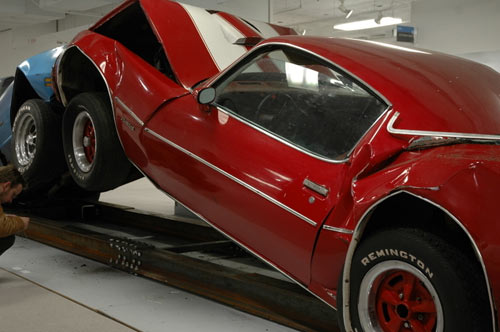
The Slow Inevitable Death of American Muscle

A metaphor for the current state of the American auto industry: two cars in an art gallery crashing into each other over a period of six days.

Slow Car Crash

(via today and tomorrow)

Update: This exhibit is currently on display at The Boiler in Brooklyn. (thx, jeff)

Update: See also Chris Burden’s Samson.

A museum installation consisting of a 100-ton jack connected to a gear box and a turnstile. The 100-ton jack pushes two large timbers against the bearing walls of the museum. Each visitor to the museum must pass through the turnstile in order to see the exhibition. Each input on the turnstile ever so slightly expands the jack, and ultimately if enough people visit the exhibition, Samson could theoretically destroy the building.

Here’s a video. (via things)

Fave · 0

Go fast

Some people are working on cars that will go 800 or even 1000 miles per hour on the flat desert of Nevada.

The rules are simple. Clock the racer through a measured mile, turn around and do it again, then average the two speeds. Mr. Shadle said Eagle would need 11 miles for each run: a mile to warm up to 250 miles per hour; four miles to light off the afterburner and get up to record speed; a mile in the speed trap; and five miles to stop. The vehicle must have at least four wheels - two of them steerable — and be back at the original start line within 60 minutes. And that’s it.

Fave · 0

The $2000 car

The Nano, the new $2000 car from India’s Tata Motors, goes from 0 to ~60 mph in 23 seconds (and even slower with the A/C on) and has the simplest dashboard I’ve seen on a car. For reference, the Honda Accord goes 0-60 in 6-9 seconds, depending on the model. (via snarkmarket)

Fave · 0

What the crash computer saw

In a car crash involving a modern vehicle, everything happens before the occupant is even aware of the collision.

1 ms - The car’s door pressure sensor detects a pressure wave.

5 ms - Car’s crash computer checks for insignificant crash events, such as a shopping trolley impact or incidental contact. It is still working out the severity of the crash. Door intrusion structure begins to absorb energy.

20 ms - Door and B-pillar begin to push on front seat. Airbag begins to push occupant’s chest away from the impact.

70 ms - Airbag continues to deflate. Occupant moves back towards middle of car.

Engineers classify crash as “complete”.

150-300 ms - Occupant becomes aware of collision.

(via gulfstream)

Fave · 0

The Hofmeister Kink

Have you ever noticed that the rear side window on a BMW has a small design element that hooks back toward the front of the car?

Rather than having the rear side window extend all the way down as might be expected, it angles back toward the front of the car.

Yeah, me either, but apparently all BMWs have it. It’s called the Hofmeister Kink, so named for the Director of Design at BMW who oversaw the style tweak, Wilhelm Hofmeister. Other carmakers have copied the Kink to make certain models appear luxury. (via spronblog)

Fave · 0

The Last Traffic Jam

From The Last Traffic Jam in The Atlantic.

Unless we exercise foresight and devise growth-limits policies for the auto industry, events will thrust us into a crisis that will lead to a substantial erosion of our domestic oil supply as well as the independence it provides us with, and a level of petroleum imports that could cost as much as $20 to $30 billion per year. (This in turn would produce a staggering balance-of-payments problem for the United States, and give the Middle Eastern suppliers a dangerous leverage over our transportation system as well.) Moreover, we would still be depleting our remaining oil reserves at an unacceptable rate, and scrambling for petroleum substitutes, with enormous potential damage to the environment.

And:

In short, common sense dictates that we begin a transition to policies designed to avoid an energy impasse that could cripple out transportation system and imperil our economy. We must set growth limits that will allow the automobile and oil industries to maintain economic stability while conserving our resources and preserving our environment. Of course, such a reorientation will require statesmanship as well as public pressure. It will not happen unless corporate self-interest yields to a responsible outlook that serves the broader interests of the nation as a whole. Above all, this shift requires a thorough redirection of the aims of these two industries.

Believe it or not, those words appeared in the magazine in 1972. These views would have seemed out-of-date and old fashioned just a year or two ago but now all those chickens are coming home to roost.

Fave · 0

Ebert’s 1957 Studebaker Golden Hawk

Roger Ebert reminisces about the car of his boyhood dreams, the 1957 Studebaker Golden Hawk.

“When these cars were new,” I said. “They weremuch faster than ‘57 Corvettes or T-Birds. The salesmen would put a client on the back seat, put a $100 bill on the front seat, and tell the client he could keep the money if he could overcome the force of the acceleration, and lean forward and pick it up while the Hawk was doing zero-to-60.”

Ebert owned a Golden Hawk for several years before he had to sell it because he couldn’t maintain it properly.

Fave · 0

Farewell, Yugo

Until last week, Yugos were still in production in Serbia. The factory will be retooled to produce Fiats for its new owner.

How do you make a Yugo go fast? Push it off a cliff.

What do you call the passengers in a Yugo? Shock absorbers.

Why do Yugos have heated rear windows? To keep your hands warm while you push it.

Ha ha. Yugo jokes were popular in my family during one particular Christmas…the year before it was dead baby jokes.

Fave · 0

Model T hacking

Many early 20th century hackers found the Ford Model T a perfect platform on which to build all manner of different mobile machines.

Among the 800 vintage automobiles brought by collectors were ones that had been converted to snowmobiles, racing coups and tow trucks. That was only a glimmer of the many innovative changes made by Model T owners, for uses Henry Ford never had in mind. They transformed the cars into tractors, pickup trucks, paddy wagons, mobile lumber mills and power plants for milling grain. An itinerant preacher converted his into a four-wheeled chapel.

Check out the slideshow for several examples, including the goat sidecar.

Fave · 0

Gallons per mile

Replacing a car that gets horrible gas mileage with one that gets good gas mileage is preferable to replacing a car that gets good gas mileage with one that gets excellent gas mileage. To that end, kottke.org contributor Cliff Kuang says to the car companies: forget about 100-mpg cars and focus on small, achievable increases in MPG ratings.

My concern is a rhetorical one: What happens when advancements in cars are eternally linked — through marketing and special prizes — with big innovations, rather than tangible results right now? Fuel efficiency gets its urgency sapped: Someone’s working on it, with results TBD. Wait and see.

Fave · 0

Killer automobiles

The average U.S. citizen completely ignores the regularity with which the automobile kills him, maims him, embroils him with the law and provides mobile shelter for rakes intent on seducing his daughters. He takes it into his garage as fondly as an Arab leading a prize mare into his tent. He woos it with Simoniz, Prestone, Ethyl and rich lubricants — and goes broke trading it in on something flashier an hour after he has made the last payment on the old one.

By last week, this peculiar state of mind had not only sucked thousands of American oil wells dry, stripped the rubber groves of Malaya, produced the world’s most inhuman industry and its most recalcitrant labor union, but had filled U.S. streets with so many automobiles that it was almost impossible to drive one. In some big cities, vast traffic jams never really got untangled from dawn to midnight; the bray of horns, the stink of exhaust fumes, and the crunch of crumpling metal eddied up from them as insistently as the vaporous roar of Niagara.

That’s from Time magazine in 1947. (thx, david)

Fave · 0

Now cars, then cars

Now-and-then photos of people who drive the same cars for long periods of time.

Fave · 0

A short appreciation of the iconic Citroen Deux Chevaux on the occasion of its 60th anniversary.

As a student and trainee journalist, I managed to drive my bright red one thousands of miles around the continent and once even to Morocco without a breakdown. The main drawback was sunburn from motoring with the cloth roof rolled back. There was so much wind you didn’t feel the rays.

Fave · 0

Truckliness is next to Godliness.

Sen. Jim King, R-Jacksonville, said he had a set [of Truck Nutz] on one of his vehicles, which he described as “all pimped out.” They are no more than “an expression of truckliness,” he said, although he’d acceded to his wife’s request to take them off.

“I find it shocking we’d tell people with metallic testicles on their bumpers that this is a violation,” said Sen. Steve Geller, D-Hallandale. “There’s got to be better things for us to spend time debating.”

(via clusterflock)

Fave · 0