kottke.org posts about art
This is still one of my all-time favorite paragraphs that has ever appeared in the NY Times. It concerns the captain of a tugboat that was towing a piece of art by Robert Smithson.
It’s enough to give a tugboat captain angina. So when Bob Henry, captain of the Rachel Marie, who is in charge of towing Smithson’s island, looked out across the East River Thursday afternoon and saw another piece of conceptual art gaining on him, he did not view the development kindly.
CandyKaraoke, a bunch of album covers reimagined by Irish artists. (via ffffound)
Olafur Eliasson’s NYC Waterfalls starts today in NYC. The project consists of four huge waterfalls erected in the East River. NYC Waterfalls is the new The Gates.
1. Perhaps the most playful art I’ve ever seen in a major museum is Olafur Eliasson’s Ventilator, a fan hung on a long cord in the main atrium in the museum. Watching it blow around the huge room, chased by children, is hard-to-beat fun.
[Dead Flash embed of http://www.flickr.com/apps/video/stewart.swf?v=49235]
2. The rest of Eliasson’s show on the third floor. His art seems so conceptually and constructurally simple yet, I dunno, I just wanted to hang out in the gallery all day, like I was required to remain part of the experience. Left me wishing I’d made it to London to see The Weather Project.
3. The typology photos of Bernd and Hilla Becher. Recommended if you like photography and multiples of things.
Irritated that I missed: van Gogh’s Starry Night (out on loan to Yale until Sept…I’ve seen it 20 times at least but still like checking it out whenever I’m there), the exhibition of George Lois’ Esquire covers, and lunch at Cafe 2.
Moving Mario: imagine Super Mario Bros as created by Michel Gondry. Check out the video to get the gist.
Any Wikipedia entry that references Adolf Wolfli is a friend of mine. Horror vacui:
Horror vacui is the filling of the entire surface of an artwork with ornamental details, figures, shapes, lines and anything else the artist might envision. It may be considered the opposite of minimalism.
(More of my friends here, apparently.)
Chris Gilmour makes intricate life-sized art entirely out of cardboard. Bikes, microscopes, cars, typewriters, wheelchairs, etc. (via fire wire)
I very much liked Gerhard Richter’s Cage paintings on display at the Tate Modern.
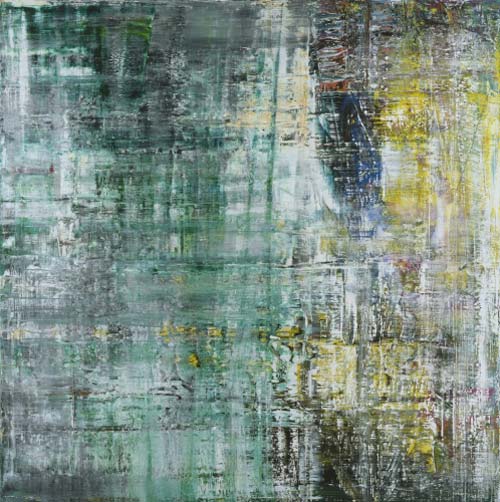
Part Pollack, part Rothko, part glitch art. From the Financial Times:
The six paintings are composed in his characteristic swiping, blurred style of over-painted and obliterated layers, fine-tuned nuances of grey and white worked through with coruscating colours — carmine, emerald, turquoise, cadmium yellow, fiery orange — dragged across the canvas, smeared, wiped, leaving fragments of beauty on cool but sensuous surfaces. They suggest rain and mist, instability and displacement, absence and endings, classical rigour and postmodern ruin. They echo the northern European palette of earnest darkness and piercing brightness that goes back to Grunewald and Caspar David Friedrich, but Richter is also a minimalist, a denier of meaning, ideals, personal signatures. He has named the works in honour of composer John Cage, in reference to his Lecture on Nothing — “I have nothing to say and I’m saying it.”
Three other things I found interesting there:
1) Miroslaw Balka’s 480x10x10, a sculpture consisting of used bars of soap held together by a stainless steel rope hanging from the ceiling. It’s not often that contemporary art smells Zestfully Clean.
2) Jean Dubuffet’s The Exemplary Life of the Soil (Texturology LXIII). The online image doesn’t do it justice…the painting looked just like a slab of rock hanging on the wall.
3) The Turbine Room is an amazing, amazing space…I could have spent hours in there. I took this photo of Ollie attempting to take his first steps in the Turbine Room. Oh, and they’ve patched the cracks from Doris Salcedo’s Shibboleth. The patching is shoddy…I wonder if that’s on purpose as a permanent aftertaste of the artwork.
Artist Jason Polan (he of the The Every Piece Of Art in The Museum Of Modern Art Book) is on a mission to draw every single person in New York City. If you’d like to be drawn, drop him a line on where you’ll be, and he’ll show up and sketch you.
Opening tonight at Jen Bekman: Love = Love by Kent Rogowski. Rogowski takes pieces from different puzzles and assembles them into new images.
Longish but interesting profile of Larry Gagosian, the world’s foremost art dealer.
Gagosian attracts artists and collectors alike because he understands the intense coupling between art and money. In 2004 the top price for a painting by Takashi Murakami at auction was $624,000. Since then, Gagosian has sold Murakamis to Cohen and others, and in November one was auctioned for $2.4m. He has repeated that trick time after time. Not long after joining his stable in 2003, the painter John Currin made his auction record of $847,500; his highest price before joining Gagosian was a little over half that. Recently Adam Sender, the head of the hedge fund Exis Capital Management, reportedly sold a Currin painting through Gagosian for $1.4m. Before Glenn Brown began showing with Gagosian, in 2004, his top price at auction was $46,000; in June 2007, a painting of his made $969,000. In May, when Anselm Reyle was still represented by Gavin Brown, his work was fetching at most around $200,000 at auction. In October, after he had joined Gagosian’s stable, a work of his made nearly four times that amount
Great 60-minute documentary on English painter Francis Bacon in six parts: one, two, three, four, five, six. The production is inventive and I’ve never seen someone answer so many seemingly penetrating questions so quickly and fluidly, save for the one he has to read off of a card produced from his pocket. (thx, dean)
Update: The program is available in one part here. (thx, marissa)
For her Mended Spiderweb project, Nina Katchadourian found spiderwebs in need of repair and fixed them with a needle and thread.
All of the patches were made by inserting segments one at a time directly into the web. Sometimes the thread was starched, which made it stiffer and easier to work with. The short threads were held in place by the stickiness of the spider web itself; longer threads were reinforced by dipping the tips into white glue. I fixed the holes in the web until it was fully repaired, or until it could no longer bear the weight of the thread.
The spiders didn’t think much of her handiwork:
The morning after the first patch job, I discovered a pile of red threads lying on the ground below the web. At first I assumed the wind had blown them out; on closer inspection it became clear that the spider had repaired the web to perfect condition using its own methods, throwing the threads out in the process. My repairs were always rejected by the spider and discarded, usually during the course of the night, even in webs which looked abandoned.
(via 3qd)
The One Day Poem Pavilion uses the sun to display a poem one line at a time over the course of an entire day. (via stingy kids)
Newer posts
Older posts



Socials & More