Photo Remakes of Famous Art
I love everything about this…I scrolled through the entire list. This one was my favorite:


(via waxy)

This site is made possible by member support. 💞
Big thanks to Arcustech for hosting the site and offering amazing tech support.
When you buy through links on kottke.org, I may earn an affiliate commission. Thanks for supporting the site!
kottke.org. home of fine hypertext products since 1998.
Beloved by 86.47% of the web.
I love everything about this…I scrolled through the entire list. This one was my favorite:
(via waxy)
The Olympic Games used to include competitions in painting, sculpture, literature, architecture, and music.
From 1912 to 1948 rules of the art competition varied, but the core of the rules remained the same. All of the entered works had to be inspired by sport, and had to be original (that is, not be published before the competition). Like in the athletic events at the Olympics, gold, silver, and bronze medals were awarded to the highest ranked artists, although not all medals were awarded in each competition. On a few occasions, in fact, no medals were presented at all.
(via @itscolossal)
Since the late 1980s, Mark Landis has been donating forged paintings he’s painted to a number of museums around the country. No one really knew why…until John Gapper from The Financial Times tracked him down.
For nearly three decades, Landis has visited museums across the US in various guises and tried to donate paintings he has forged. As well as Father Scott, he has posed as “Steven Gardiner” among other aliases. He never asks for money, although museums have often hosted meals for him and made small gifts. His only stipulation is that he is donating in his parents’ names — often his actual father, Lieutenant Commander Arthur Landis Jr, a former US Navy officer.
Landis has been prolific and amazingly persistent. A few weeks before he came to Lafayette, “Father Scott” arrived at the Nelson-Atkins Museum of Art in Kansas City, Missouri, with a forgery of Head of a Sioux by Alfred Jacob Miller that he said he was giving in memory of his mother, “Helen Mitchell Scott”. Landis has so far offered copies of that work to five other museums. Yet in all this time, although curators speculate about his motives, no one has found out why he is doing it.
Update: Landis is the subject of a documentary film called Art and Craft.
Mark Landis has been called one of the most prolific art forgers in US history. His impressive body of work spans thirty years, covering a wide range of painting styles and periods that includes 15th Century Icons, Picasso, and even Walt Disney. And while the copies could fetch impressive sums on the open market, Landis isn’t in it for money. Posing as a philanthropic donor, a grieving executor of a family member’s will, and most recently as a Jesuit priest, Landis has given away hundreds of works over the years to a staggering list of institutions across the United States.
Artist Ariana Page Russell has a skin condition called dermatographic urticaria that causes her skin to become inflamed when lightly scratched. Russell uses the condition to make art on her body.

(via collacubed)
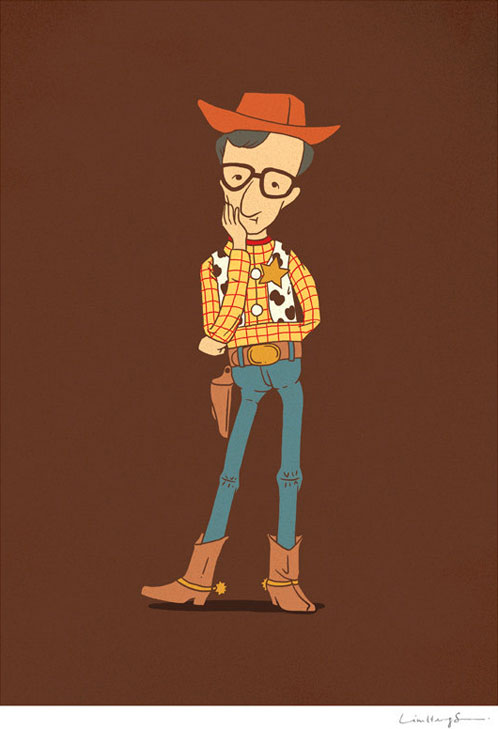
From artist Lim Heng Swee. Grab a print at Etsy while you can.
Fun fact: Tom Hanks does the voice for Woody in the movies but in most other media, he’s voiced by Tom’s younger brother Jim Hanks.
What’s this then? Jovian moon? Instagrammed photo of Earth taken from the ISS? Head of a nail?

Nope, it’s actually a well-worn frying pan from a project by Christopher Jonassen.
Ha! Evan Roth is selling a series of “multi-touch finger paintings” called Open Twitter, Check Twitter, Close Twitter. The paintings are made by placing tracing paper over an iPhone screen while he checks Twitter with a painted finger.

Artist Jonus Lund is broadcasting what he’s browsing in realtime. Each time he goes to a new site in his web browser, his site updates. When I visited earlier, he was looking at Lifehacker.
This is … well, I don’t really know what to say about it. It’s a video game version of Marina Abramović’s The Artist is Present. You buy a ticket, walk into the museum, look at some art, and then you wait in line. (via waxy)
Ursus Wehrli is coming out with a new book, The Art of Clean Up, which features pairs of photographs of different objects, in disorder and then sorted. Here’s my favorite pair:


Photos from the book are disappearing from various sites around the web as takedown notices are sent out, but you can get the gist of the book by watching this video by Wehrli about how one of the photos was made:
On Saturday night, an 11-by-6-inch Rembrandt pen-and-ink drawing called “The Judgement”, worth $250K, was stolen from the Ritz-Carlton Marina del Rey. Interestingly, Rembrandt pieces are the second most stolen pieces of art.
Art experts reached Sunday said works by Rembrandt are among the most popular targets for art thieves, second only to those by Picasso, because of the artist’s name recognition and their value. Anthony Amore, chief investigator at the Isabella Stewart Gardner Museum in Boston and co-author of the book “Stealing Rembrandts,” said there have been 81 documented thefts of the artist’s work in the last 100 years.
It’s like I always say: When I edit Kottke, art gets stolen.
Update:
That was fast. The drawing has been recovered. Thanks, Patrick.
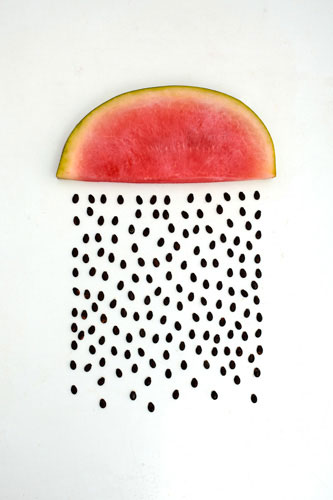
By Sarah Illenberger, who does many other things in a similarly playful style. Print is available. And now that I’m looking, I think I’ve seen her Soft Brain piece before. (Hey, I have!)
I posted about Chris Burden’s Metropolis II a few months ago. The artist is almost set to deliver the piece to Los Angeles County Museum of Art and there’s a proper preview for it:
My favorite line of the interview with Burden that runs over the video:
The idea that a car runs free, those days are about to close.
(via sippey)
Thomas Pavitte designed and then solved the world’s largest connect-the-dots puzzle (of the Mona Lisa). It took him 9 and 1/2 hours.
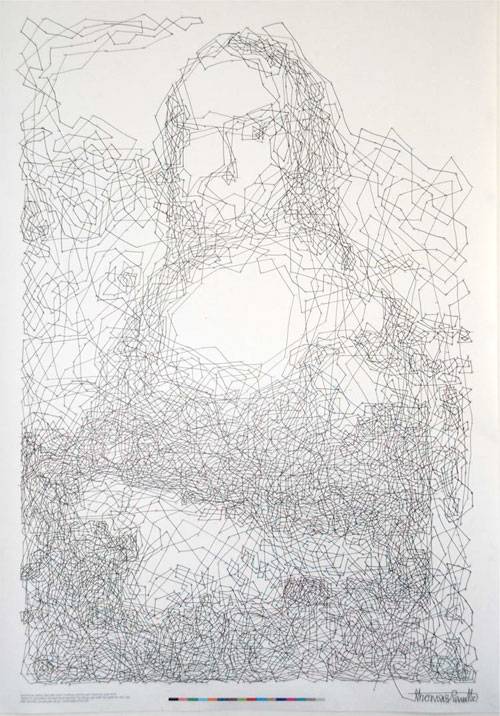
A time lapse video of Pavitte solving the puzzle is up on Vimeo. (via colossal)
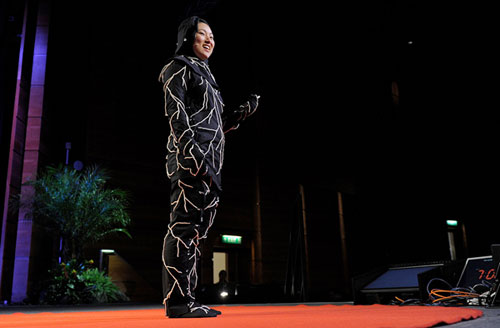
Jae Rhim Lee is growing mushrooms that will eat her body after she dies. She has also designed a special suit that will house the mushrooms as they do their work.
I am interested in cultural death denial, and why we are so distanced from our bodies, and especially how death denial leads to funeral practices that harm the environment — using formaldehyde and pink make-up and all that to make your loved one look vibrant and alive, so that you can imagine they’re just sleeping rather than actually dead. The US government recently upgraded formaldehyde from a probable carcinogen to a known carcinogen, so by trying to preserve the body we poison the living.
So I was thinking, what is the antidote to that? For me the answer was this mushroom - the Infinity Mushroom. It is a symbol of a new way of thinking about death.
Socials & More