kottke.org posts about Sun
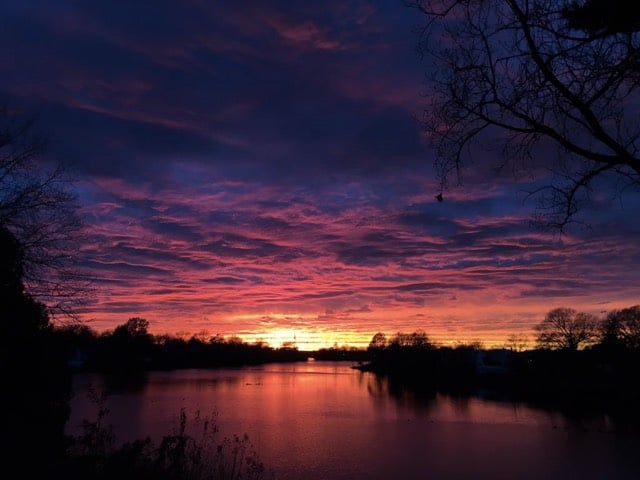
A team of three Pennsylvania meteorologists is now providing a coast-to-coast sunset quality forecast.
The team behind SunsetWx has already published a thorough methodology of its algorithm and a case study of successfully predicted “vivid” sunsets its first day of forecasting last week. Basically, the model blends high-resolution forecasts of humidity, pressure changes, and clouds at various levels of the atmosphere, weighting wispy upper-level clouds the strongest and penalizing for thick, low-level clouds or average clear sky evenings.
They totally called Sunday’s bonkers NYC sunset, so maybe they’re worth a follow. Sunset photo by @AirlineFlyer.
In a nod to our nation’s recreational drug users, NASA has created this 30-minute ultra high-resolution look at our Sun, assembled from thousands of photographs taken by the Solar Dynamics Observatory, which snaps a 16-megapixel image of the Sun every few seconds. Duuuuuuuude…
Artist and programmer Jeff Thompson has compiled 15,000 hand-drawn maps of the Sun made by astronomers into a single video, creating a mesmerizing and delightfully makeshift stop-motion animation of the Sun’s activity over the last 43 years. Astronomers have been drawing these “solar synoptic maps” since 1956 in order to keep track of the Sun’s “weather”…sunspots, flares, and the like. (via slate)
How massive are they? The Sun is 1 solar mass and as wide as 109 Earths. Sagittarius A, the black hole at the center of the Milky Way, weighs 4.3 million solar masses and is as wide as Mercury is far from the Sun. The black hole at the center of the Phoenix Cluster is one of the largest known black holes in the Universe; it’s 73 billion miles across, which is 19 times larger than our entire solar system (from the Sun to Pluto). As for how much it weighs, check this out:
I also like that if you made the Earth into a black hole, it would be the size of a peanut. (thx, reidar)
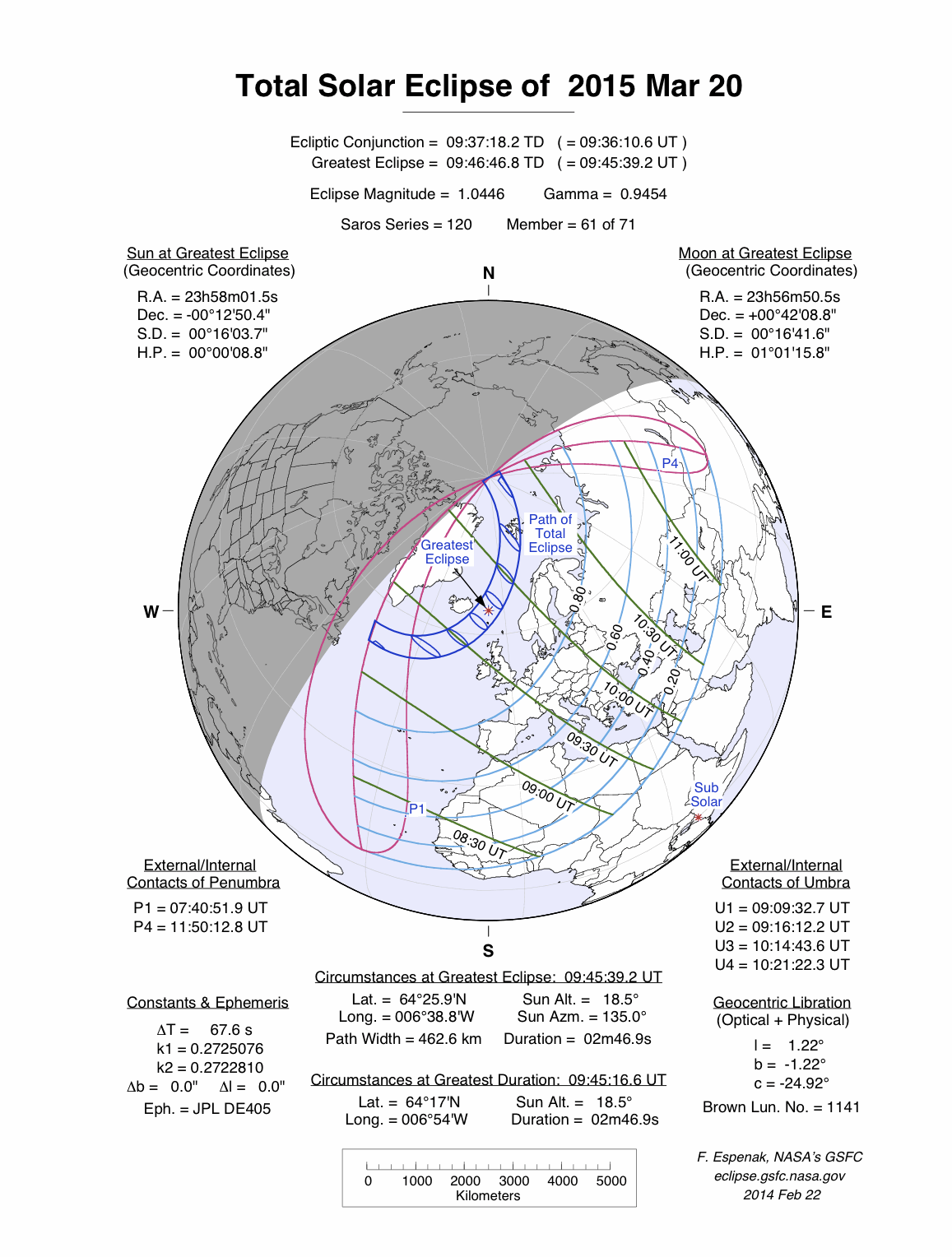
A group of astronomy enthusiasts rented a plane and flew through the shadow cast by the recent eclipse of the Sun. One passenger took the following video. Look at that shadow creeping across the cloud cover! So cool.
P.S. Still super excited for the 2017 eclipse! (via slate)
From the Russian Space Agency, a video of what the sky would look like if the Sun were replaced by some other stars. It starts off with the binary star system of Alpha Centuri, but watch until the end for Polaris, which has a radius 46 times that of the Sun.
See also the view from Earth of different planets replacing the Moon and imagining Earth with Saturn’s rings.
From Quora, an answer to the question “If we pour water on the sun with a bucket as big as the sun, will the sun be extinguished?”
The probable answer is “no.” The Sun involves a special type of fire that is able to “burn” water, and so it will just get hotter, and six times brighter.
Water is 89% oxygen BY MASS. And the Sun’s overall density is 1.4 times that of water. So if you have a volume of water the VOLUME of the Sun, it will have 1/1.4 = 0.71 times the mass of the Sun, and this mass will be .71*.89 = 63% of a solar mass of oxygen and 8% of a solar mass of hydrogen. The Sun itself is 0.74 solar masses of hydrogen and 0.24 solar masses of helium.
So you end up with a 1.7 solar mass star with composition 48% hydrogen, 37% oxygen, and 14% helium (with 1% heavier elements).
Now, will such a star burn? Yes, but not with the type of proton-proton fusion the Sun uses. A star 1.7 times the mass of the Sun will heat up and burn almost entirely by the CNO fusion cycle, after making some carbon and nitrogen to go along with all the oxygen you’ve started with. So with CNO fusion and that mass you get a type F0 star with about 1.3 times the radius and 6 times the luminosity of the present Sun, and a temperature somewhat hotter than the Sun (7200 K vs. the Sun’s 5800 K). It will be bluish-white, with more UV. That, along with that 6 times heat input, will cause the Earth’s biosphere to be fried, and oceans to probably boil.
Well, we probably shouldn’t do that then. (via gizmodo)
This is a time lapse of the surface of the Sun, constructed of more than 17,000 images taken by the Solar Dynamics Observatory from Oct 14 to Oct 30, 2014. The bright area that starts on the far right is sunspot AR 12192, the largest observed sunspot since 1990.
The sunspot is about 80,000 miles across (as wide as 10 Earths) and it’s visible from Earth with the naked eye. Best viewed as large as possible…I bet this looks amazing on the new retina iMac. (via @pageman)
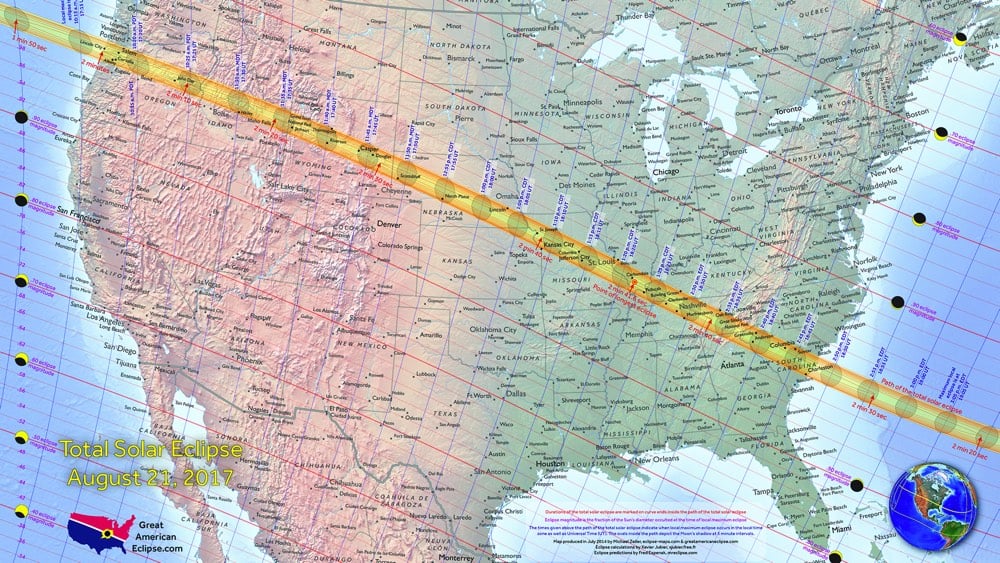
I do not officially have a bucket list1 but if I did have one, watching a total solar eclipse would be on it. Was just talking about it the other day in fact. Well. I am pretty damn excited for the Great American Eclipse of 2017!
In August 21, 2017, millions of people across the United States will see nature’s most wondrous spectacle — a total eclipse of the Sun. It is a scene of unimaginable beauty; the Moon completely blocks the Sun, daytime becomes a deep twilight, and the Sun’s corona shimmers in the darkened sky. This is your guide to understand, prepare for, and view this rare celestial event.
It goes right through the middle of the country too…almost everyone in the lower 48 is within a day’s drive of seeing it. Cities in the path of the totality include Salem, OR, Jackson, WY, Lincoln, NE, St. Louis, MO (nearly), Nashville, TN, and Charleston, SC.
Weather will definitely play a factor in actually seeing the eclipse, so I will be keeping an eye on Eclipser (“Climatology and Maps for the Eclipse Chaser”) as the event draws near. Early analysis indicates Oregon as the best chance for clear skies. Matt, I am hereby laying claim to your guest room in three years time. So excited!!
NASA’s Solar Dynamics Observatory is getting some really amazing shots of the Sun, including this 200,000 mile-long solar eruption that left a huge canyon on the surface of the Sun:
Different wavelengths help capture different aspect of events in the corona. The red images shown in the movie help highlight plasma at temperatures of 90,000° F and are good for observing filaments as they form and erupt. The yellow images, showing temperatures at 1,000,000° F, are useful for observing material coursing along the sun’s magnetic field lines, seen in the movie as an arcade of loops across the area of the eruption. The browner images at the beginning of the movie show material at temperatures of 1,800,000° F, and it is here where the canyon of fire imagery is most obvious.
The level of detail shown is incredible. (via @DavidGrann)
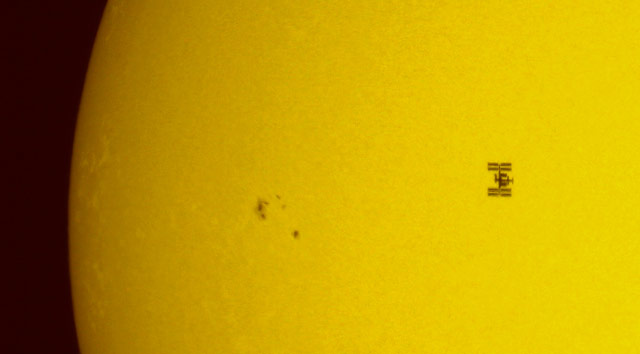
Romanian photographer Maximilian Teodorescu recently caught the International Space Station in transit across the Sun.
Teodorescu has also taken photos of the ISS in transit across the Moon.
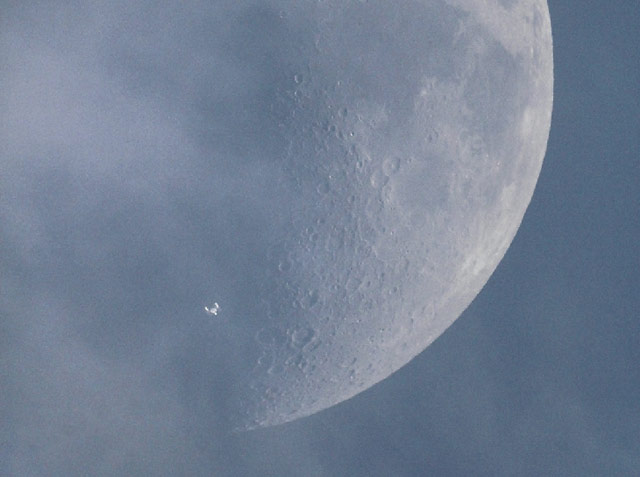
These photos make the ISS seem tiny and huge all at the same time. And be sure to click through on the links to see the full-sized photos.
Turning the Sun into a giant radio telescope through gravitational lensing will take some work, but it is possible.
An Italian space scientist, Claudio Maccone, believes that gravitational lensing could be used for something even more extraordinary: searching for radio signals from alien civilizations. Maccone wants to use the sun as a gravitational lens to make an extraordinarily sensitive radio telescope. He did not invent the idea, which he calls FOCAL, but he has studied it more deeply than anyone else. A radio telescope at a gravitational focal point of the sun would be incredibly sensitive. (Unlike an optical lens, a gravitational lens actually has many focal points that lie along a straight line, called a focal line; imagine a line running through an observer, the center of the lens, and the target.) For one particular frequency that has been proposed as a channel for interstellar communication, a telescope would amplify the signal by a factor of 1.3 quadrillion.
The Sun is so dense at its core that the average photon created by the fusion process takes more than 40,000 years to escape to the surface. !!!
The center of the Sun is extremely dense, and a photon can only travel a tiny distance before running into another hydrogen nucleus. It gets absorbed by that nucleus and the re-emitted in a random direction. If that direction is back towards the center of the Sun, the photon has lost ground! It will get re-absorbed, and then re-emitted, over and over, trillions of times.
This is from 1997, so that figure might have been revised a bit (anyone have updated numbers?) but still, that’s incredible. (via hacker news)
In complete defiance of its parents, NASA’s Solar Dynamics Observatory has stared directly at the Sun for the past three years. Here’s a video of those three years made from still images taken by the SDO.
During the course of the video, the sun subtly increases and decreases in apparent size. This is because the distance between the SDO spacecraft and the sun varies over time. The image is, however, remarkably consistent and stable despite the fact that SDO orbits the Earth at 6,876 miles per hour and the Earth orbits the sun at 67,062 miles per hour.
The video notes say the animation uses two images per day…it would be nice to see the same animation with a higher frame rate. (via ★interesting)
Since the Sun moves relative to the other stars around it at about 45,000 miles/hr, if you change the frame of reference from the Sun to the surrounding stellar system, you get planetary motion that looks something like this:
I would take this video with a grain of salt though, especially when it says things like “the Sun is like a comet, dragging the planets in its wake”…the planets don’t lag behind the Sun. Better to think of the thing as a conceptual schematic: resembling reality but not really accurate. (via @pieratt)
Update: There’s a new version of the video that addresses some of the concerns raised about the first video:
(thx, john)
Update: Phil Plait from Bad Astronomy has posted a pretty thorough takedown of this video.
However, there’s a problem with it: It’s wrong. And not just superficially; it’s deeply wrong, based on a very wrong premise. While there are some useful visualizations in it, I caution people to take it with a galaxy-sized grain of salt.
Newer posts
Older posts


Socials & More