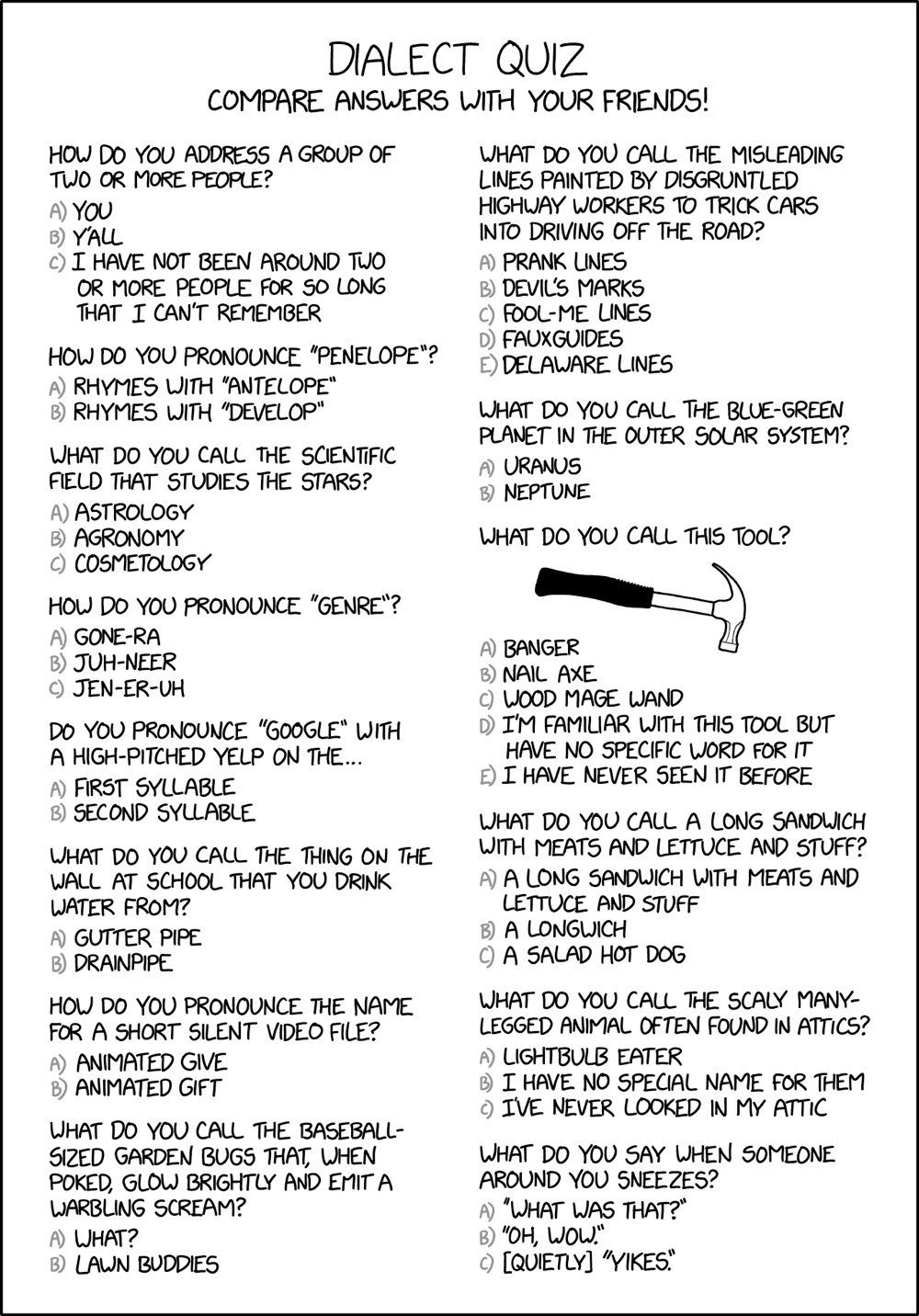
Remember when dialectquizzes and maps were a thing? XKCD is joining the fun with their own quiz. Reader, I giggled when I got to “lawn buddies” and full-on laughed at “longwich”. Longwich is totally going in my vocabulary arsenal.
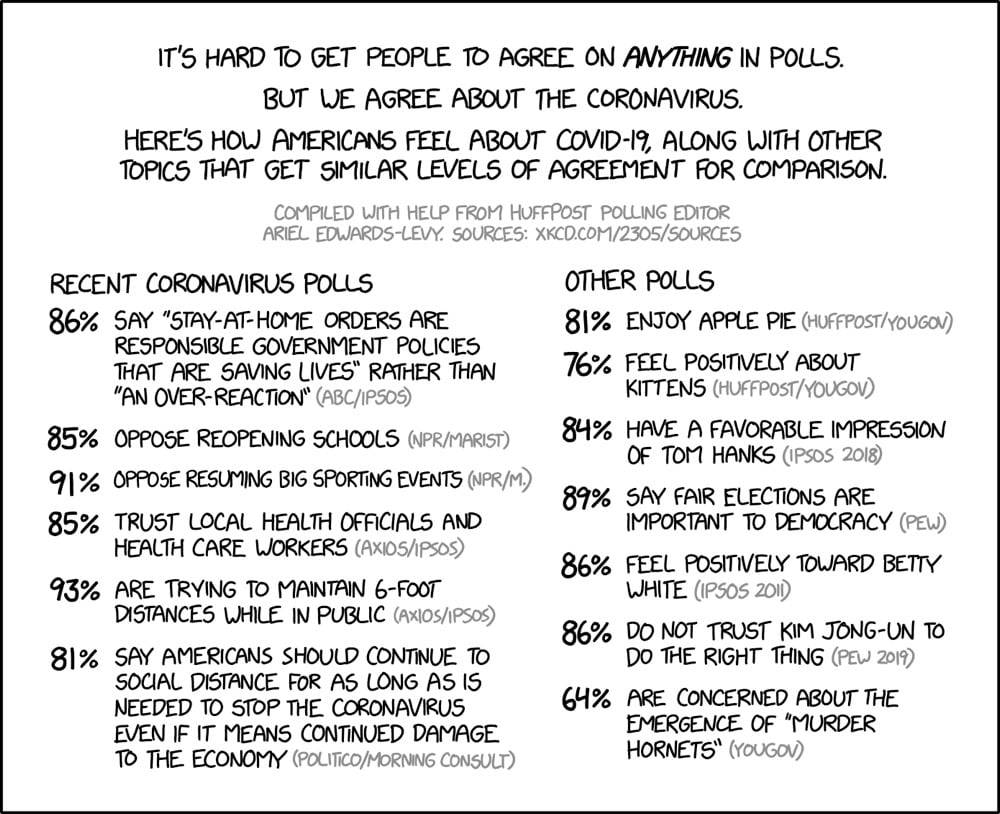
Recent polling compiled by Randall Munroe indicates that Americans agree on what to do about the Covid-19 pandemic to a greater extent than they “feel positively about kittens” or even “enjoy apple pie”.
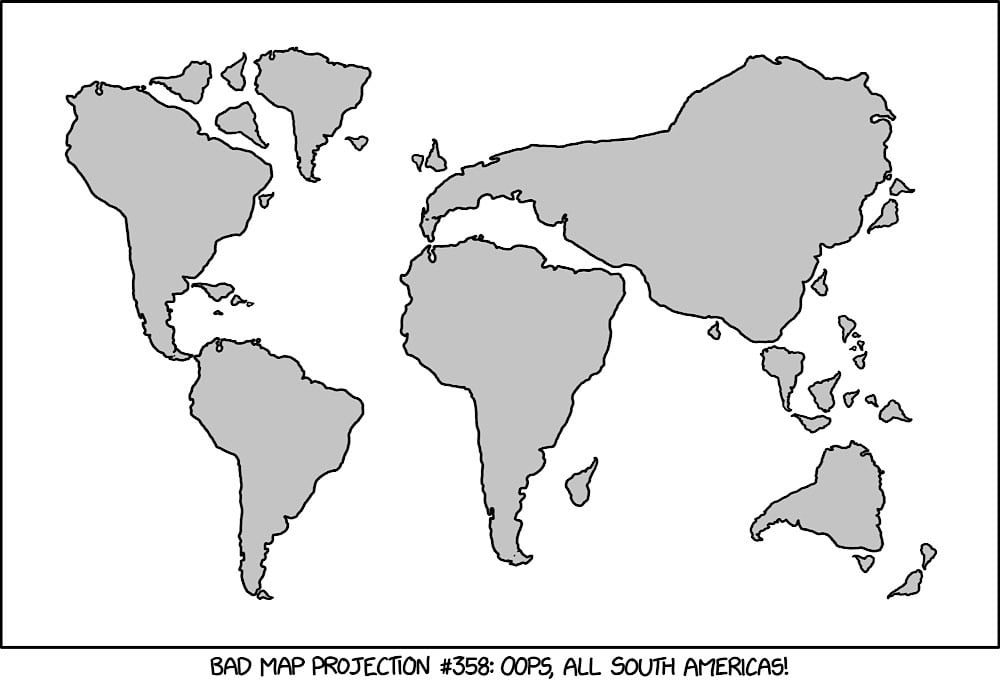
I bet you never noticed that South America can kind of approximate most of the world’s other continents pretty well. XKCD’s Randall Munroe did and made a bad map projection of it.
From Randall Munroe at XKCD, here’s a spoilers generator for the latest Star Wars movie.
In this Star Wars movie, our heroes return to take on the First Order and new villain Theranos with some help with their new friend Dab Tweetdeck. Rey builds a new lightsaber with a beige blade, and they head out to confront the First Order’s new superweapon, the Moonsquisher, a space station capable of cutting a planet in half and smashing the halves together like two cymbals. They unexpectedly join forces with their old enemy Boba Fett and destroy the superweapon in a battle featuring Kylo Ren putting on another helmet over his smaller one. P.S. Rey’s parents are Obi-wan and Laura Dern.
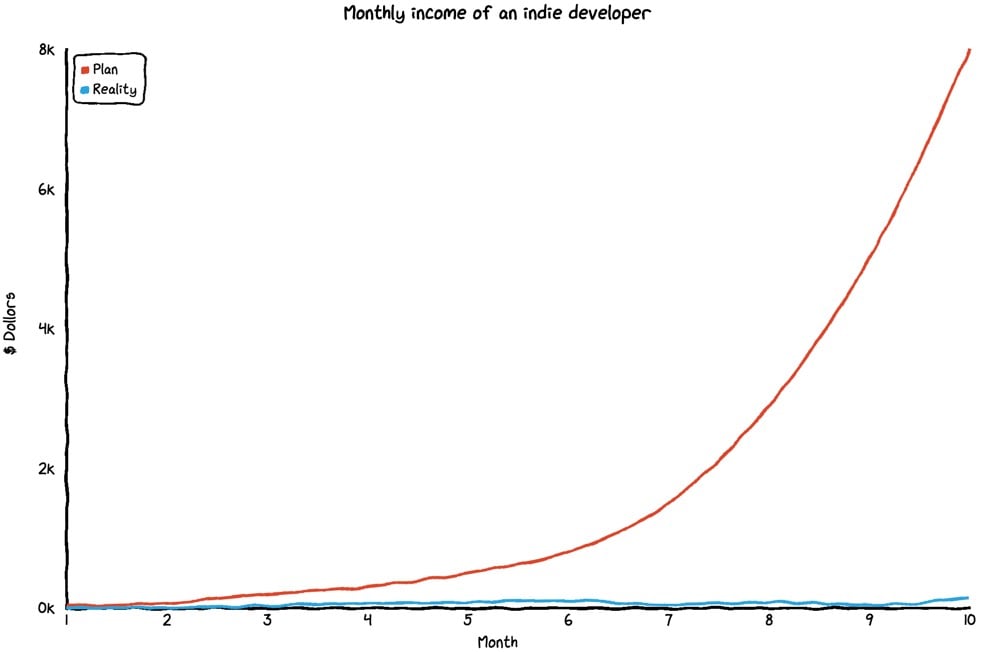
It’s easy to get started with chart.xkcd. All that’s required is the script included in your page along with a single
You can use it to make line charts, XY charts, bar charts, radar charts, and pie/doughnut charts. I am definitely going to be using this in the future.
Moon dust may not burn you, but it’s no picnic. Like Earth sand, moon dust is effectively made of tiny glass shards, but the sharp edges have not been worn down by erosion. As a result, it can be pretty unhealthy.
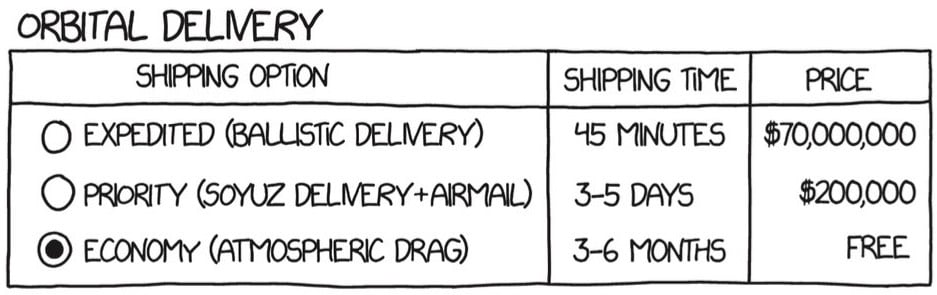
Getting an object down to Earth from the International Space Station is easy: you can just toss it out the door and wait. Eventually, it will fall to Earth.
There’s a very small amount of atmosphere at the ISS’s altitude. It’s not much, but it’s enough to produce a tiny but measurable amount of drag. This drag sooner or later causes objects to slow down, fall into a lower and lower orbit, and eventually hit the atmosphere and (usually) burn up. The ISS also feels this drag; it uses thrusters to compensate, periodically boosting itself up into a higher orbit to make up for lost altitude. If it didn’t, its orbit would gradually decay until it fell back to Earth.
This shipping method has two big problems: First, your package will burn up in the atmosphere before it ever reaches the ground. And second, if it does survive, you’ll have no way to know where it will land. To deliver your package, you’ll have to solve both these problems.
Fun fact: a piece of paper drifting down from orbit might move slowly enough not to burn up on reentry.
In the latest issue of his newsletter, Rex Sorgatz proposes a name for the growing collection of media about the recent past: the Historical Cinematic Universe (HCU for short, name after the MCU, naturally).
By my estimation, the uptick started in movies, with a surge in reality-based Oscar-bait like Spotlight, The Wolf of Wall Street, The Post, The Social Network, and the films of Adam McKay, especially Vice and The Big Short. More recently, and more significantly, the trend has spilled into scripted television, with such ambitious projects as HBO’s Brexit movie, Paramount’s Waco miniseries, Netflix’s Unabomber series, USA’s Tupac / Biggie miniseries, Hulu’s 9/11 series, Buzzfeed’s 1968 series, and, of course, HBO’s Chernobyl miniseries, which is the best show on TV right now. (A+ rec!)
With the influx of scripted historical reinterpretation, traditional documentaries have broadened their scope, expanding into binge experiences. The boomlet is most obvious in those esteemed investigations from HBO, such as Leaving Neverland and The Jinx. But this vim for verisimilitude has spread to unexpected locales, like Lifetime, with Surviving R. Kelly, and A&E, with The Clinton Affair, my personal favorite of this genre. Each of these historical investigations have yielded massive cultural influence.
I am a huge fan of the HCU, particularly of podcasts like Slow Burn and an excellent documentary he doesn’t mention, OJ: Made in America. As Sorgatz notes, Slow Burn creator Leon Neyfakh just launched a new podcast called Fiasco, the first season of which is about the 2000 Bush/Gore election.1 The podcast is only available via subscription, but you can listen to the first episode on the website.
Update: In this video, Patrick Willems talks about accidental cinematic universes, like the one about the US space program, which combines films like The Right Stuff, Apollo 13, Hidden Figures, and First Man into one overarching narrative. Or the British WWII cinematic universe that includes movies like The King’s Speech, Darkest Hour, and Dunkirk.
Which I have been thinking about a lot recently — it is recent history’s biggest counterfactual. Imagine a world where Al Gore became President in 2001. The US taking climate change seriously back then would have made a huge difference. No using 9/11 to sharply escalate our meddling & deadly presence in the Middle East. Perhaps no financial crisis in 2008. Perhaps no Roberts or Alito on the Supreme Court. Sigh.↩
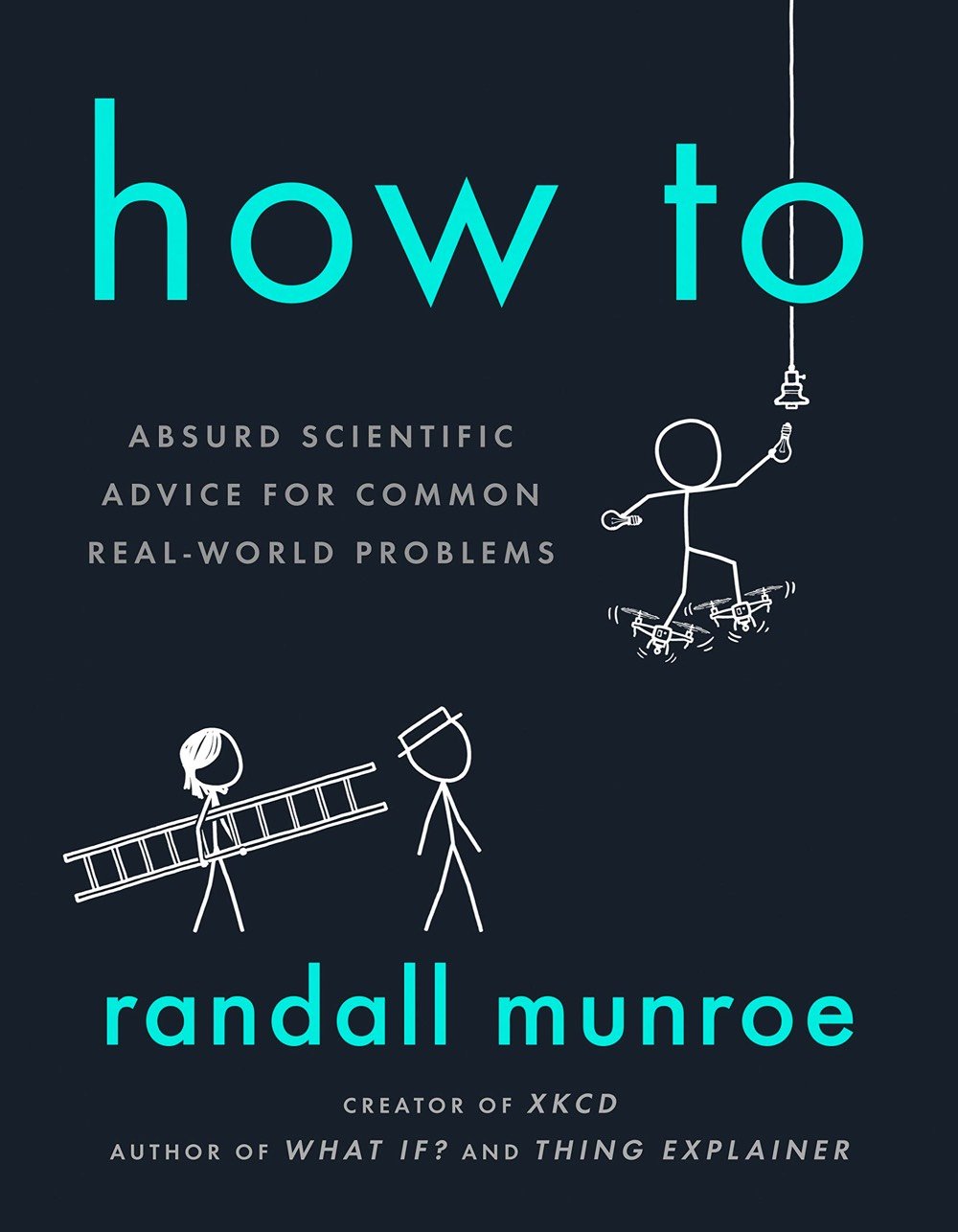
Bestselling author and cartoonist Randall Munroe explains how to predict the weather by analyzing the pixels of your Facebook photos. He teaches you how to tell if you’re a baby boomer or a 90’s kid by measuring the radioactivity of your teeth. He offers tips for taking a selfie with a telescope, crossing a river by boiling it, and getting to your appointments on time by destroying the Moon. And if you want to get rid of the book once you’re done with it, he walks you through your options for proper disposal, including dissolving it in the ocean, converting it to a vapor, using tectonic plates to subduct it into the Earth’s mantle, or launching it into the Sun.
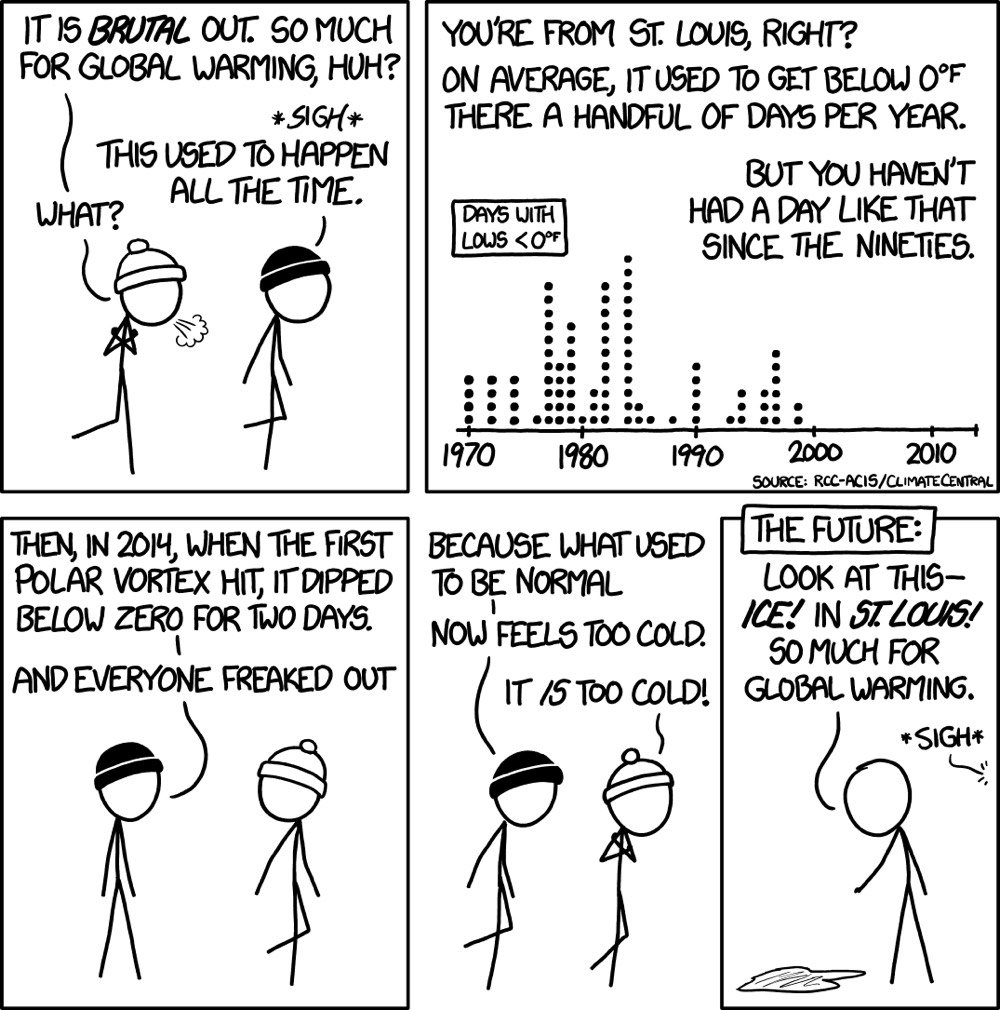
In what is now an annual tradition, when the temperatures in some part of the US plunge below zero degrees on the Fahrenheit scale, some nitwit Republican climate change-denier live-tweets from the back pocket of industry something like “It’s so cold out where’s the global warming when we need it???? #OwnTheLibs”. This time around, it was our very own Shitwhistle-in-Chief who tweeted merrily about the current polar vortex bearing down on the Midwest:
In the beautiful Midwest, windchill temperatures are reaching minus 60 degrees, the coldest ever recorded. In coming days, expected to get even colder. People can’t last outside even for minutes. What the hell is going on with Global Waming? Please come back fast, we need you!
When I was a kid growing up in Wisconsin, I recall experiencing overnight low temperatures in the -30°F to -40°F range several times and vividly remember being stranded in my house for a week in 1996 when the all-time record low for the state (-55°F) was established in nearby Couderay.
Because of rapid Arctic warming, the north/south temperature difference has diminished. This reduces pressure differences between the Arctic and mid-latitudes, weakening jet stream winds. And just as slow-moving rivers typically take a winding route, a slower-flowing jet stream tends to meander.
Large north/south undulations in the jet stream generate wave energy in the atmosphere. If they are wavy and persistent enough, the energy can travel upward and disrupt the stratospheric polar vortex. Sometimes this upper vortex becomes so distorted that it splits into two or more swirling eddies.
These “daughter” vortices tend to wander southward, bringing their very cold air with them and leaving behind a warmer-than-normal Arctic.
Equipped with only a magnifying glass and the light of the Sun, it’s pretty easy to start a fire.1 So, with a much bigger glass, could you start a fire with moonlight?
First, here’s a general rule of thumb: You can’t use lenses and mirrors to make something hotter than the surface of the light source itself. In other words, you can’t use sunlight to make something hotter than the surface of the Sun.
There are lots of ways to show why this is true using optics, but a simpler — if perhaps less satisfying — argument comes from thermodynamics:
Lenses and mirrors work for free; they don’t take any energy to operate.[2] If you could use lenses and mirrors to make heat flow from the Sun to a spot on the ground that’s hotter than the Sun, you’d be making heat flow from a colder place to a hotter place without expending energy. The second law of thermodynamics says you can’t do that. If you could, you could make a perpetual motion machine.
In a better world, Randall Munroe would be writing middle school science textbooks.
A few summers ago when I was showing my kids how to do this, I started futzing with the small pile of tissue paper and pine needles we’d assembled and forgot about the magnifying glass I was holding…until I felt a searing pain in my leg and looked down to see a bit of smoke curling up from my slightly toasted thigh. Kids, do as dad says, not as he does.↩
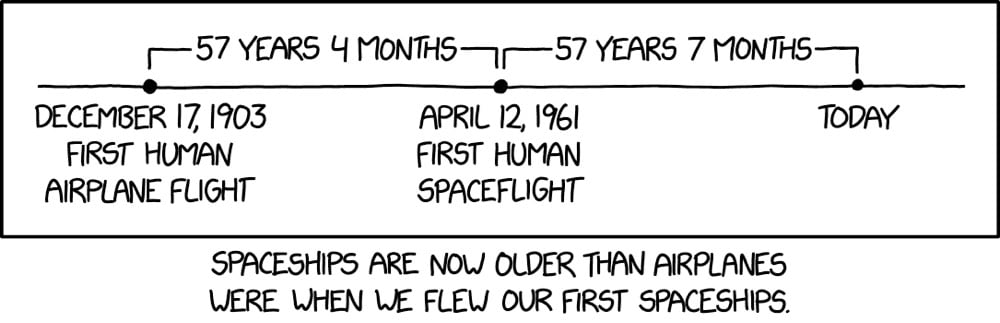
From XKCD, a reminder that human spaceflight is older than we might think and human flight is more recent.
I am a sucker for these sorts of things. Perhaps my favorite is that Cleopatra lived closer to the Moon landing than she did to the construction of the Great Pyramid of Giza. Or maybe it’s that Ralph Macchio is five years older now than Pat Morita was when he played Mr. Miyagi opposite Macchio in The Karate Kid.
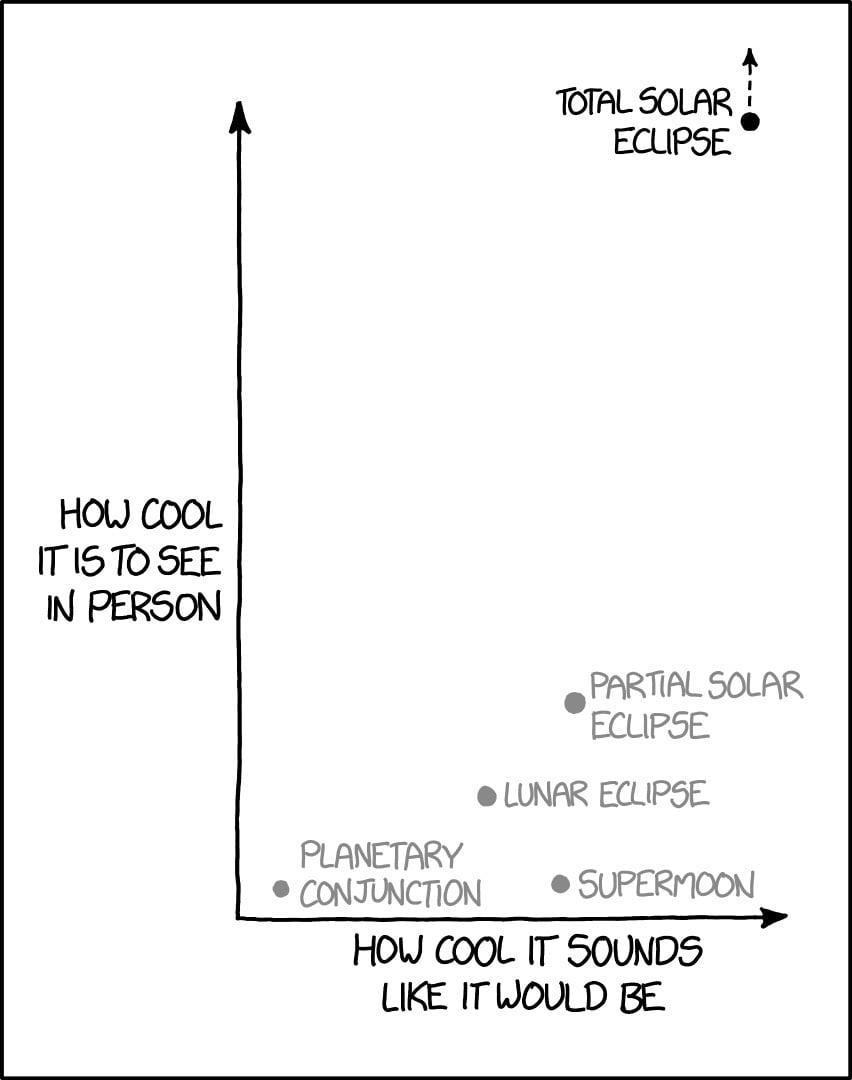
I had seen a partial eclipse in 1970. A partial eclipse is very interesting. It bears almost no relation to a total eclipse. Seeing a partial eclipse bears the same relation to seeing a total eclipse as kissing a man does to marrying him, or as flying in an airplane does to falling out of an airplane. Although the one experience precedes the other, it in no way prepares you for it.
I heard lots of disappointment with the eclipse among friends and on social media. It was neat — look, there’s a chunk out of the Sun — but they thought it would be darker or that the air would get colder. But none of that stuff really happens unless you’re really close to totality…and then it goes completely dark and your brain turns inside out. Twitter user @hwoodscotty said:
Probably the coolest thing I’ve ever seen. Totality is so much different than even 99%. 10/10 Would recommend.
Standing on a mountaintop for totality was crossing into another dimension, suddenly finding ourselves on another world. Amazing. Sparkling ring, sun fire ghostly streaming, darkest circle. I understand now why people chase the eclipse. Totality is unlike anything. Entire landscape shifted, valleys, hills, mountains painted in nightcolour and cold. Sparkling planets came out in a midnight sky.
But back to Dillard’s piece…this part, about the shadow rushing towards them, sounds amazing:
I have said that I heard screams. (I have since read that screaming, with hysteria, is a common reaction even to expected total eclipses.) People on all the hillsides, including, I think, myself, screamed when the black body of the moon detached from the sky and rolled over the sun. But something else was happening at that same instant, and it was this, I believe, which made us scream.
The second before the sun went out we saw a wall of dark shadow come speeding at us. We no sooner saw it than it was upon us, like thunder. It roared up the valley. It slammed our hill and knocked us out. It was the monstrous swift shadow cone of the moon. I have since read that this wave of shadow moves 1,800 miles an hour. Language can give no sense of this sort of speed — 1,800 miles an hour. It was 195 miles wide. No end was in sight — you saw only the edge. It rolled at you across the land at 1,800 miles an hour, hauling darkness like plague behind it. Seeing it, and knowing it was coming straight for you, was like feeling a slug of anesthetic shoot up your arm. If you think very fast, you may have time to think, “Soon it will hit my brain.” You can feel the deadness race up your arm; you can feel the appalling, inhuman speed of your own blood. We saw the wall of shadow coming, and screamed before it hit.
Next time, and there will definitely be a next time, I’m hoping to get up high somewhere so I can see the shadow and more of the 360-degree sunset. BRB, pricing plane tickets to Argentina…
Update: Before the 2017 eclipse, Vox talked to some eclipse chasers about what it’s like to witness a total solar eclipse.
now that i’ve recovered from the drive, i can say that a lot of what these eclipse chasers told me makes sense now. agree completely that it’s something you have to see for yourself. what was different for me though is …. i got pretty sad. there’s a fine line between awe and grief. maybe in a different year it would have gone the other way, but tbh every exceptionally beautiful sunset makes me a tiny bit sad too. but this was sunset sadness times a thousand. absolutely punched by the impermanence. i hope i see it again and i hope you can see it too.
Note: If you are a member and tried to log in, it didn't work, and now you're stuck in a neverending login loop of death, try disabling any ad blockers or extensions. Or try logging out and then back in. Still having trouble? Email me!







Socials & More