



Bleeding Edge book trailer
The book trailer for Thomas Pynchon’s new novel is either brilliant or the dumbest thing ever.
Fun fact: the phrase “I don’t even” was invented to react to this video. (via @GreatDismal)

This site is made possible by member support. 💞
Big thanks to Arcustech for hosting the site and offering amazing tech support.
When you buy through links on kottke.org, I may earn an affiliate commission. Thanks for supporting the site!
kottke.org. home of fine hypertext products since 1998.
Beloved by 86.47% of the web.
The book trailer for Thomas Pynchon’s new novel is either brilliant or the dumbest thing ever.
Fun fact: the phrase “I don’t even” was invented to react to this video. (via @GreatDismal)
A federal judge ruled this morning that NYC’s controversial stop-and-frisk practice violated the rights of “tens of thousands” of New Yorkers.
In a decision issued on Monday, the judge, Shira A. Scheindlin, ruled that police officers have for years been systematically stopping innocent people in the street without any objective reason to suspect them of wrongdoing. Officers often frisked these people, usually young minority men, for weapons or searched their pockets for contraband, like drugs, before letting them go, according to the 195-page decision.
These stop-and-frisk episodes, which soared in number over the last decade as crime continued to decline, demonstrated a widespread disregard for the Fourth Amendment, which protects against unreasonable searches and seizures by the government, according to the ruling. It also found violations with the 14th Amendment.
To fix the constitutional violations, Judge Scheindlin of Federal District Court in Manhattan said she intended to designate an outside lawyer, Peter L. Zimroth, to monitor the Police Department’s compliance with the Constitution.
This is good news. Treating every young black male in the city like a criminal is not a policing strategy and it’s embarrassing it has gone on this long. This kind of thing, along with the recent NSA revelations and other issues, make me wonder if “innocent until proven guilty” is still something the US citizenry and its law enforcement agencies still believe in. (via @beep)
Update: Using data from the last half of 2013, the NY Times says ‘Stop-and-Frisk’ Is All but Gone From New York.
Many who live and work in the neighborhoods say they see scant evidence of change, and some say the police are simply not reporting some or all of their stops. The police did not respond to requests for comment.
But something is clearly different: Misdemeanor drug and weapon charges, the most common arrests to result from a stop, are down considerably. Advocates say misdemeanor marijuana charges, which require that the drug is in plain sight, are a bellwether, because the police ordered thousands to empty pockets, and arrested them.
I’ll reserve judgement until the numbers from 2014 are in, particularly those post-Bloomberg.
In July, Jay Z rapped Picasso Baby at Pace Gallery in NYC for six hours. The fruits of that labor have been condensed by director Mark Romanek into a 10-minute music video that premiered on HBO last night. Here’s the film:
The idea of performance art came to mind. I was aware of Marina Abramovic’s Artist is Present, even though I was in London shooting ‘Never Let Me Go’ and didn’t get to go. And the idea that Jay-Z regularly performs to 60,000 people at a time, I thought, ‘What about performing at one person at a time?’ He absolutely loved it. He interrupted me and said, ‘Hold on! I’ve got chills. That idea is perfect.’ He thinks, like me, that the music video has had its era. I also wanted to make sure we had Marina’s blessing. So she attended the event and took part in the event. She couldn’t have been more happy or enthusiastic about us using her concept and pushing it forward.
Also, somehow, I have never heard Jay Z talk before. That’s his voice?
Museum Hack is offering non-traditional tours of the Metropolitan Museum of Art in NYC.
Join this “Museum Hack” tour to turn one of New York’s most spectacular cultural institutions into a totally unique experience. We will show you the very best and most intriguing that the Metropolitan Museum of Art has on display.
This is not a boring art history lecture. What we offer is a fun, group-oriented VIP tour experience. You will be entertained… and learn a bit along the way. We strive to offer a brand new view of the Met, one that you wouldn’t get by simply visiting the museum on your own.
Great idea. Museum Hack grew out of a smaller effort to Hack the Met.
In 2011, Toyota offered to donate their celebrated business management process to The Food Bank for New York City. After some initial skepticism, the donation has “proved transformative” for the Food Bank.
“They make cars; I run a kitchen,” said Daryl Foriest, director of distribution at the Food Bank’s pantry and soup kitchen in Harlem. “This won’t work.”
When Toyota insisted it would, Mr. Foriest presented the company with a challenge.
“The line of people waiting to eat is too long,” Mr. Foriest said. “Make the line shorter.”
Toyota’s engineers went to work. The kitchen, which can seat 50 people, typically opened for dinner at 4 p.m., and when all the chairs were filled, a line would form outside. Mr. Foriest would wait for enough space to open up to allow 10 people in. The average wait time could be up to an hour and a half.
Toyota made three changes. They eliminated the 10-at-a-time system, allowing diners to flow in one by one as soon as a chair was free. Next, a waiting area was set up inside where people lined up closer to where they would pick up food trays. Finally, an employee was assigned the sole duty of spotting empty seats so they could be filled quickly. The average wait time dropped to 18 minutes and more people were fed.
A very pretty but almost completely useless circular map of the NYC subway.
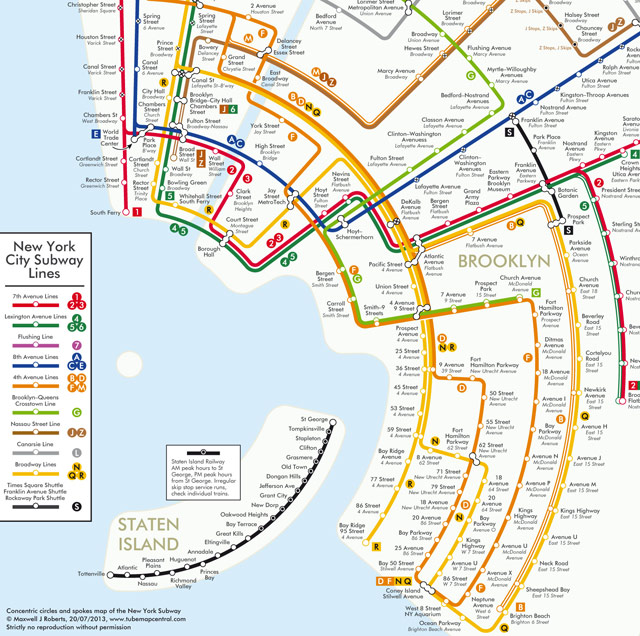
There’s a London Tube version too.
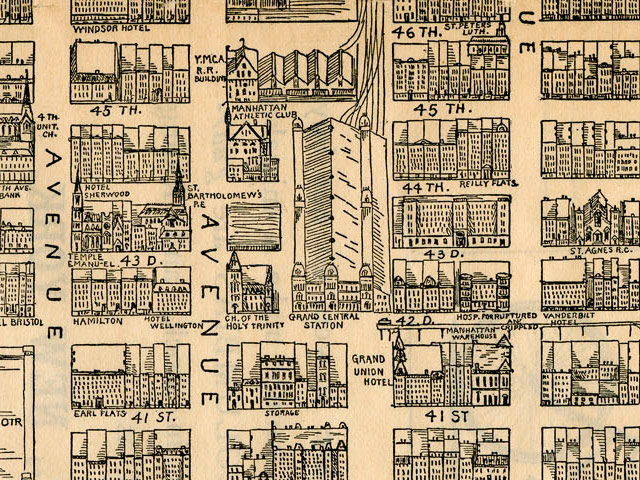
From 1890, a hand-drawn map of Midtown Manhattan “from 34th Street to 59th Street and from 1st Avenue to 6th Avenue”.
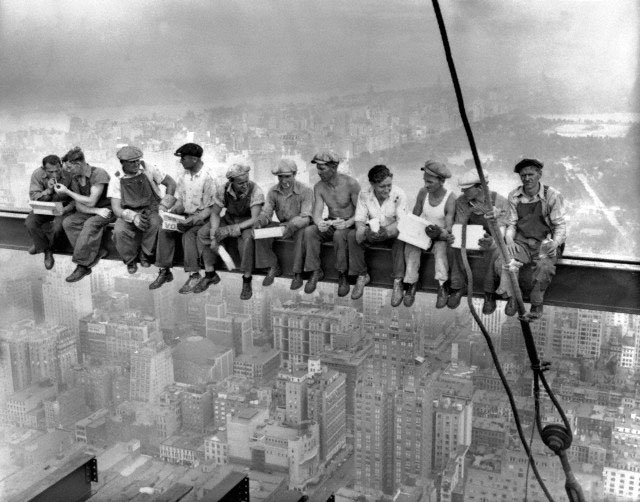
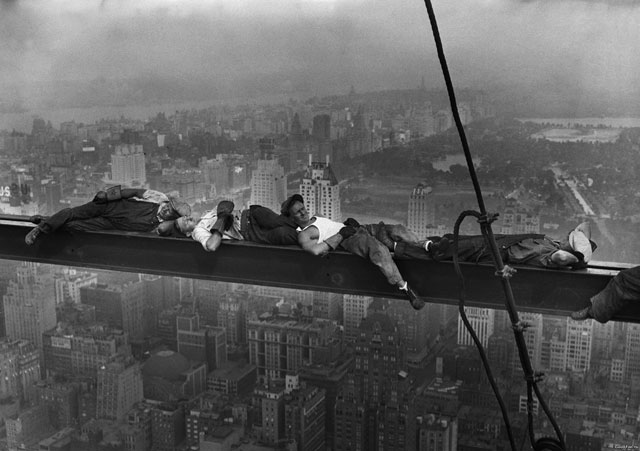
That’s the iconic “Lunch atop a Skyscraper” photo taken in 1932 during the construction of the RCA Building (aka 30 Rock) in NYC. Eleven construction workers eating lunch on a steel girder 840 feet in the air. The shot was a PR stunt to drum up excitement around the near completion of the new skyscraper…no one even knows for sure who took the photo because it was likely a multiple photographer situation. On the same day the lunch photo was taken, some of the same men were photographed taking a nap on the same girder:
Ah, the good old days, when people used to talk to each other in public rather than looking at their phones or listening to headphones all the time. Except that’s not been the case for awhile as XKCD demonstrates with a series of quotes from various publications dating back to 1871. This is from William Smith’s Morley: Ancient and Modern published in 1886.
With the advent of cheap newspapers and superior means of locomotion… the dreamy quiet old days are over… for men now live think and work at express speed. They have their Mercury or Post laid on their breakfast table in the early morning, and if they are too hurried to snatch from it the news during that meal, they carry it off, to be sulkily read as they travel… leaving them no time to talk with the friend who may share the compartment with them… the hurry and bustle of modern life… lacks the quiet and repose of the period when our forefathers, the day’s work done, took their ease…
In 1946, a young Stanley Kubrick worked as a photographer for Look magazine and took this shot of NYC subway commuters reading newspapers:
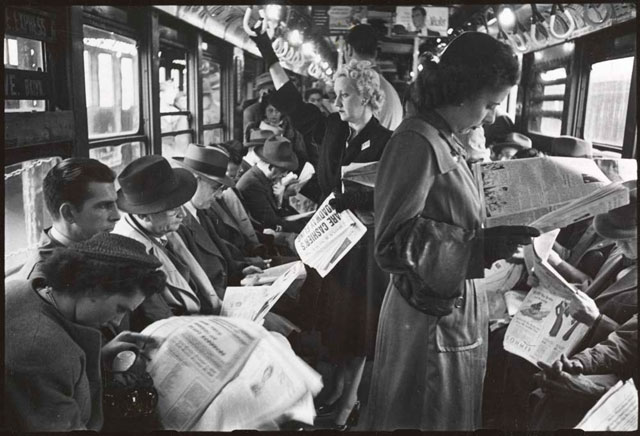
The more things change, etc. More of Kubrick’s subway photography can be found here.
Museum is the world’s smallest museum, located in a small walk-in closet-sized space in Cortlandt Alley between Franklin St & White St in NYC. Collectors Weekly talked with one of the museum’s founders.
In the current season, there’s a collection of toothpaste tubes from around the world. There’s a collection of mutilated U.S. currencies, money that’s counterfeit or real money that’s been scrawled on. There’s a collection from Alvin Goldstein, who was the founder and editor of Screw magazine, who shared with us personal belongings that have stayed with him throughout the narrative of his life. There’s a collection of Disney-themed children’s bulletproof backpacks. They’re things that touch upon something that’s happening in society, things that comment on where we’re at and how we’re thinking and what we’re doing.
Jacob Riis came to NYC in 1870 at the age of 21. He had $40 in his pocket, which he quickly spent. Unemployed, he lived for a time in the city’s notorious slums before working his way up the social and economic ladder to become one of New York’s strongest advocates for reform. Riis also took early advantage of flash photography to steer his camera into the city’s darkest corners — tenements, dark alleys, sweatshops, opium dens, beer halls — and emerged with photographs that helped shift public opinion on NYC’s poverty and slums.

Collections of Riis’ photography can be viewed at Museum Syndicate and the Museum of the City of New York. Riis included many of his photographs in a book he published in 1890 called How the Other Half Lives: Studies among the Tenements of New York. (via petapixel)
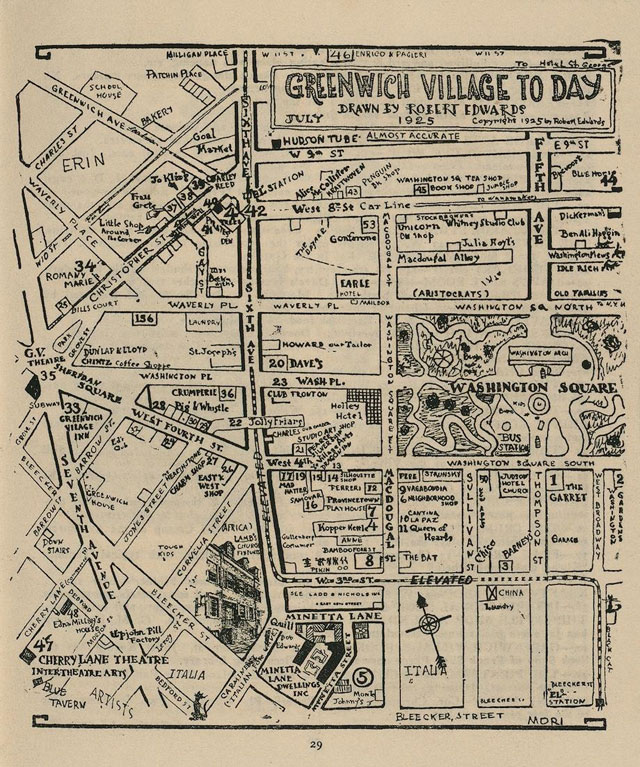
From a 1925 issue of Quill magazine, a map of NYC’s Greenwich Village hand-drawn by Robert Edwards.

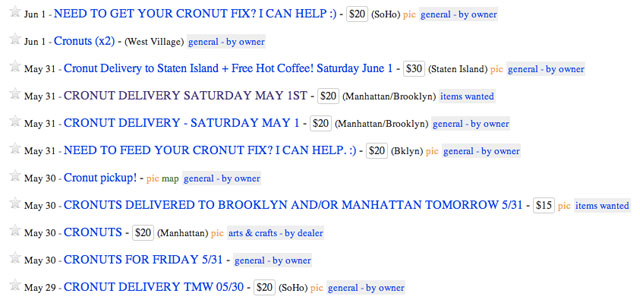
Cronuts are donuts made from croissant dough and they are all the rage here in NYC. They were invented by chef Dominique Ansel and they are only available in limited quantities at his bakery in Soho. Apparently people start lining up for them at 6am and all 200 of the world’s daily supply of cronuts are gone within minutes of opening. Naturally, a black market has sprung up, with cronuts selling on Craigslist for upwards of $25/item:
Kevin Roose has some ideas for Ansel about expanding the reach of the cronut, but in the meantime, Edd Kimber replicated the treat at home with a quickie croissant dough.
Since I wont be in New York any time soon I thought I would see if I could replicate them at home, and you know what? They are pretty damn good! Now the dough I’m using isnt a proper croissant dough, its my quick dough made with just 20 minutes active work which, compared to traditional croissant dough is a snap to make.
Update: Pillsbury has gotten into the act as well with a cronut recipe that uses their crescent dough.
Update: In his forthcoming cookbook, Ansel reveals the recipe for the cronut and it’s not for the faint of heart…the recipe takes three days to make.
This film was apparently shot in NYC in 1939. Features scenes in Midtown, Chinatown, Harlem, and more locales around the city.
(via @UnlikelyWorlds)
Ben Crair visited some of Manhattan’s fancier joints and ordered a decidedly unclassy cocktail: the Long Island Iced Tea.
11 Madison Park is either a very good restaurant or the absolute best restaurant in New York City. It depends on whom you ask. But don’t ask me: I’ve only had a drink at 11 Madison Park, and that drink was a Long Island Iced Tea. It came in a highball with four perfect cubes of ice and a wedge of lemon. It cost sixteen dollars and tasted just like college.
“I haven’t served one of these in six months,” the bartender told me. Like his peers at the other fine New York bars and restaurants where I have lately been ordering Long Island Iced Teas, he had repeated my order back to me: “Long Island Iced Tea?” His neck muscles tightened, giving bloom to a gritted smile. That smile said: “The customer is always right.” I confirmed the order, and he obligingly prepared it. Later, when we struck up a conversation, he told me the last person to order a Long Island Iced Tea at 11 Madison Park “was definitely not from New York.”
True story: the guy who invented the Long Island Iced Tea is named Bob Butt.
Socials & More