kottke.org posts about Met Museum
Lovely short video about artist Jas Knight, who is a participant in the Met Museum’s Copyist Program:
The Copyist Program offers time and space for artists to develop their own interpretation of an artwork through intimate study in the Museum’s galleries. Copyists have created reinterpretations of original artworks in The Met collection since 1872.
Here’s Knight from the video, in which he is copying Diego Velázquez’s Juan de Pareja:
Almost every artist was a copyist up until the 20th century because as a painter you would go through certain exercises to learn how to paint. You haven’t begun to see a painting until you’ve copied it.
And I especially liked this bit:
Velázquez’s brain is on that canvas. So we’re encountering a person’s brain that doesn’t exist anymore when we’re looking at a painting by them. I’m literally interacting with Velázquez.
In a piece about Harold Fisk’s Mississippi meander maps, I wrote about art as a time machine:
It takes some imagination, but standing before a painting by Hilma af Klint, a sculpture by Bernini, or a cave painting in Chauvet, France draws you back in time in a powerful way: you know you’re standing precisely where those artists stood hundreds or even thousands of years ago, laying paint to surface or chisel to stone. Even experiencing art through prints or photographs leads the mind to consider all the cultural, political, technological, and economic things that were happening when the work was produced. Art is a doorway to past worlds.
You can see Knight’s copy of Velázquez’s Juan de Pareja and compare it with the original. (via the kid should see this)
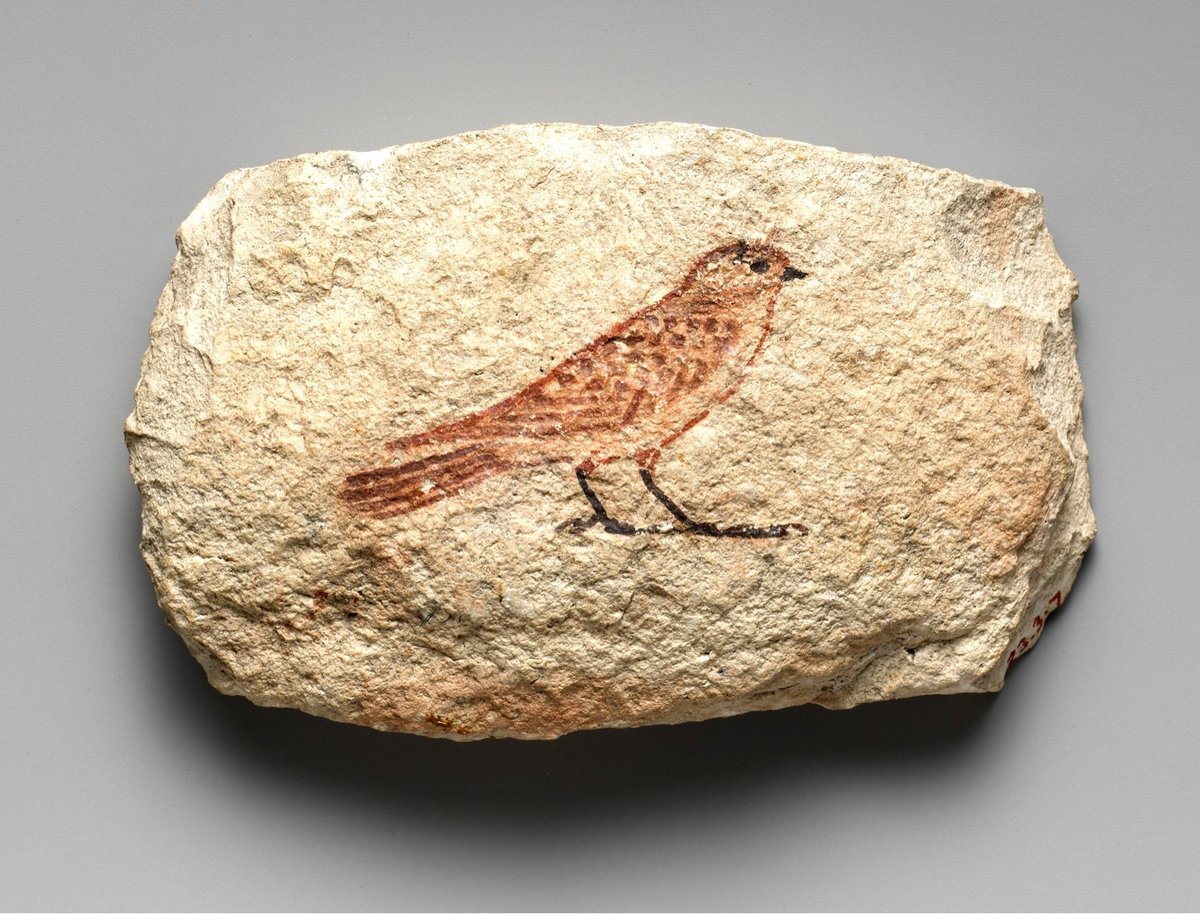
From the collection of the Met, an Egyptian artist’s sketch of a sparrow circa 1479–1458 BCE. Much of the art that filters down to us from ancient civilizations was used for official purposes (state, religion, commerce); it’s nice to see something simpler like this drawing. Archaeologist Alison Fisk:
This may have been a practice drawing of the sparrow hieroglyph which was used for words meaning ‘small’, ‘poor’, or ‘bad’
The Egyptian artisans who decorated tombs and temples, drew sketches and jotted down notes on the plentiful limestone flakes which were by-products of temple and rock-cut tomb construction. Egyptologists refer to them as ‘ostraca’ (singular: ostracon). More info: ancientegyptonline.co.uk/ostracon/
From that link about ostracon:
The word “ostracon” is derived from the Greek “ostrakon” (meaning a piece of pottery used as a voting ballot). When a vote was held on whether to banish a person from society these shards were used to cast votes. This is the origin of the word “ostracism” (literally meaning “to be voted out”).
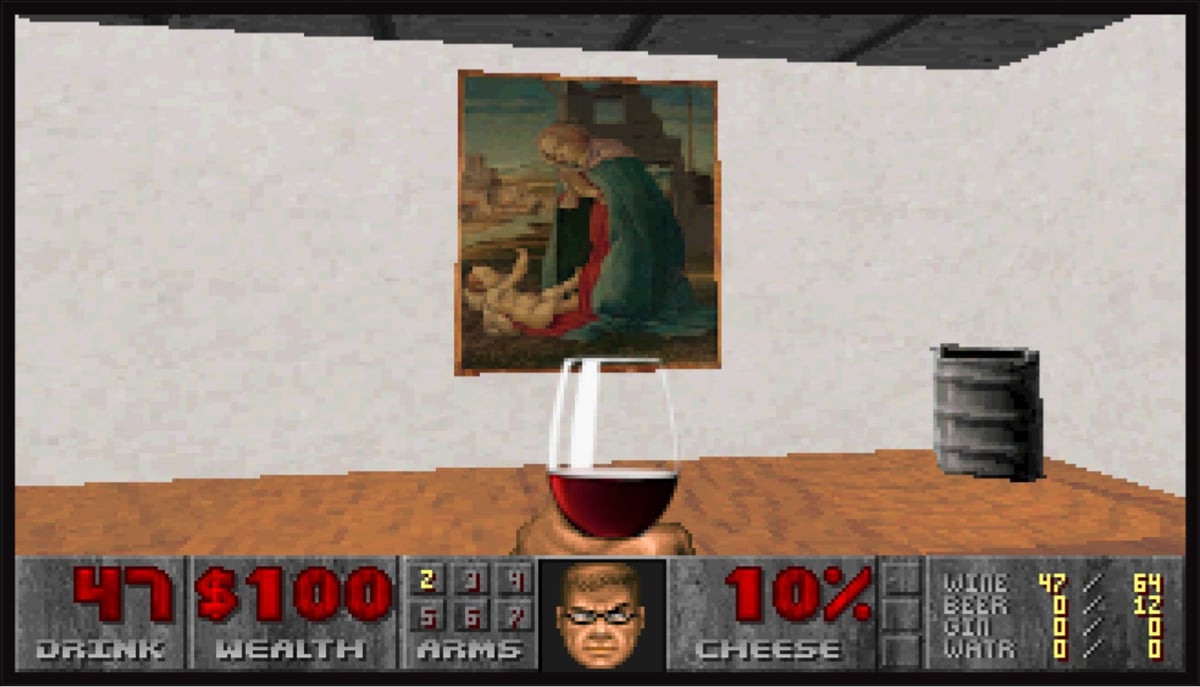
Have you ever wanted to browse art from the Metropolitan Museum in a first-person shooter interface? You are in luck because DOOM: The Gallery Experience exists.
DOOM: The Gallery Experience was created as an art piece designed to parody the wonderfully pretentious world of gallery openings.
In this experience, you will be able to walk around and appreciate some fine art while sipping some wine and enjoying the complimentary hors d’oeuvres in the beautifully renovated and re-imagined E1M1 of id Software’s DOOM (1993).
They sourced the art from the Met’s Open Access collection and in the game you can click through to see each piece on the Met’s website. Here’s a video of the gameplay:
And of course people are speedrunning it. (via waxy.org)
After leaving a job at The New Yorker in the wake of his older brother’s death, Patrick Bringley spent 10 years working as a guard at the Metropolitan Museum of Art in NYC. He wrote a book about his experience at the museum, All the Beauty in the World: The Metropolitan Museum of Art and Me (ebook). From a review at NPR:
In the wake of his 27-year-old brother Tom’s death from cancer in 2008, Bringley, two years his junior, gave up a prestigious “high-flying desk job” at The New Yorker, where “they told me I was ‘going places,’” for a job in which “I was happy to be going nowhere.” He explains, “I had lost someone. I did not wish to move on from that. In a sense I didn’t wish to move at all.”
Drawn to “the most straightforward job I could think of in the most beautiful place I knew” — a job that promised room to grieve and reflect in the wake of his loss — Bringley arrived at the Met in the fall of 2008. He explains his state of mind when he pivoted toward this union position for which he donned a cheap, blue, polyester uniform and received an allowance of $80 a year for socks: “My heart is full, my heart is breaking, and I badly want to stand still a while,” he writes.
From a piece in the New Yorker in which Bringley tours his old stomping grounds:
He answered an ad in the Times and went to an open house. “They tell you the hours” — for beginners, twelve hours on Fridays and Saturdays and eight hours on Sundays — “and half the people leave,” he recalled. After a week of training (“Protect life and property, in that order,” he was told), he joined the Met’s largest department: some five hundred guards, who work in rotating “platoons.” Bringley spent the next decade at the museum, and has now written a guard’s-eye memoir, “All the Beauty in the World,” detailing a job that is equal parts dreamy, dull, and pragmatic. “You can spend an hour deciding to learn about ancient Egypt, or look around at people and write a short story about one in your head,” he explained.
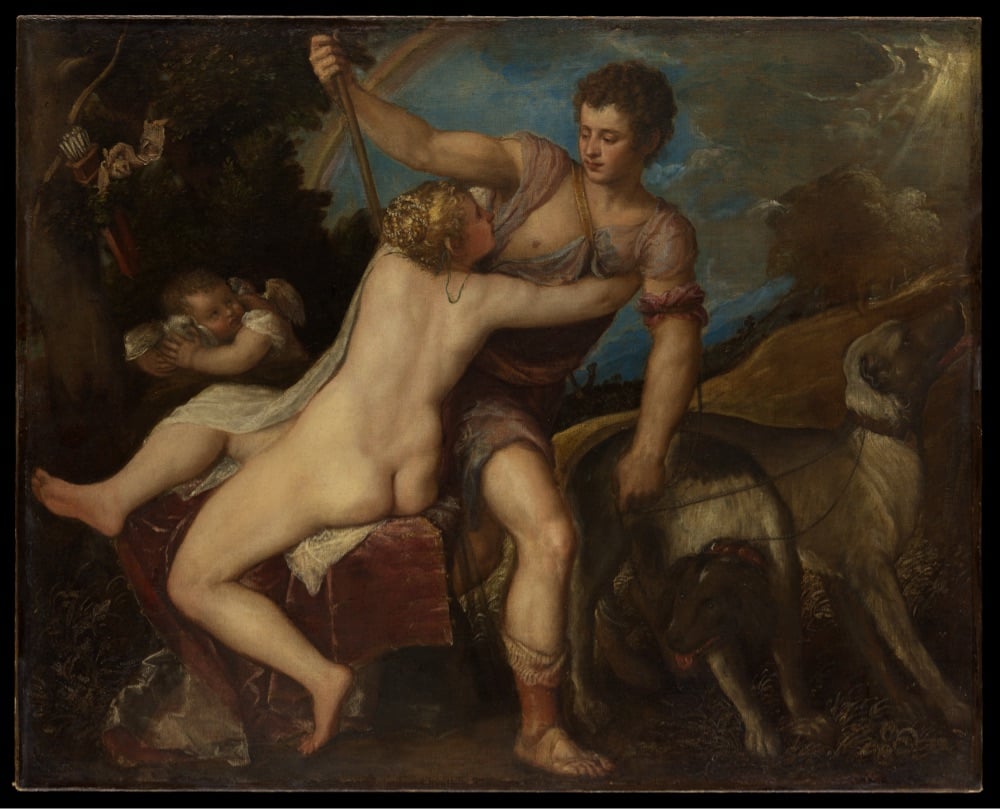
Bringley’s website has a page that lists all the art he mentions in the book, with links to each artwork on the Met’s website. I love this sort of thing from authors — it’s where I found the image at the top of the page: Titian’s Venus and Adonis. You can also book a tour of the museum with Bringley.
After months of lockdown and closure due to the pandemic, Desus Nice & The Kid Mero go to the Met Museum in NYC to take in some art. Would 100% take a tour of any art museum with these two astute cultural commentators.
The Met recently cleaned and repaired a 1660 painting by Charles Le Brun called Everhard Jabach and His Family. It took ten months of painstaking work, as this video shows:
Colossal has some before-and-after shots of the painting.
NYC’s Metropolitan Museum of Art has made a whopping 400,000 high-resolution digital images of its collection available for free download. You can browse the collection here.
In making the announcement, Mr. Campbell said: “Through this new, open-access policy, we join a growing number of museums that provide free access to images of art in the public domain. I am delighted that digital technology can open the doors to this trove of images from our encyclopedic collection.”
The Metropolitan Museum’s initiative-called Open Access for Scholarly Content (OASC)-provides access to images of art in its collection that the Museum believes to be in the public domain and free of other known restrictions; these images are now available for scholarly use in any media.
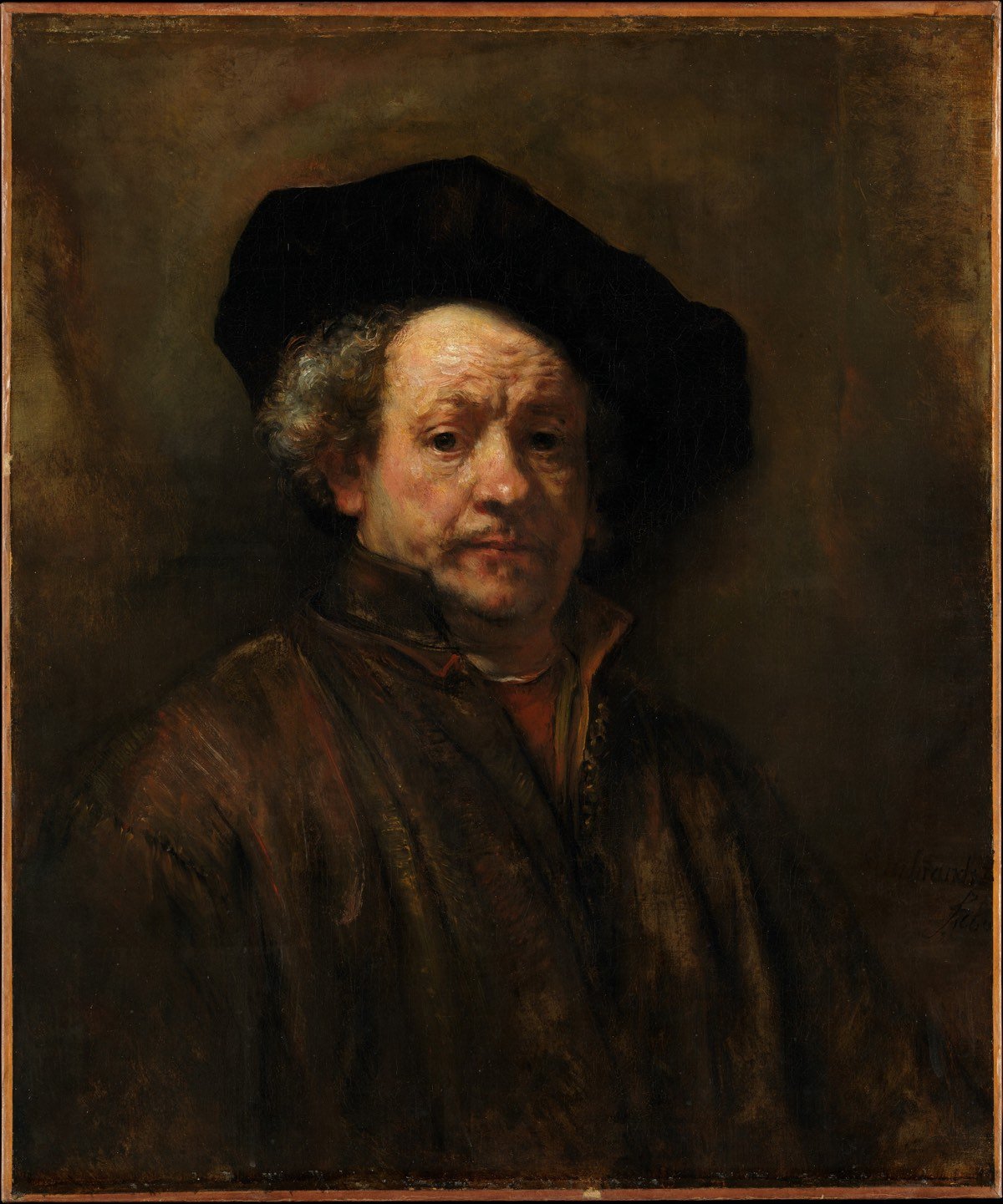
For instance, here’s a 12-megapixel image of Rembrandt’s 1660 self-portrait…you can see quite a bit of detail:
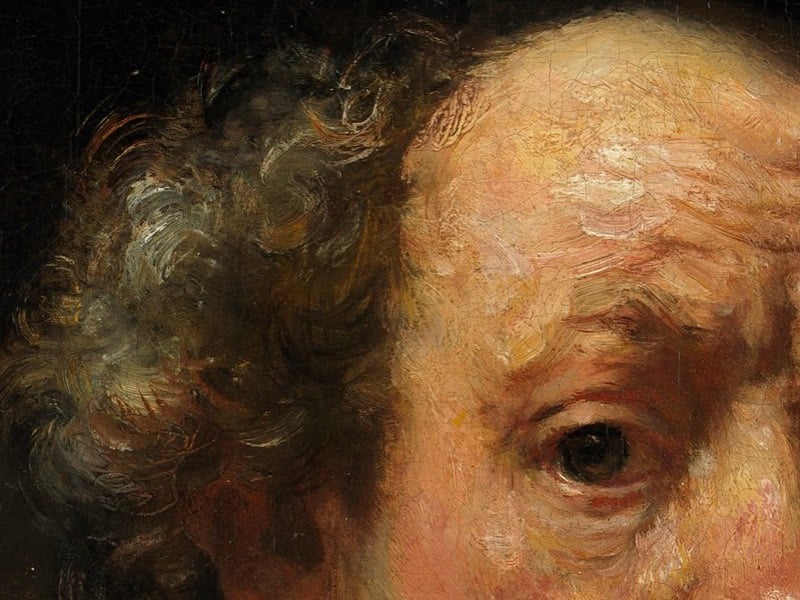
(thx, fiona)
Update: Wendy Macnaughton on why the high-resolution images released by the Met are such a big deal for art students and art history fans.
For someone who went to art school being able to do this is a revelation. I used to go to the museum with my sketchpad and copy the old masters. I’d get as close as I could to understand the brush strokes, colors, lines. The guards knew who to watch out for and would bark suddenly when we stuck our faces over the imaginary line.
As class assignments we were required to copy hundreds — literally hundreds — of the masters drawings and paintings. for those we mostly worked from images in books — a picture the size of a wallet photo.
Which is one of the many reasons this new met resource is fucking phenomenal.
You can get so, so close — far closer than one could in real life.
Update: Today (Feb 7, 2017) the Met announced that they’re releasing 375,000 images under Creative Commons’ CC0 license, which “allows anyone to use, re-use, and remix a work without restriction”. Previously, those works were restricted to non-commercial use only.
Museum Hack is offering non-traditional tours of the Metropolitan Museum of Art in NYC.
Join this “Museum Hack” tour to turn one of New York’s most spectacular cultural institutions into a totally unique experience. We will show you the very best and most intriguing that the Metropolitan Museum of Art has on display.
This is not a boring art history lecture. What we offer is a fun, group-oriented VIP tour experience. You will be entertained… and learn a bit along the way. We strive to offer a brand new view of the Met, one that you wouldn’t get by simply visiting the museum on your own.
Great idea. Museum Hack grew out of a smaller effort to Hack the Met.
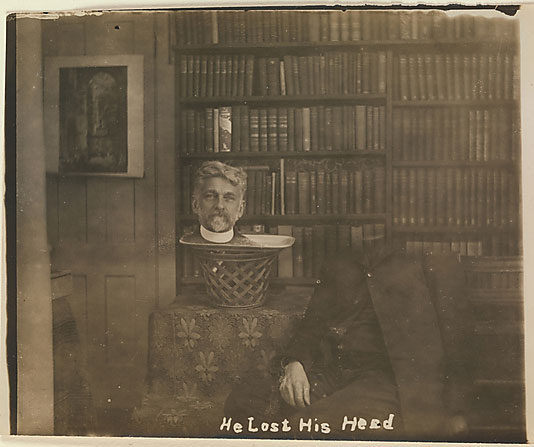
NYC’s Metropolitan Museum of Art has an exhibit running until January 27, 2013 featuring over 200 photos employing old timey trickery.
For early art photographers, the ultimate creativity lay not in the act of taking a photograph but in the subsequent transformation of the camera image into a hand-crafted picture.
Nipples at the Met is a photographic collection of all the nipples on display in the permanent collection at the Met Museum in NYC.

(via @claytoncubitt)
For their latest mission, Improv Everywhere got someone who looked very much like King Philip IV of Spain to sign autographs in front of a Velázquez painting of the monarch.
Everett Fahy, the former head of the European painting department at the Met, believes that one of the museum’s paintings by Francesco Granacci is actually by Michelangelo.
I believe Michelangelo painted it in 1506, two years before he started on the Sistine ceiling. It was already in my brain in 1971, the year after it was bought. When the Metropolitan showed it in 1971, I wrote for an exhibition called ‘Masterpieces of Fifty Centuries’ that the second panel recalled the figures in the Sistine Chapel. As years went by, it firmed up. I had long believed it to be by Michelangelo, but exactly when I don’t know. There wasn’t a moment when I suddenly said, ‘This is absolutely by Michelangelo.’ It was a gradual recognition.
One the clues Fahy used to make his determination involves the rocks in the painting; they resemble the quarry at which Michelangelo spent several months in 1497. The painting can be viewed larger on the Met’s website.
Diane Arbus’ archives were recently gifted to the Met in NYC.
Unlike the belongings of artists who fade gradually from view, which are sometimes scattered, pilfered or lost, Arbus’s effects were in some ways frozen in time when she committed suicide at 48. Quickly her life began to acquire a cult status paralleling that of her photography.
(via sippey)
A quick note about the Van Gogh show at the Met that’s closing at the end of the month: if you’re in NYC, go see it. Admittedly, I’m a fan of Van Gogh, but I thought this was one of the best museum exhibitions I’ve ever seen. The exhibition features drawings (as well as a few paintings) from his short 10-year career as an artist, and you can really see how much he progressed during that time and how much his drawings and paintings were related. I can’t wait to go back over to the MoMA and look at Starry Night and The Postman and view them not as paintings, but more as drawings done with paint.
Opening tomorrow at the Met Museum in NYC, an exhibition of drawings by Vincent van Gogh. October 18, 2005 through December 31, 2005.
Older posts




Socials & More