kottke.org posts about Mars
In a meditative video for the NY Times, Dennis Overbye takes us on a tour of eclipses that happen in our solar system and beyond.
On the 21st day of August, 2017, the moon will slide between the Earth and the sun, painting a swath of darkness across North America. The Great American Solar Eclipse. An exercise in cosmic geometry. A reminder that we live on one sphere among many, all moving to the laws of Kepler, Newton and Einstein.
Humans have many more vantage points from which to observe solar eclipses than when the last solar eclipse occurred in the US in 1979. I had no idea that the Mars rovers had caught partial solar eclipses on Mars…so cool. (via @jossfong)

NASA’s Opportunity rover started exploring the surface of Mars in January 2004. Its mission was supposed to last about 90 days, but over 13 years later, Opportunity is still rolling around the red planet, doing science and taking photos. Jason Major processed a few of Opportunity’s most recent snaps of the Endeavour Crater and they’re just wonderful. I’m especially taken with the one included above…it belongs in a museum!
Using real images of Mars taken by the HiRISE camera on the Mars Reconnaissance Orbiter, Jan Fröjdman created a 3D-rendered flyover of several areas of the planet’s surface.
In this film I have chosen some locations and processed the images into panning video clips. There is a feeling that you are flying above Mars looking down watching interesting locations on the planet. And there are really great places on Mars! I would love to see images taken by a landscape photographer on Mars, especially from the polar regions. But I’m afraid I won’t see that kind of images during my lifetime.
It has really been time-consuming making these panning clips. In my 3D-process I have manually hand-picked reference points on the anaglyph image pairs. For this film I have chosen more than 33.000 reference points! It took me 3 months of calendar time working with the project every now and then.
Watch this in the highest def you can muster…gorgeous.
Yesterday, Elon Musk shared SpaceX’s plan for colonizing Mars. Gizmodo has a good overview of the plan.
SpaceX plans to build a “self-sustaining city” on Mars, according to its founder Elon Musk. But, while we now know a lot more about how SpaceX plans to get to Mars, details about how people will actually survive up there remain sketchy.
Musk dropped the news on Tuesday during an address at the International Astronautical Congress meeting in Guadalajara, Mexico, where he had promised to reveal how the company planned to send people to live on Mars.
“I don’t have an immediate doomsday prophecy,” said Musk, but he noted that he saw only two possible paths forward. “One path is to stay on Earth forever, and there will be some extinction event. The alternative is to become a multi-planetary species, which I hope you will agree is the right way to go.”
Musk says that human flights to Mars could start as soon as 2023. So audacious, I love it. I am so rooting for him to pull this off.
Update: Wait But Why has a characteristically entertaining and informative piece about SpaceX’s Big Fucking Rocket.
“It’s so mind-blowing. It blows my mind, and I see it every week.”
Elon’s pumped. And when you learn about the big fucking rocket he’s building, you’ll understand why.
First, let’s absorb the challenge at hand. It’s often said that space is hard. To this day, only a few hundred people have been in space, only a few countries have the ability to launch something into space, and the history of human space travel is littered with tragic launch failures. Firing something super heavy and delicate and full of explosive liquid up through the atmosphere without anything going wrong is incredibly hard.
But when we talk about humans going into space, we’re talking mostly about humans going into Low Earth Orbit, a layer of space between 100 and 1,200 miles above the ground — and normally, they’re headed only 250 miles up to the International Space Station. The only time humans have gone farther were the small handful of Americans who made it out to the moon in the 1960s, traveling about 250,000 miles away.
When Earth and Mars are at their closest, Mars is somewhere between 34 and 60 million miles away — about 200 times farther away than the moon and about 200,000 times farther away than the ISS.
The moon is just over one light second away.
Mars is more than three light minutes away.
Mars is far.
While we’re on the subject, NASA announced late last week that they are extending the missions of nine spacecraft sprinkled about the solar system. Included are the New Horizon probe, which will wing off to study an object in the Kuiper Belt after doing so well with Pluto and the rover Opportunity, which was slated for a mission lasting just over 90 days but has now spent more than 12 years exploring the surface of Mars.
The Dawn mission to Ceres is another spacecraft whose duration has been extended, beating long odds. Part of the spacecraft’s functionality had not been working for some time, but was recently repaired.
It was a bit unexpected because Dawn is low on fuel. “Less than a year ago, I would have thought it was ridiculous that the spacecraft would even be operating at this point,” said Marc D. Rayman, the chief engineer for the Dawn mission.
The Dawn spacecraft was designed to use four spinning wheels to pivot in different directions. But at its previous destination, the asteroid Vesta, two of the four wheels overheated and failed. At Ceres, the wheels stayed off, and the spacecraft used its thrusters instead to pivot.
In December, Dawn reached its lowest orbit, just 240 miles above Ceres. Dr. Rayman said he and his team had expected Dawn to exhaust its remaining propellant by March.
But they spun up the wheels again. That succeeded, cutting the use of the thrusters. “It all worked out beautifully,” Dr. Rayman said. That left enough fuel to contemplate doing something more.
When the Curiosity rover landed on the surface of Mars, it took high-resolution photos all the way down. Luke Fitch took those photos and stitched them together into a first-person HD video of the rover’s landing.
Update: I was wondering if someone had done a stabilized version of this video and lo:
(via @willhains)
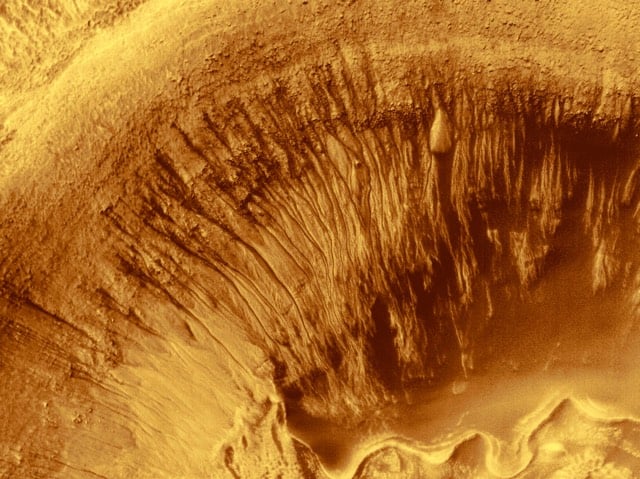
NASA’s press conference doesn’t start for a few minutes yet, but the NY Times has the scoop: NASA has found “definitive signs” of liquid water on the surface of Mars. Like, right now on Mars, not millions of years ago.
In a paper published in the journal Nature Geoscience, Dr. McEwen and other scientists identified waterlogged molecules — salts of a type known as perchlorates - in readings from orbit.
“That’s a direct detection of water in the form of hydration of salts,” Dr. McEwen said. “There pretty much has to have been liquid water recently present to produce the hydrated salt.”
By “recently,” Dr. McEwen said he meant “days, something of that order.”
This is fantastic timing for the release of The Martian movie, which comes out this weekend.
Update: And here’s the official press release from NASA.
“Our quest on Mars has been to ‘follow the water,’ in our search for life in the universe, and now we have convincing science that validates what we’ve long suspected,” said John Grunsfeld, astronaut and associate administrator of NASA’s Science Mission Directorate in Washington. “This is a significant development, as it appears to confirm that water — albeit briny — is flowing today on the surface of Mars.”
These downhill flows, known as recurring slope lineae (RSL), often have been described as possibly related to liquid water. The new findings of hydrated salts on the slopes point to what that relationship may be to these dark features. The hydrated salts would lower the freezing point of a liquid brine, just as salt on roads here on Earth causes ice and snow to melt more rapidly. Scientists say it’s likely a shallow subsurface flow, with enough water wicking to the surface to explain the darkening.

What are you doing today Jason? Oh not much just exploring Mars. The hell you say. Like fun I am! NASA has released a pair of web apps: one lets you drive Curiosity around the surface of Mars and the other is a 3D visualization of the planet. Oh cool that’s what I’m doing today now too. And when you’re done with that, follow NASA’s new Tumblr. Far out man.
Unlike the Earth, Mars and the Moon don’t have strong directional magnetic fields, which means traditional compasses don’t work. So how did the Apollo rovers and current Mars rovers navigate their way around? By using manually set directional gyroscope and wheel odometers.
While current un-crewed rovers don’t have to return to the comfort of a lunar module, some aspects of the Apollo systems live on in their design. Four U.S. Martian rovers have used wheel odometers that account for slippage to calculate distance traveled. They’ve also employed gyroscopes (in the form of an inertial measurement units) to determine heading and pitch/roll information.
One of the fun things about reading The Martian is you get to learn a little bit about this sort of thing. Here’s a passage about navigation on Mars where astronaut Mark Watney is trying to get to a landmark several days’ drive away.
Navigation is tricky.
The Hab’s nav beacon only reaches 40 kilometers, so it’s useless to me out here. I knew that’d be an issue when I was planning this little road trip, so I came up with a brilliant plan that didn’t work.
The computer has detailed maps, so I figured I could navigate by landmarks. I was wrong. Turns out you can’t navigate by landmarks if you can’t find any god damned landmarks.
Our landing site is at the delta of a long-gone river . NASA chose it because if there are any microscopic fossils to be had, it’s a good place to look. Also, the water would have dragged rock and soil samples from thousands of kilometers away. With some digging, we could get a broad geological history.
That’s great for science, but it means the Hab’s in a featureless wasteland.
I considered making a compass. The rover has plenty of electricity, and the med kit has a needle. Only one problem: Mars doesn’t have a magnetic field.
So I navigate by Phobos. It whips around Mars so fast it actually rises and sets twice a day, running west to east. It isn’t the most accurate system, but it works.
I wonder why the rovers in the story weren’t outfitted with directional gyroscopes and wheel odometers? (See also the operations manual for the lunar rovers.) (via @JaredCrookston)
Whilst roving about Mars, Curiosity has slowly but surely racked up evidence for a past Mars that was warm, wet, and possibly habitable.
John P. Grotzinger of Caltech, the project scientist for the mission, reported at a news conference on Monday that the rover’s yearlong trek to Mount Sharp provided strong new evidence that Gale Crater had large lakes, rivers and deltas, on and off, for millions to tens of millions of years. The geology shows that even when the surface water dried up, plenty of water would have remained underground, he said.
Moreover, the team concluded, numerous deltalike and lakelike formations detected by orbiting satellites are almost certainly the dried remains of substantial ancient lakes and deltas. None of this proves that life existed on the planet, but the case for an early Mars that was ripe and ready for life has grown stronger.
“As a science team, Mars is looking very attractive to us as a habitable planet,” Dr. Grotzinger said in an interview. “Not just sections of Gale Crater and not just a handful of locations, but at different times around the globe.”
See also the interactive 28 Months on Mars.
Update: And right on cue, Curiosity has recorded a two-month-long methane burst on Mars. One explanation for the methane is that it’s a waste product of living organisms.
The presence of methane is significant because the gas cannot exist for long. Calculations indicate that sunlight and chemical reactions in the Martian atmosphere would break up the molecules within a few hundred years, so any methane there now must have been created recently.
It could have been created by a geological process known as serpentinization, which requires both heat and liquid water. Or it could be a product of life in the form of microbes known as methanogens, which release methane as a waste product.
Even if the explanation for the methane turns out to be geological, the hydrothermal systems would still be prime locations to search for signs of life.
Update: And now Curiosity has found “biologically useful nitrogen” on Mars.
There is no evidence to suggest that the fixed nitrogen molecules found by the team were created by life. The surface of Mars is inhospitable for known forms of life. Instead, the team thinks the nitrates are ancient, and likely came from non-biological processes like meteorite impacts and lightning in Mars’ distant past.
Features resembling dry riverbeds and the discovery of minerals that form only in the presence of liquid water suggest that Mars was more hospitable in the remote past. The Curiosity team has found evidence that other ingredients needed for life, such as liquid water and organic matter, were present on Mars at the Curiosity site in Gale Crater billions of years ago.
“Finding a biochemically accessible form of nitrogen is more support for the ancient Martian environment at Gale Crater being habitable,” said Jennifer Stern of NASA’s Goddard Space Flight Center in Greenbelt, Maryland.
Update: The analysis of a year of weather and soil data collected by Curiosity indicates that a small amount of liquid water could exist below the surface of Mars.
Martian weather and soil conditions that NASA’s Curiosity rover has measured, together with a type of salt found in Martian soil, could put liquid brine in the soil at night.
Perchlorate identified in Martian soil by the Curiosity mission, and previously by NASA’s Phoenix Mars Lander mission, has properties of absorbing water vapor from the atmosphere and lowering the freezing temperature of water. This has been proposed for years as a mechanism for possible existence of transient liquid brines at higher latitudes on modern Mars, despite the Red Planet’s cold and dry conditions.
New calculations were based on more than a full Mars year of temperature and humidity measurements by Curiosity. They indicate that conditions at the rover’s near-equatorial location were favorable for small quantities of brine to form during some nights throughout the year, drying out again after sunrise. Conditions should be even more favorable at higher latitudes, where colder temperatures and more water vapor can result in higher relative humidity more often.
The Guardian and other media outlets have translated this news into Nasa’s Curiosity rover finds water below surface of Mars even though NASA’s release clearly states “we have not detected brines”. Come on, guys.
A weight-loss doctor from Indiana owns a surprising number of the world’s known meteorites, including about 2/3s of an unusual Martian meteorite called Black Beauty, which is valued at more than $10,000 per gram.
There is one diva in particular that I’m here to pay homage to: Black Beauty, a shiny, scaly-skinned, 4.4-billion-year-old rock from Mars. It began its journey to Earth more than 5 million years ago, about the time humans and chimpanzees were splitting from a common ancestor. That is when an asteroid struck Mars, catapulting the rock into space. Sometime in the last thousand years or so, orbital mechanics and gravity delivered the wandering rock to Earth. Surviving an incendiary plunge through the atmosphere, it landed in more than a dozen pieces in the western Sahara. There the fragments sat, untouched except by wind and sand. Finally, a nomad plucked a piece from the dunes. After passing through the hands of several Moroccan middlemen, the first piece wound up in Piatek’s hands in 2011. He would acquire nine more.
Black Beauty has since set the collecting world on fire, reaching values of more than $10,000 per gram. (Gold trades for $40 per gram.) The price is in no small part due to the parade of scientific discoveries emerging from the rock’s jumbled-up guts. It is the oldest rock from Mars and chock-full of the planet’s primordial water. Most intriguing of all, it appears to be the first martian meteorite made of sediment, deposited by wind or water. That makes Black Beauty not only a cosmic blessing-sedimentary rocks are fragile and thought unlikely to survive interplanetary launches-but also a boon for astrobiologists. “If you’re going to look for life, you want a sedimentary rock,” says Munir Humayun, a meteoriticist at Florida State University in Tallahassee who led a study that last year pinpointed the rock’s age.
It can be difficult to understand how large (or small) astronomical objects are, so here are some handy comparisons to things on Earth. Here’s the size of Mars compared to the United States & Canada:

And here’s a neutron star nestled next to Liverpool on the northwest coast of England:
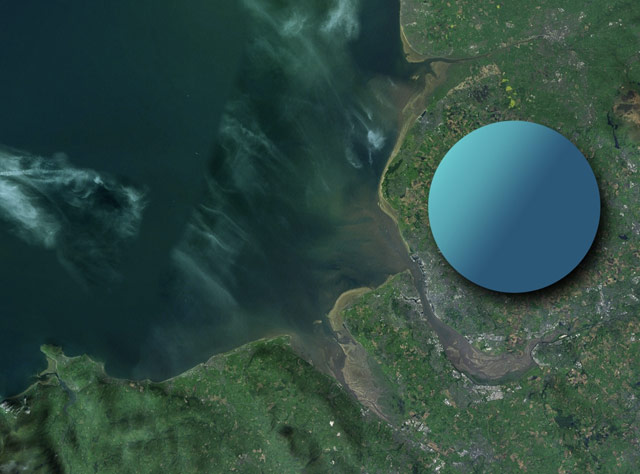
A neutron star also crams in over 1.5 times the mass of the Sun into a tiny ball maybe not much bigger than your daily commute to work, and the Sun is huge (see the size of the Sun later). So this thing is incredibly dense, so dense in fact that just a tea spoon of it would weigh over a billion tonnes, and if you could stand on its surface you’d feel the gravitational pull of 200 billion times that of our planet…not that you’d ever survive it of course.
(via @theclintmcleod)
If there wasn’t life on Mars before, there might be now. Before NASA sent Curiosity to Mars, it was thoroughly cleaned of all traces of contaminants. But swabs of rover’s surfaces taken before it was sent to Mars have revealed 377 different strains of bacteria that potentially could have made the trip. Some of them may have even survived.
A study that identified 377 strains found that a surprising number resist extreme temperatures and damage caused by ultraviolet-C radiation, the most potentially harmful type. The results, presented today at the annual meeting of the American Society for Microbiology, are a first step towards elucidating how certain bacteria might survive decontamination and space flight.
Great article by Burkhard Bilger about NASA’s Curiosity mission to Mars.
The search for life on Mars is now in its sixth decade. Forty spacecraft have been sent there, and not one has found a single fossil or living thing. The closer we look, the more hostile the planet seems: parched and frozen in every season, its atmosphere inert and murderously thin, its surface scoured by solar winds. By the time Earth took its first breath three billion years ago, geologists now believe, Mars had been suffocating for a billion years. The air had thinned and rivers evaporated; dust storms swept up and ice caps seized what was left of the water. The Great Desiccation Event, as it’s sometimes called, is even more of a mystery than the Great Oxygenation on Earth. We know only this: one planet lived and the other died. One turned green, the other red.
Perfect read if you’ve been curious about what Curiosity is up to on Mars but needed something a bit more narrative than the mission home page or Wikipedia page to guide you. Also features the phrase “a self-eating watermelon of despair”, so there’s that. Oh, and here’s the Seven Minutes of Terror video referred to in the story.
Newer posts
Older posts





Socials & More