kottke.org posts about Harry Potter
The most teasing of teaser trailers is out for Fantastic Beasts and Where to Find Them, the Harry Potter prequel that everyone insists isn’t a prequel. Out November 2016. (via trailer town)
Update: Toooootally a prequel…Dumbledore gets name-dropped in this one:
Update: The full trailer has been released:
Everyone knows that The Karate Kid is the story of Daniel LaRusso, an undersized new-kid-in-school who, with the help of a wise mentor and unconventional training in the martial arts, is able to triumph over a gang of bullies picking on him. What this video presupposes is, maybe Daniel is the real bully?
To no one’s surprise, Johnny advances to the final round and karma catches up with Daniel when his leg is injured by the boy he wantonly attacked on the soccer field. However, just as Johnny is about to be awarded his trophy, Daniel is granted unnatural strength by the demon sorcerer Miyagi, enabling him to defeat Johnny and win the tournament in an upset.
See also more revisionist history of beloved media: Hermione Granger as the real hero of the Harry Potter books and Tim Carmody’s The Iceman List, which is about “classic movie antagonists who were actually pretty much right all along”.
Update: Another one to add to the list: Ross Geller is the hero of Friends, an intellectual and romantic man who is brought low by his so-called friends:
But the characters of the show were pitted against him from the beginning (consider episode 1, when Joey says of Ross: “This guy says hello, I wanna kill myself.”) In fact, any time Ross would say anything about his interests, his studies, his ideas, whenever he was mid-sentence, one of his “friends” was sure to groan and say how boring Ross was, how stupid it is to be smart, and that nobody cares. Cue the laughter of the live studio audience. This gag went on, pretty much every episode, for 10 seasons. Can you blame Ross for going crazy?
And like a Greek tragedy, our hero is caught in a prophecy that cannot be avoided. The show’s producers, akin to the immutable voice of the gods, declared that Ross must end up with Rachel, the one who shops. Honestly, I think he could’ve done better.
This is an interesting theory about the Harry Potter series: the whole thing is about a mentally ill young boy (Harry) who is institutionalized by his parents (the Dursleys) in a mental institution (Hogwarts) and the contents of the books are Harry’s fantasy.
In the Harry Potter series, his parents are famous wizards, who were famous in all the world for their unparalleled love for the boy Harry, which set the whole series in motion, killing them and leaving the boy a scarred orphan. (This is a fantasy, crafted as the direct opposite of the way in which children usually end up scarred — through abuse and neglect.)
If we interpret the story as Harry’s fantasy, then the Dursleys are Harry’s real parents, and the Potters are imaginary. The Durselys either can’t cope with the increasingly-delusional boy living with them, or perhaps they are merely abusive, and it’s the abuse that’s making him delusional. In any event, the parent-figures constantly mistreat him, favor the brother, and inflict endless cruelty and humiliation on him. One day, Harry snaps, and Dudley (who is really Harry’s brother) is severely injured, in a way requiring repeated hospital treatments. (In the delusion, Harry imagines that a pig’s tail is magically grown from Dudley’s buttocks.) As a result of this incident, Harry is taken away to a “special school.”
In order to keep the Harry Potter gravy train going, Scholastic and Bloomsbury are releasing a fully illustrated version of each of the seven Harry Potter books over the next seven years. Here’s the cover for Harry Potter and the Sorcerer’s Stone:
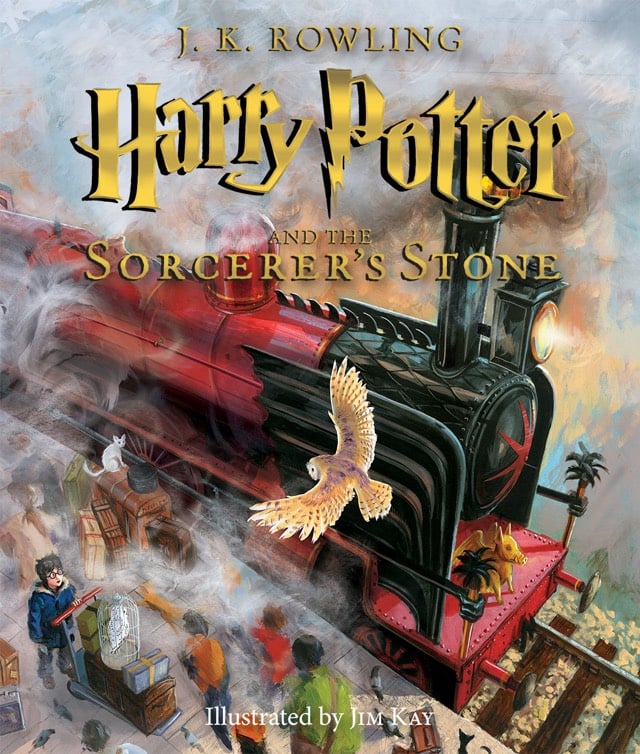
The book will contain 100+ full-color illustrations done by Jim Kay. (via buzzfeed)
Along with imagining Mary Poppins as one of Doctor Who’s Time Lords, one of my favorite literary alternate realities is imagining Hermione Granger as the main character of the Harry Potter books. In 2011, Sady Doyle wrote a review of the books as if Rowling had focused on Hermione.
In Hermione, Joanne Rowling undermines all of the cliches that we have come to expect in our mythic heroes. It’s easy to imagine Hermione’s origin story as some warmed-over Star Wars claptrap, with tragically missing parents and unsatisfying parental substitutes and a realization that she belongs to a hidden order, with wondrous (and unsettlingly genetic) gifts. But, no: Hermione’s normal parents are her normal parents. She just so happens to be gifted. Being special, Rowling tells us, isn’t about where you come from; it’s about what you can do, if you put your mind to it. And what Hermione can do, when she puts her mind to it, is magic.
Ditto for the whole “Chosen One” thing. Look: I’ve enjoyed stories that relied on a “Chosen One” mythology to convince us that the hero is worth our time. I liked Buffy the Vampire Slayer as much as anyone. But it’s hard to deny that “Chosen Ones” are lazy writing. Why is this person the hero? Because everyone says he’s the hero. Why does everyone say he’s the hero? Because everyone says so, shut up, there’s magic.
And more recently, Daniel Dalton had a more overtly feminist and humorous take.
It was clear that she was the one who was protecting Harry and Ron, and this was never more evident than when she revealed she could control time.
She’d been using her Time-Turner to attend twice the number of classes, but she agreed to use it to help Harry save his godfather, even though it meant she’d never be able to use it again.
She’d given up her greatest power for her best friend, because helping people made her feel good.
And though she hoped he understood the sacrifice she was making by letting her education slide, she knew he didn’t. Because men.
Over the past year or so, I’ve been rereading the books and rewatching the movies with my kids through the Hermione-as-hero lens. And I’ve noticed that even without altering the story as Doyle and Dalton do, Hermione is by far the smartest, most loyal, and bravest young witch or wizard at Hogwarts. Harry has his moments but the kid had a rough and abusive childhood and so his principal talent is getting angry and doing stupid impulsive shit. Mainly, he’s manipulated by Voldemort and Dumbledore into doing exactly what they want him to do, and he plays the part splendidly. On the other hand, Hermione is an amazing witch and has a real choice as to how she wants to apply her considerable talents. And she chooses goodness, friendship, and doing the right thing over comfort, power, and even her own family, every time. (via @djacobs)
Some recent studies suggest that reading Harry Potter may make kids nicer people.
As the familiar story goes, not long ago there was an orphan who on his 11th birthday discovered he had a gift that set him apart from his preteen peers. Over the years he endured the usual adolescent challenges — maturation, relationships, social conflicts, general teenage neuroses. He also faced the less common challenge of battling a murderous, psychopathic wizard set on establishing a eugenic police state. I’m referring to the young wizard Harry Potter, the bespeckled, morally-upright protagonist in author JK Rowling’s wildly popular fantasy book series; his nemesis is Lord Voldemort, the story’s malevolent antagonist. And, while it might sound far-fetched, new research suggests that Rowling’s world of house-elves, half-giants and three-headed dogs has the potential to make us nicer people.
I’ve been reading Harry Potter with the kids for awhile now. We’re almost finished with The Prisoner of Azkaban. One of my favorite parts of reading it with them is when they’re confused about a situation or a particular word and we get to have a conversation. While reading Chamber of Secrets, we talked about mudbloods, prejudice, and fascism. We’ve talked about good and evil and how many of the books’ characters actually possess both good and not-so-good qualities. More recently, we talked about bravery and cowardice in the context of being a friend and how even Neville, who seems frightened of everything, is a brave and true friend for trying to stop Hermione, Ron, and Harry from leaving the Gryffindor common room in search of the Sorcerer’s Stone. I don’t know if they’re better people for it, but I value the chance to have those conversations with them about something they’re really into.
In a piece for the Pottermore web site, JK Rowling writes an update on how the gang from the Harry Potter books is doing. The piece is an account of the Quidditch World Cup Final written by Rita Skeeter, the gossip columnist from the books. You need a login to read it on Pottermore, but someone uploaded it to Reddit as well.
The Potter family and the rest of Dumbledore’s Army have been given accommodation in the VIP section of the campsite, which is protected by heavy charms and patrolled by Security Warlocks. Their presence has ensured large crowds along the cordoned area, all hoping for a glimpse of their heroes. At 3pm today they got their wish when, to the accompaniment of loud screams, Potter took his young sons James and Albus to visit the players’ compound, where he introduced them to Bulgarian Seeker Viktor Krum.
About to turn 34, there are a couple of threads of silver in the famous Auror’s black hair, but he continues to wear the distinctive round glasses that some might say are better suited to a style-deficient twelve-year-old. The famous lightning scar has company: Potter is sporting a nasty cut over his right cheekbone. Requests for information as to its provenance merely produced the usual response from the Ministry of Magic: ‘We do not comment on the top secret work of the Auror department, as we have told you no less than 514 times, Ms. Skeeter.’ So what are they hiding? Is the Chosen One embroiled in fresh mysteries that will one day explode upon us all, plunging us into a new age of terror and mayhem?
That last line is one of a few references to possible new stories in the piece…the last paragraph mentions a new biography of Harry and his pals due out at the end of this month:
And for those who want to know exactly how imperfect they are, my new biography: Dumbledore’s Army: The Dark Side of the Demob will be available from Flourish and Blotts on July 31st.
Could Rowling be setting the stage for an eighth Potter book or is she just winding us up?
What if Ayn Rand had written Harry Potter? It might go a little something like this.
Professor Snape stood at the front of the room, sort of Jewishly. “There will be no foolish wand-waving or silly incantations in this class. As such, I don’t expect many of you to appreciate the subtle science and exact art that is potion-making. However, for those select few who possess, the predisposition…I can teach you how to bewitch the mind and ensnare the senses. I can tell you how to bottle fame, brew glory, and even put a stopper in death.”
Harry’s hand shot up.
“What is it, Potter?” Snape asked, irritated.
“What’s the value of these potions on the open market?”
“What?”
“Why are you teaching children how to make these valuable products for ourselves at a schoolteacher’s salary instead of creating products to meet modern demand?”
“You impertinent boy-“
“Conversely, what’s to stop me from selling these potions myself after you teach us how to master them?”
“I-“
“This is really more of a question for the Economics of Potion-Making, I guess. What time are econ lessons here?”
“We have no economics lessons in this school, you ridiculous boy.”
Harry Potter stood up bravely. “We do now. Come with me if you want to learn about market forces!”
The students poured into the hallway after him. They had a leader at last.
I have to admit, this alternate Harry Potter ending would have been pretty great.
Harry Potter would, forever, be The Boy Who Lived.
Earlier this year, Hogwarts School of Witchcraft and Wizardry was subjected to a review by the Board of Education and was found wanting in several areas.
Pupils at Hogwarts have access to a reasonably wide range of esoteric qualifications, suited to its key demographic. As an independent school, it does not have to follow the National Curriculum closely; however, it is disappointing to note that basic requirements such as English, Mathematics and Religious Education are all lacking or entirely missing from the school’s syllabus. This has had adverse effects on all students, many of whom have never even been taught basic KS1 or 2 literacy. A few students have attended state or independent primary schools, and these students typically perform very well in contrast to their peers.
The majority of students appear to be under-performing, with most pupils struggling in all their lessons, most of which appear to be set at too challenging a level. One particular class, which seemed to be based on A-Level chemistry, proved too difficult for even the most proficient students. Only one pupil managed to complete the lesson objectives, mainly thanks to his use of an annotated text book.
(via slate)
Well, sort of. Rowling is writing a screenplay for Warner Bros. based on a Hogwart’s textbook called Fantastic Beasts and Where to Find Them.
Although it will be set in the worldwide community of witches and wizards where I was so happy for seventeen years, ‘Fantastic Beasts and Where to Find Them’ is neither a prequel nor a sequel to the Harry Potter series, but an extension of the wizarding world. The laws and customs of the hidden magical society will be familiar to anyone who has read the Harry Potter books or seen the films, but Newt’s story will start in New York, seventy years before Harry’s gets underway.
On the eve of the release of her first novel specifically written for adult readers, Ian Parker profiles J.K. Rowling for the New Yorker. In many ways, this passage about Harry Potter sums up Parker’s take on Rowling herself:
For all the satisfying closure provided by “Harry Potter and the Deathly Hallows,” gloomier readers may still detect a note of melancholy; there is a narrowness of life for former Hogwarts students, whose career opportunities barely extend beyond the wizard civil service, wizard schoolteaching, and professional Quidditch. This magical society has no use for science; there’s little commerce; and thousands of years of wizarding seems to have generated no culture beyond a short volume of fables and a tabloid newspaper. (Wizard technology is often a cutely flawed approximation of non-wizard technology — owls for e-mail — and one wonders how quickly Harry and his schoolfriends could have won their battles against the evil Lord Voldemort, given two or three cell phones and a gun.) In a time of wizard peace, at least, Harry’s separation from the real world — even as he lives in it — can seem tragic.
In a time of personal prosperity, Rowling’s separation from the real world — even as she lives in it — can seem tragic.
From Sady Doyle, an alternate history of the Harry Potter series if Rowling would have written the books from the perspective of Hermione Granger.
So, before she goes away for good, let us sing the praises of Hermione. A generation could not have asked for a better role model. Looking back over the series — from Hermione Granger and the Philosopher’s Stone through to Hermione Granger and the Deathly Hallows — the startling thing about it is how original it is. It’s what inspires your respect for Rowling: She could only have written the Hermione Granger by refusing to take the easy way out.
For starters, she gave us a female lead. As difficult as it is to imagine, Rowling was pressured to revise her initial drafts to make the lead wizard male. “More universal,” they said. “Nobody’s going to follow a female character for 4,000 pages,” they said. “Girls don’t buy books,” they said, “and boys won’t buy books about them.” But Rowling proved them wrong. She was even asked to hide her own gender, and to publish her books under a pen name, so that children wouldn’t run screaming at the thought of reading something by a lady. But Joanne Rowling never bowed to the forces of crass commercialism. She will forever be “Joanne Rowling,” and the Hermione Granger series will always be Hermione’s show.
Worknik has a fun post up about the language of the Harry Potter books & movies.
Characters’ names are often also common words. A dumbledore is a bumblebee. Snape is a ship-building term that means “to bevel the end of (a timber or plank) so that it will fit accurately upon an inclined surface.” Hagrid is the past participle of hagride, which means “to harass or torment by dread or nightmares.” Skeeter is a term for an annoying pest, and not just Rita Skeeter, blood-sucking journalist. Mundungus is “waste animal product” or “poor-quality tobacco with a foul, rancid, or putrid smell,” a good name for a sneaky thief.
(via @djacobs)
If you’re headed out to see the final Potter movie this weekend, here’s a recap of the previous seven films in just seven minutes:
Newer posts
Older posts


Socials & More