




This Is Us
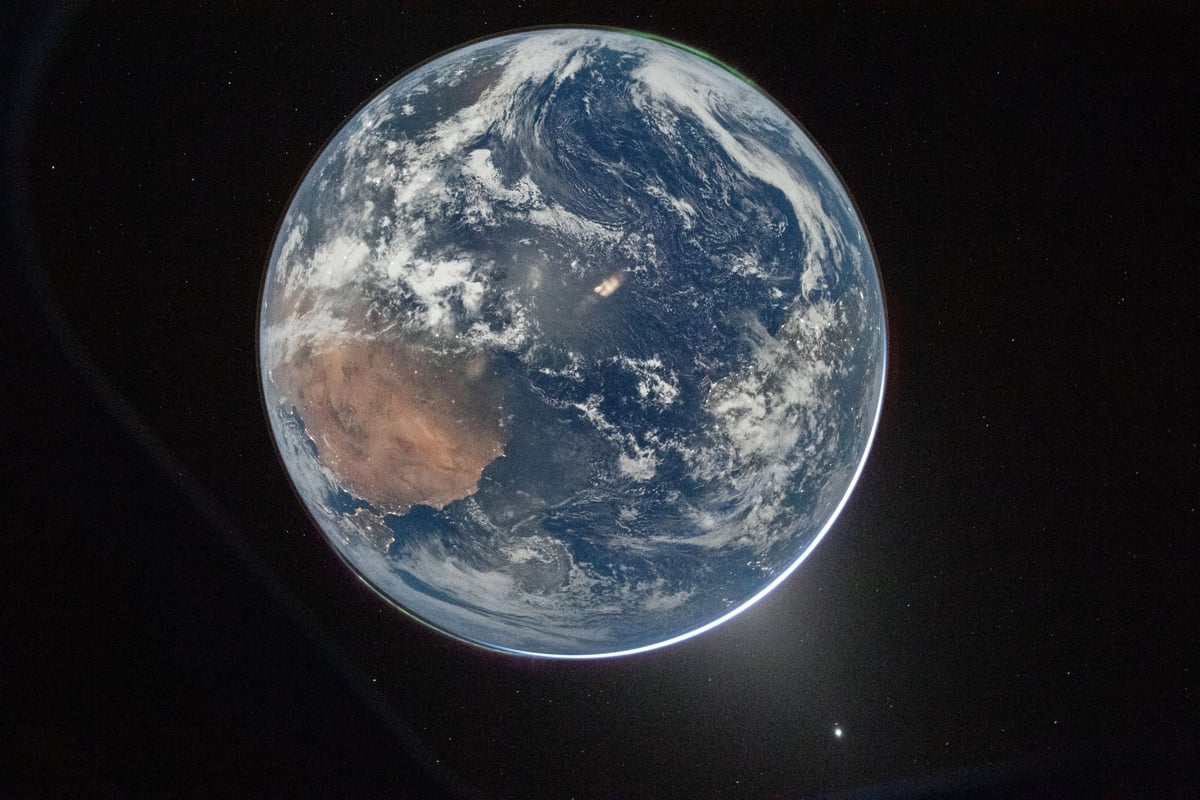
The commander of NASA’s Artemis II mission to the Moon, Reid Wiseman, took this photo of the Earth as the spacecraft speeds away our planet.
There are two auroras (top right and bottom left) and zodiacal light (bottom right) is visible as the Earth eclipses the Sun.
That is so cool. Worth clicking through to see the high-resolution image.
Comments 7
thread
latest
popular
The photo's metadata reveals it was taken with a Nikon D5, focal length of 22mm, aperture of f/4, and an exposure time of 1/4 sec. Since the Earth is eclipsing the Sun, the photo shows the dark side of the Earth. The noise in the original image, the long-ish exposure time (you can see the stars in the image as well), and the absence of direct sunlight suggests the photo was taken using the light of the Moon (i.e. reflected sunlight). Amaze!
It's shot at ISO 51200, which surely makes all the photo nerds cringe.
More to see in that image:
* Aurora Australis (bright green, upper right) & Aurora Borealis (plane green, lower left) visible as faint streaks
* The bright dot in the lower right is Venus
* The white haze in the lower right is zodiacal light: dust in the plane of the Solar System lit by sunlight
Dammit! I had my eyes closed.
If that is Spain and Africa in the lower left, I find myself wondering whether the shot is upside down. Or maybe the astronauts were. Or, more likely, I am missing something.
"Upside down" is an interesting concept in this context.
https://petapixel.com/2026/02/24/artemis-ii-astronauts-will-bring-10-year-old-dslrs-with-them-to-the-moon/
If you feel like this comment goes against the grain of the community guidelines or is otherwise inappropriate, please let me know and I will take a look at it.
In order to comment or fave, you need to be a kottke.org member. Check out your membership options.
Note: If you are a member and tried to log in, it didn't work, and now you're stuck in a neverending login loop of death, try disabling any ad blockers or extensions. Or try logging out and then back in. Still having trouble? Email me!