




This site is made possible by member support. 💞
Big thanks to Arcustech for hosting the site and offering amazing tech support.
When you buy through links on kottke.org, I may earn an affiliate commission. Thanks for supporting the site!
kottke.org. home of fine hypertext products since 1998.
Beloved by 86.47% of the web.
Entries for May 2019
Tactical Driving Looks Fun (But Don’t Try This at Home)
Wyatt Knox is a former rally car driver and driving instructor at Team O’Neil Rally School and in this video, he shows us some of the tactical driving techniques that would be in the repetoire of law enforcement or special operations personnel, including running cars off the road, backing up at high speed, and doing a j-turn. (What’s a j-turn? It’s that cool thing they do in the movies where a car in reverse does a 180 and continues driving forwards in the same direction. It was a signature move of Jim Rockford on The Rockford Files.)
All that driving looked fun and this rally school happens to be only 80 miles away from where I live, so I went to their site to look at some classes. Their rally and drift schools are $1400/day (which seems totally fair because it includes car rental, tires, safety equipment, and insurance) but sadly that is not in my price range.
Avengers: Endgame and GoT’s Battle of Winterfell, which had the better fight sequence? The answer might surprise you.
Norway’s Proposed New Passports Are Beautiful
Back in 2014, a design studio called Neue won a national competition to redesign the Norwegian passport. What they came up with is bold and beautiful.

Norwegian landscapes fill the visa pages:

And if you shine a UV light on them, you can see the aurora borealis:

The landscapes surrounding us give a sense of belonging and pride, and fill a symbolic function for the entire nation. Images of scenery and landscape can easily become cliches, but by being widely accepted and deeply rooted in Norwegian culture, they are also very easy to identify with. In addition, to Norwegians, nature is more than beautiful scenery. It supplies us with rich fisheries, clean hydroelectric power, and various other industries.
I don’t think this new design has launched though…beyond a flurry of press about the competition back in 2014, I couldn’t find any evidence of the new design in the wild. (via dense discovery)
A “mammone” is an adult Italian man who is still physically and emotionally dependent on his mother. “72.7 percent of adult Italian males between the ages of 18 to 34 still live with mothers who take care of them.”
17-year-old Chance the Rapper Performing at a Public Library
One of the places where Chance the Rapper got his start was at YOUmedia, a youth center at the Harold Washington Library in downtown Chicago. In this video, a 17-year-old Chance performs “Nostalgia”, a song that later appeared on his first mixtape. In this 2013 interview, Chance explained how performances like that helped him as an artist:
Another big launch pad for me was YOUmedia. YOUmedia is a sick ass spot. It’s downtown [Chicago] and it’s a youth center, but it’s a part of Harold Washington Library. The entire first floor, if you go to Harold Washington Library, there’s a sick-ass fucking student center, but it’s city funded. The majority of the dope, young artists that are in Chicago came out of that bitch. I came out of there, Vic Mensa, Nico from Kids These Days. So a lot of different people came out of there. You can learn music theory there, they have production software classes, you can take engineering classes, DJ classes.
“The big thing was the open mic. They used to have this open mic there every Wednesday that we would all go to, and it was from 5 to 7 every Wednesday. It would literally be 200 people in there and it was me performing. This was last year, when I was making #10Day. 200 people would come out to see us perform, 200 kids. The list would be super-fucking full, 30 kids trying to perform different poetry pieces, people coming up there footworking and breakdancing, doing standup, singing and rapping, just doing crazy shit.
“It was a really ill thing because it was smack in the center of downtown, so anybody from any school could come there because every train comes to the loop [downtown]. I met damn near all the producers on #10Day through this library. It was the spot. I’m too old now. I don’t go there anymore, but I used to literally go there until after I turned 18, for a minute.”
See also The Notorious B.I.G. freestyling on a corner in Bed-Stuy at 17, 17-year-old LL Cool J playing a Maine gymnasium, and the Beastie Boys rapping “Cookie Puss” in 1983 (when Ad-Rock was only 17).
Eight Ways to Teach Climate Change in School
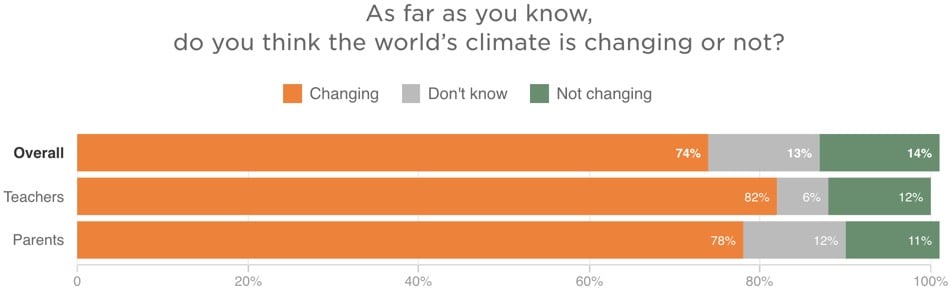
According to a poll conducted by NPR/Ipsos, over 80% of American parents want climate change to be taught in our schools, but only 42% of the teachers polled say that they teach it in their classrooms.
If they don’t hear about it at home, will kids learn about climate change in school? To answer this question, NPR/Ipsos also completed a nationally representative survey of around 500 teachers. These educators were even more likely than the general public to believe in climate change and to support teaching climate change.
In fact, 86% of teachers believe climate change should be taught in schools. In theory.
But in practice, it’s more complicated. More than half — 55% — of teachers we surveyed said they do not cover climate change in their own classrooms or even talk to their students about it.
The most common reason given? Nearly two-thirds (65%) said it’s outside their subject area.
NPR education correspondent Anya Kamenetz shared 8 Ways To Teach Climate Change In Almost Any Classroom, regardless of what subject you teach.
5. Assign a research project, multimedia presentation or speech.
Gay Collins teaches public speaking at Waterford High School in Waterford, Conn. She is interested in “civil discourse” as a tool for problem-solving, so she encourages her students “to shape their speeches around critical topics, like the use of plastics, minimalism, and other environmental issues.
I am, however, still hung up on the 12% of teachers polled who said that the world’s climate is not changing.
Shuudan Koudou Is the Japanese Art of Synchronized Precision Walking
For more than 50 years, students at the Nippon Sport Science University in Japan have practiced shuudan koudou, which translates as “collective action”. You can see them in action in these pair of videos:
If you want the really good stuff, skip to ~1:35 in the first video to watch two columns of quick-walking students march backwards through each other. Whoa.
David Attenborough on How to Save Our Planet
In this short video essay, David Attenborough succinctly describes the main problem of the anthropocene (that modern humans are not living sustainably as they once could as hunter gatherers), explains the effect we’ve had on the planet, and then suggests how we can fix things (italics mine):
The plan for our planet is remarkably simple. Reduce our impact by making sure that everything we do, we can do forever.
Sustainability is such a buzzword these days that I have long since stopped thinking about what it actually means; Attenborough nails it with “making sure that everything we do, we can do forever”. The Earth seems infinite in scope but not with 7, 8, or 9 billion humans hungry for food, thirsty for water, and lusty for status & entertainment.
The simple plan Attenborough describes has four parts:
1. Phase out fossil fuels and replace them with renewables.
2. Upgrading to efficient food production and reducing our consumption of meat.
3. Proper worldwide ocean management.
4. Rewilding the world.
As he allows, it’s a bit more complicated than that — check out Paul Hawken’s list for a more detailed list of things we can do to fight climate change.
Grace Hopper Explains a Nanosecond
In this short clip from 1983, legendary computer scientist Grace Hopper uses a short length of wire to explain what a nanosecond is.
Now what I wanted when I asked for a nanosecond was: I wanted a piece of wire which would represent the maximum
distance that electricity could travel in a billionth of a second. Now of course it wouldn’t really be through wire — it’d be out in space, the velocity of light. So if we start with a velocity of light and use your friendly computer, you’ll discover that a nanosecond is 11.8 inches long, the maximum limiting distance that electricity can travel in a billionth of a second.
You can watch the entirety of a similar lecture Hopper gave at MIT in 1985, in which she “practically invents computer science at the chalkboard”. (via tmn)
A food blogger is testing baking recipes in blind-tasting bake-offs. Recipes from indie blogs tend to fare better than those from big publications.
Headshots
Kaija Straumanis took a series of portraits of herself being hit in the face with all sorts of different objects, from a dodgeball to a book to an old boot.

(via moss & fog)
A history of the Star Trek franchise’s LGBTQ+ representation. Despite the “infinite diversity” of the Trek ethos, gay characters have been rare.
Fighting Climate Change with CO2-Eating “Ideal Plants”
At the Salk Institute for Biological Studies, Dr. Joanne Chory is working on a project to create plants capable of storing more carbon for a longer period of time than normal plants in order to help mitigate the effects of climate change.
Suberin — also known as cork — is a naturally occurring carbon-rich substance found in plant roots. It absorbs carbon yet resists decomposition (which releases carbon back into the atmosphere), enriches soil and helps plants resist stress.
By understanding and improving just a few genetic pathways in plants, Salk’s plant biologists believe they can help plants grow bigger, more robust root systems that absorb larger amounts of carbon, burying it in the ground in the form of suberin.
The Salk team will use cutting-edge genetic and genomic techniques to develop these Salk Ideal Plants.
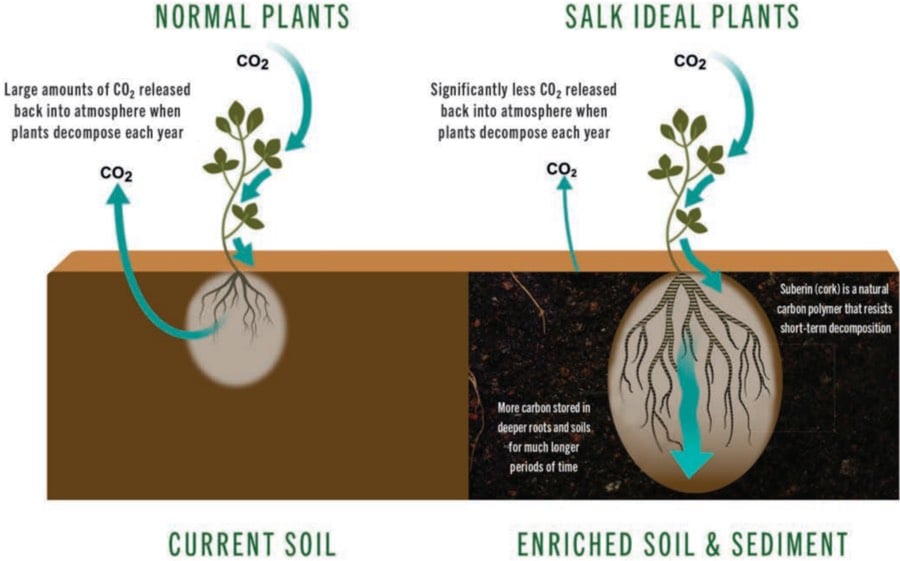
According to this piece in the Guardian on the project, one of the techniques they’re using is CRISPR, basically a genetic copy/paste system. Once the team demonstrates they can grow these larger root systems in model plants, they’ll genetically transfer that capability to the world’s largest food crops like rice, wheat, and corn.
As a bonus, the team believes that Ideal Plants will have other positive effects:
In addition to mitigating climate change, the enhanced root systems will help protect plants from stresses caused by climate changes and the additional carbon in the soil will make the soil richer, promoting better crop yields and more food for a growing global population.
This project is firmly on the wizard end of the wizards vs prophets spectrum.
Socials & More