kottke.org posts about war
Kevin Delaney, the head of Wayland High School’s history department, gave his 11th grade students an interesting challenge: find out everything you can about the person who owned a dusty briefcase full of papers that Delaney had found in the storage room. The man, Martin Joyce, turned out to have a life that spanned many significant events in history and his story provided the students with a personal lens into history.
Inside were the assorted papers — letters, military records, photos — left behind by a man named Martin W. Joyce, a long-since deceased West Roxbury resident who began his military career as an infantryman in World War I and ended it as commanding officer of the liberated Dachau concentration camp. Delaney could have contacted a university or a librarian and handed the trove of primary sources over to a researcher skilled in sorting through this kind of thing. Instead, he applied for a grant, and asked an archivist to come teach his students how to handle fragile historical materials. Then, for the next two years, he and his 11th grade American history students read through the documents, organized and uploaded them to the web, and wrote the biography of a man whom history nearly forgot, but who nonetheless witnessed a great deal of it.
“Joyce became the thread that went through our general studies,” Delaney says. “When we were studying World War I, we did the traditional World War I lessons and readings. And then stopped the clocks and thought, ‘What’s going on with Joyce in this period?’”
As the class repeatedly asked and answered that question, they slowly uncovered the life of a man who not only oversaw the liberated Dachau but also found himself a participant in an uncommon number of consequential events throughout Massachusetts and U.S. history. In a way Delaney couldn’t have imagined when he first popped open the suitcase that day, Joyce would turn out to be something akin to Boston’s own Forrest Gump — a perfect set of eyes through which to visit America’s past.
Fantastic, what a great story. My favorite tidbit is that after all the wars and stuff, he and his wife were on the Andrea Doria when it was struck by the Stockholm and sunk. Part of the students’ project was building a web site pertaining to Joyce’s life and includes scans of all the papers they discovered…it’s well worth looking through. (via @SlateVault)
When you consider the alternatives — even, and perhaps especially, if you are deeply concerned with sparing civilians — you are led, as Obama was, to the logic of the drone.
The Atlantic’s Mark Bowden provides his take on how to think about drones: The Killing Machines.
For the Journal of the American Revolution, Todd Andrlik compiled a list of the ages of the key participants in the Revolutionary War as of July 4, 1776. Many of them were surprisingly young:
Marquis de Lafayette, 18
James Monroe, 18
Gilbert Stuart, 20
Aaron Burr, 20
Alexander Hamilton, 21
Betsy Ross, 24
James Madison, 25
This is kind of blowing my mind…because of the compression of history, I’d always assumed all these people were around the same age. But in thinking about it, all startups need young people…Hamilton, Lafayette, and Burr were perhaps the Gates, Jobs, and Zuckerberg of the War. Some more ages, just for reference:
Thomas Jefferson, 33
John Adams, 40
Paul Revere, 41
George Washington, 44
Samuel Adams, 53
The oldest prominent participant in the Revolution, by a wide margin, was Benjamin Franklin, who was 70 years old on July 4, 1776. Franklin was a full two generations removed from the likes of Madison and Hamilton. But the oldest participant in the war was Samuel Whittemore, who fought in an early skirmish at the age of 80. I’ll let Wikipedia take it from here:
Whittemore was in his fields when he spotted an approaching British relief brigade under Earl Percy, sent to assist the retreat. Whittemore loaded his musket and ambushed the British from behind a nearby stone wall, killing one soldier. He then drew his dueling pistols and killed a grenadier and mortally wounded a second. By the time Whittemore had fired his third shot, a British detachment reached his position; Whittemore drew his sword and attacked. He was shot in the face, bayoneted thirteen times, and left for dead in a pool of blood. He was found alive, trying to load his musket to fight again. He was taken to Dr. Cotton Tufts of Medford, who perceived no hope for his survival. However, Whittemore lived another 18 years until dying of natural causes at the age of 98.
!!!
Smithsonian.com has a neat interactive map that shows how the Battle of Gettysburg played out in the Civil War. For best results, do one run through zoomed out a little and then another run-through to at a closer zoom level to see the details. (via digg)

Maybe the most depressing part of this three part series of photographs of Iraq from the past ten years is not the photos of all the horrible things people are capable of doing to each other, not the [God, I can’t even think of the right set of rage-adjectives here] faces of Bush, Cheney, and Rumsfeld, but the fact that there is a part two to this series that starts in 2003, just after the fucking asinine MISSION ACCOMPLISHED banner.
But maybe it was all worth it? To see these happy faces riding an amusement ride? Or these young people able to express themselves? Was it the right thing done the wrong way for the wrong reasons? I dunno. I just don’t know.
In 1968, Richard Nixon, then a candidate for President, used backchannel negotiations to scuttle peace talks that may have ended the Vietnam War. Nixon was afraid an end to the war meant an end to his campaign.
By the time of the election in November 1968, LBJ had evidence Nixon had sabotaged the Vietnam war peace talks — or, as he put it, that Nixon was guilty of treason and had “blood on his hands”.
The war went on for seven more bloody years, most of them under Nixon’s watch. Shameful.
Rand Paul has had the floor to the Senate for 10 hours now, filibustering against the nomination of John Brennan as CIA director. You can watch here. What’s a filibuster?
A filibuster in the United States Senate usually refers to any dilatory or obstructive tactics used to prevent a measure from being brought to a vote. The most common form of filibuster occurs when a senator attempts to delay or entirely prevent a vote on a bill by extending the debate on the measure, but other dilatory tactics exist. The rules permit a senator, or a series of senators, to speak for as long as they wish and on any topic they choose, unless “three-fifths of the Senators duly chosen and sworn” (usually 60 out of 100 senators) brings debate to a close by invoking cloture under Senate Rule XXII.
What’s Paul upset about? Drones:
Paul said that all presidents must honor the Fifth Amendment. “No American should ever be killed in their house without warrant and some kind of aggressive behavior by them,” Paul said on the Senate floor. “To be bombed in your sleep? There’s nothing American about that … [Obama] says trust him because he hasn’t done it yet. He says he doesn’t intend to do so, but he might. Mr. President, that’s not good enough … so I’ve come here to speak for as long as I can to draw attention to something that I find to really be very disturbing.”
“I will not sit quietly and let him shred the Constitution,” Paul added.”No person will be deprived of life, liberty, or property without due process,” he said, quoting the Fifth Amendment.
I have written about Obama’s continued use of drones before.
With drones in the news this week, The New Yorker’s Dexter Filkins takes a look at what the drone wars are like on the receiving end of the action, and reminds us what we don’t know about drones (and their targets).
When an employee of the C.I.A. fires a missile from a unmanned drone into a compound along the Afghan-Pakistani border, he almost certainly doesn’t know for sure whom he’s shooting at.
This Justice Department memo about when the US government, without hearing or trial or due process or whatever other “rights” we as a country hold dear, can kill US citizens is fucking bullshit.
A confidential Justice Department memo concludes that the U.S. government can order the killing of American citizens if they are believed to be “senior operational leaders” of al-Qaida or “an associated force” — even if there is no intelligence indicating they are engaged in an active plot to attack the U.S.
The 16-page memo, a copy of which was obtained by NBC News, provides new details about the legal reasoning behind one of the Obama administration’s most secretive and controversial polices: its dramatically increased use of drone strikes against al-Qaida suspects abroad, including those aimed at American citizens, such as the September 2011 strike in Yemen that killed alleged al-Qaida operatives Anwar al-Awlaki and Samir Khan. Both were U.S. citizens who had never been indicted by the U.S. government nor charged with any crimes.
The whole memo is here. A staggering disappointment from a man many think is better than this. See also: Obama’s lethal Presidency.
Tom Junod has been on the drone beat since writing The Lethal Presidency of Barack Obama in July.
Sure, we as a nation have always killed people. A lot of people. But no president has ever waged war by killing enemies one by one, targeting them individually for execution, wherever they are. The Obama administration has taken pains to tell us, over and over again, that they are careful, scrupulous of our laws, and determined to avoid the loss of collateral, innocent lives. They’re careful because when it comes to waging war on individuals, the distinction between war and murder becomes a fine one. Especially when, on occasion, the individuals we target are Americans and when, in one instance, the collateral damage was an American boy.
Individual targetting isn’t exclusively done by military drones, but they are the favored method. Junod notes that even as Obama said that “a decade of war is now ending” in his inauguration speech, a drone strike killed three suspected Al Qaeda members in Yemen.
President Obama’s second inaugural was supposed to sound something like Lincoln’s: the speech of a man tired of war, and eager to move the nation beyond its bloody reach. In truth, it was the speech of a man who has perfected a form of war that can be written off as a kind of peace. He was able to put the pain of war in the past because his efforts to expand painless war have come to fruition.
Here’s the full report on the recent Yemeni strikes from the AP:
An American drone strike on Monday on a car east of Sana, the capital, killed three people suspected of being members of Al Qaeda, said Yemeni security officials. On Saturday, two American drone strikes killed eight people in Marib Province. Yemen, aided by the United States, has been battling the local branch of Al Qaeda. The United States rarely comments on its military role in Yemen but has acknowledged targeting Qaeda militants in the past.
Dangerous dangerous precedent here. If George W. Bush were doing this sort of thing, we’d be marching in the streets about it. Why does Obama get a free pass? (And on Bradley Manning? And on Guantanamo?) Anyone in the press want to ask the President about the legality & moral stickiness of drone strikes at his next press conference?
This impressive 7,000 word essay written by user Memphet’ran on the appropriately named Spacebattles.com forum attempts to answer that question.
There are only a handful of engines that allow a combination of high thrust and low mass ratio. The most promising are Orion nuclear pulse propulsion and the nuclear salt water rocket. Some nuclear thermal designs also have thrust high enough to possibly be useful, although only for a small ship. The user “RJP” on Spacebattles also suggested something called a fission fragment drive which works by throwing high-velocity fuel fragments out the back of the ship, but other sites I’ve researched suggest it would be a low-thrust high-ISP [in-space propulsion] system more suitable to an explorer than a warship. Orion works by the (seemingly insane, but actually quite effective) method of throwing nuclear bombs behind the spacecraft and having it ride the blasts. The hot gasses from the detonations hit a heavy pusher plate at the back of the ship and drive it forward. NSWR [nuclear salt water rocket] is similar, but it instead uses a solution of fissionables in salt water that spontaneously explodes as it leaves the rocket nozzle. Both systems cleverly shift the propulsive reaction outside the spacecraft, eliminating the need to deal with most of the heat it produces and allowing it to be made much more energetic.
And previously on kottke.org:
For the same reason that we have Space Shuttle launch delays, we’ll be able to tell exactly what trajectories our enemies could take between planets: the launch window. At any given point in time, there are only so many routes from here to Mars that will leave our imperialist forces enough fuel and energy to put down the colonists’ revolt.
If you’ve got a hankering to go hands on, the video games EVE and FTL approach realistic space battles in their own ways.
(via @BenKuckera)
A little late for Veteran’s Day, but this is a great collection of photography from Vietnam. These two stick out for me (both photos by Horst Faas):
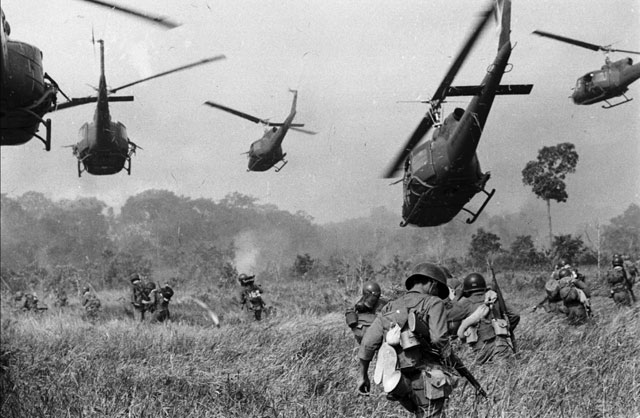
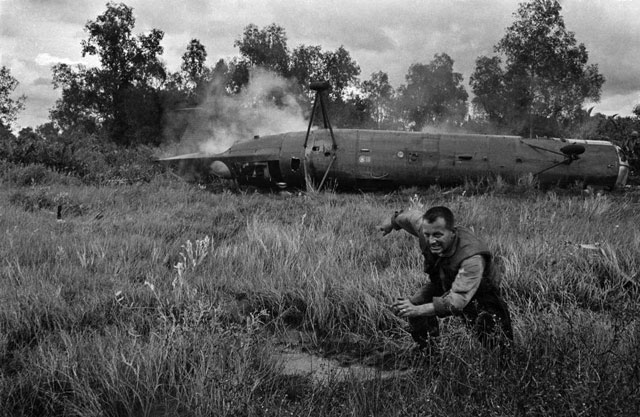
Some images NSFW and may be disturbing, etc. (via @Colossal)
This is a time lapse world map showing all the battles that have occurred in the past 1000 years. Worth sitting through the whole thing to see Europe go absolutely bonkers in the late 1930s.
(via @DavidGrann)
The @RealTimeWWII Twitter account is tweeting the events of World War II as they happened 72 years ago. A sample tweet from a few hours ago:
Germany has announced (again) that it will respect the neutrality of Belgium & Holland; “No German troops will enter the Low Countries”
Meanwhile back in 1668, Samuel Pepys is having trouble with his wife because he had a dalliance with the maid.
To dinner. The girle with us, but my wife troubled thereat to see her, and do tell me so, which troubles me, for I love the girle.
The standard form of Soviet war correspondence during WWII were letters folded into a triangular shape.

During the war, the mails were brought for free from the front to home. It could not have been differently, because probably the postage stamps would have been the last item the halting logistic support would have delivered to the front. Even so, postcards and envelopes were shortages. The soldiers’ genius has thus created, right in the first months of the war, the format that was a letter and its own envelope in one. The folding process is very similar to how we, in our childhood, folded our soldier’s shako, knowing nothing about the triangular soldier’s letters.
(via raul)
Newer posts
Older posts





Socials & More