



Diving champion of the world
This dive, by Leeds United midfielder Adryan in match against Derby County, might be the worst dive of all time.
He’s flopping around like Sonny Corleone getting shot up at the toll booth in The Godfather. Hilarious.

This site is made possible by member support. 💞
Big thanks to Arcustech for hosting the site and offering amazing tech support.
When you buy through links on kottke.org, I may earn an affiliate commission. Thanks for supporting the site!
kottke.org. home of fine hypertext products since 1998.
Beloved by 86.47% of the web.
This dive, by Leeds United midfielder Adryan in match against Derby County, might be the worst dive of all time.
He’s flopping around like Sonny Corleone getting shot up at the toll booth in The Godfather. Hilarious.
A Euro 2016 qualifying match between Albania and Serbia was abandoned today after a drone flying a banner with a map of Kosovo and the Albanian flag on it hovered over the pitch.
Tensions increased further when the flag was snared by Serbia’s Stefan Mitrovic, who then pulled on the strings connecting it to the drone. He was immediately confronted by Albanian players, and a shoving match ensued.
The match was abandoned after a lengthy delay. At the recommendation of UEFA, no Albanian fans were allowed into the stadium for the match in Belgrade due to tensions between the two nations. Kosovo, where the population includes both ethnic Serbs and Albanians, declared its independence from Serbia in 2008, a declaration that the Serbians dispute. Nick Ames wrote a soccer-centric take on the tensions between the two nations.
It comes down, really, to Kosovo — and that is a phrase that can be applied as shorthand for Serbian-Albanian relations as a whole. As Tim Judah writes in his seminal history, The Serbs: “So poisoned is the whole subject of Kosovo that when Albanian or Serbian academics come to discuss its history, especially its modern history, all pretence of impartiality is lost.”
Kosovo, situated to the south of Serbia and the north-east of Albania, declared independence in 2008 having previously been part of Serbia. The Serbs still regard it as their own, but it is recognised by 56 percent of UN member states and its ethnic makeup is, depending on which side you refer to, overwhelmingly Albanian. (It’s worth noting that figures vary wildly.)
The emotional significance goes as far back as 1389, when the Serbs were defeated by the Ottoman army in the Battle of Kosovo, which took place near its modern-day capital, Pristina. It has been much-mythologised in Serbian history. Far more recently, memories of the 1998-99 Kosovo War — an appallingly brutal fight for the territory from which it has not really recovered — still run deep.
FYI: the YouTube embed above was recorded off of a TV…if you’re in the US, the ESPN story has better video.

As I’ve written before, after the World Cup in 2010, I wanted to keep watching soccer but didn’t quite know how club soccer worked or anything about the various teams. I wish I’d had this book then: Club Soccer 101. It’s a guide to 101 of the most well-known teams from leagues all over the world.
The book covers the history of European powerhouses like Arsenal, Barcelona, Bayern Munich, Chelsea, Inter Milan, Manchester United, Paris Saint-Germain, and Real Madrid; historic South American clubs like Boca Juniors, Corinthians, Penarol, and Santos; and rising clubs from Africa, Asia, and America, including such leading MLS clubs as LA Galaxy, New York Red Bulls, and Seattle Sounders. Writing with the passion and panache of a deeply knowledgeable and opinionated fan, Luke Dempsey explains what makes each club distinctive: their origins, fans, and style of play; their greatest (and most heartbreaking) seasons and historic victories and defeats; and their most famous players — from Pelé, Eusébio, and Maradona to Lionel Messi, Wayne Rooney, and Ronaldo.
Lionel Messi made his debut for FC Barcelona 10 years ago. At Grantland, Brian Phillips assesses his career thus far.
The irony of that goal against Getafe, in retrospect, is that he’s not the next Maradona; he’s nothing like Maradona. Maradona was all energy, right on the surface; watching Messi is like watching someone run in a dream. Like Cristiano Ronaldo, Maradona jumped up to challenge you; if you took the field against him, he wanted to humiliate you, to taunt you. Messi plays like he doesn’t know you’re there. His imagination is so perfectly fused with his technique that his assumptions can obliterate you before his skill does.
He has always seemed oddly nonthreatening for someone with a legitimate claim to being the best soccer player in history. He seems nice, and maybe he is. (He goes on trial for tax evasion soon; it is impossible to believe he defrauded authorities on purpose, because it is impossible to believe that he manages his finances at all.) On the pitch, though, this is deceptive. It’s an artifact of his indifference to your attention. He doesn’t notice whether or not you notice. His greatness is nonthreatening because it is so elusive, even though its elusiveness is what makes it a threat.
Messi is only 27, holds or is within striking distance of all sorts of all-time records, and I’m already sad about his career ending. This is big talk, perhaps nonsense, but Messi might be better at soccer than Michael Jordan was at basketball. I dunno, I was bummed when Jordan retired (well, the first two times anyway), but with Messi, thinking about his retirement, it seems to me like soccer will lose something special that it will never ever see again.
This goal by AC Milan’s Jeremy Menez against Parma over the weekend is just beyond:
No-look backheel. Jeebus.
If you enjoyed the World Cup but don’t know how to proceed into the seemingly impenetrable world of soccer, with its overlapping leagues, cups, and tournaments, this guide from Grantland is for you.
Just because the World Cup is over doesn’t mean soccer stops. Soccer never stops; that’s one of its biggest appeals. There are so many different teams, leagues, club competitions, and international tournaments that, if you want to, you can always find someone to cheer for or some team to root against. It can also be a bit daunting to wade into without any experience. Luckily, you have me, your Russian Premier League-watching, tactics board-chalking, Opta Stats-devouring Gandalf, to help you tailor your soccer-watching habits. And now I will answer some completely made-up questions to guide you along your soccer path.
This was basically my situation after the 2010 World Cup, a soccer fan with nowhere to direct his fandom. What I did was:
1. Picked a player I enjoyed watching (Messi) and started following his club team (FC Barcelona) and, to a somewhat lesser degree, the league that team played in (La Liga). I know a lot more cities in Spain than I used to.
2. Watched as many Champions League matches as I could every year, again more or less following Barcelona.
3. Got into UEFA European Championship, which is basically the World Cup but just for Europe. It’s held every four years on a two-year stagger from the WC and the next one is in 2016 in France, which, I’m realizing just now, I should try to attend.
I also watched a few Premier League matches here and there…it’s a great league with good competition. What I didn’t do is follow any MLS or the USMNT, although after this WC, I might give the Gold Cup and Copa America tournaments some more attention. And qualifying matches for the 2018 World Cup start in mid-2015…soccer never ends.
An open-and-shut case from FiveThirtyEight: Lionel Messi is far and away the best player in football. Ronaldo is the only player who is close and he’s not even all that close.
By now I’ve studied nearly every aspect of Messi’s game, down to a touch-by-touch level: his shooting and scoring production; where he shoots from; how often he sets up his own shots; what kind of kicks he uses to make those shots; his ability to take on defenders; how accurate his passes are; the kind of passes he makes; how often he creates scoring chances; how often those chances lead to goals; even how his defensive playmaking compares to other high-volume shooters.
And that’s just the stuff that made it into this article. I arrived at a conclusion that I wasn’t really expecting or prepared for: Lionel Messi is impossible.
It’s not possible to shoot more efficiently from outside the penalty area than many players shoot inside it. It’s not possible to lead the world in weak-kick goals and long-range goals. It’s not possible to score on unassisted plays as well as the best players in the world score on assisted ones. It’s not possible to lead the world’s forwards both in taking on defenders and in dishing the ball to others. And it’s certainly not possible to do most of these things by insanely wide margins.
But Messi does all of this and more.
The piece is chock-full of evidential graphs of how much of an outlier Messi is among his talented peers:

One of my favorite things that I’ve written about sports is how Lionel Messi rarely dives, which allows him to keep the advantage he has over the defense.
There haven’t been many good books written about soccer, but here are eleven of them worth your time. Franklin Foer’s How Soccer Explains the World: An Unlikely Theory of Globalization looks especially interesting.
A groundbreaking work — named one of the five most influential sports books of the decade by Sports Illustrated — How Soccer Explains the World is a unique and brilliantly illuminating look at soccer, the world’s most popular sport, as a lens through which to view the pressing issues of our age, from the clash of civilizations to the global economy.
Foer is one of the contributors, alongside authors Aleksandar Hemon and Karl Ove Knausgaard, to the New Republic’s excellent World Cup coverage.
Watch as two players from the Japanese national soccer team try to score against 55 kids.
The kids had two opportunities to stop the pro players, once with 33 players and the second time with 55 players. This didn’t turn out how I expected, given how a similar stunt involving fencing ended.
This was posted on Marginal Revolution a few days ago and garnered several interesting comments about how much better professional athletes are than us regular folk. Here are a few:
Rugby: I played against an international player once. Watching him play, I’d seen a chap who ran in straight lines, a strong tackler with a weak kick. Playing against him revealed him to be skillful, agile and possessed of a howitzer kick.
Back in the 1980s a friend was watching a pickup basketball game in Boston and reported what happened when a player from the Celtics showed up. He was so much faster, more athletic, and more agile than the other players that it seemed like he was playing a different sport. The player turned out to be Scott Wedman, who by that time was old and slow by NBA standards, and mainly hung around the 3-point line to shoot outside shots after the defense had collapsed on Bird, McHale, et al. But compared to non-NBA players, he was Michael Jordan (or LeBron James).
My U-19 team (we were very good by local standards) had a practice with the New Zealand All Blacks, who were on some sort of tour. It was like they were from a different planet. I stood no chance of containing, or conversely getting past, the smallest of them under almost any circumstance.
Back in the olden thymes I was a pretty good baseball player. Early in my high school career I got the chance to catch a AAA pitcher. I went into thinking I would have no trouble. The first pitch was on top of me so fast I was knocked off balance. It took a bunch of pass balls before I got used to how to handle his breaking stuff.
The result in the video might also shed some light on the question of choosing to fight one horse-sized duck or 100 duck-sized horses.
For a Visa commercial, Errol Morris gathers a number of Nobel Peace Prize winners and nominees (including Lech Walesa) to talk about how important it is for their countries to beat the crap out of the other countries in the World Cup.
Two quotes in the video caught my ear:
Sport is a continuation of war by other means.
Look, football isn’t life or death. It’s much more important than that.
The first is a riff on Prussian general Carl von Clausewitz’s aphorism “War is the continuation of Politik by other means”. Clausewitz also devised the concept of “the fog of war”, which Morris used for the title of a film. The second is a paraphrase of a quote by legendary football coach Bill Shankly:
Some people believe football is a matter of life and death, I am very disappointed with that attitude. I can assure you it is much, much more important than that.
The NY Times has an interactive look at the balls used in the World Cup from 1930 onward. Here’s the ball from 1930:
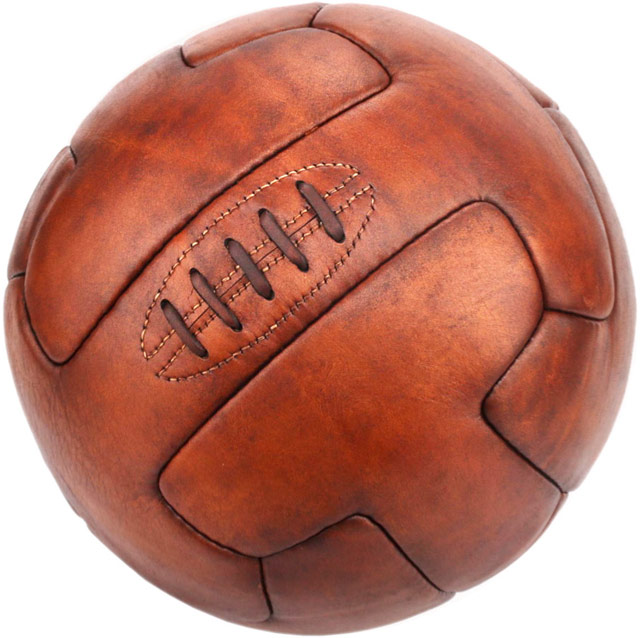
Look at those laces! Just like the ol’ American handegg.
From Grantland’s Mike Goodman, a guide to nerding out about soccer, using the language already spoken by American sports nerds.
What exactly is a good shot in soccer? The nascent field of soccer analytics is hard at work trying to figure that out. It won’t surprise anybody to learn that closer is better, and using your feet is much, much better than using your head. So, much like getting into the lane is of paramount importance in basketball, getting the ball at your feet in front of the goal is just about the best thing you can do in soccer. Getting to the byline (baseline) in the corner of the penalty areas (like where Maicon was in the above video) is a hot destination. That’s where you can cut the ball back for a teammate to have one of those coveted close shots. Hey, look at that - it’s like basketball again: Get to the goal or get to the corners.
For the World Cup, the managers of Mexico, Bosnia-Herzogovina, Spain, Germany, and Chile have all banned players from having sex for the duration of the tournament. France and Brazil’s players have to slow down, too:
Usually normal sex is done in balanced way, but there are certain forms, certain ways and others who do acrobatics. We will put limits and survey the players.
— Brazil manager Luiz Felipe Scolari
Intriguing but creepy! (What does “survey” mean?)
Athletics and abstinence have gone together for seemingly forever, but scientific studies suggest that sex as such doesn’t impair athletic performance.
The bigger worry might be the cultural connection between sex and sports, particularly soccer in Brazil: Adidas withdrew two purportedly World Cup-themed T-shirts with the slogans “Looking To Score” (with a woman in a bikini and a soccer ball for the O in “Score”) and “I <3 Brazil” (with the heart drawn to resemble a woman’s rear end in a bikini). That’s not creepy, that’s being a creep.
There’s a weird dehumanization that happens in sports and sports fandom. Athletes get reduced to their performance, which is usually understood in abstract terms: statistics, salaries, wins and losses. Everything around the game, from families to fans to the ordinary women and men whose lives intersect with the players, is measured in terms of how it affects competition. This in turn justifies all kinds of intrusions into people’s lives, whether from coaches or fans or media, but never for its own sake.
It’s almost as if when you start to think about sex as an act with ethical dimensions, it disrupts (in a good way) the shallow ways we usually consider people’s bodies for the purposes of both work and commerce. When nobody is disposable, it throws the whole system off. That’s a kind of acrobatics that sports just can’t seem to handle.
(“Normal Sex, No Acrobatics” via @webbmedia)
A nice appreciation of Barry Sanders by Andrew Sharp at Grantland.
“Barry Sanders is my new idol,” Bo Jackson said after a Raiders-Lions game in 1990. “I love the way the guy runs. When I grow up, I want to be just like him.”
The Raiders won that game, and the Lions were 4-9 at the time, but it didn’t even matter.
All anyone could talk about afterward was the “little water bug” who “might rewrite history.”
This wasn’t necessarily a metaphor for Barry’s entire Lions career — he was on more playoff teams than people remember — but it definitely covers about half the years he spent in Detroit. Even when the Lions were awful, Barry would still have a few plays every game that would keep people gawking afterward.
Bo Jackson had a similar effect on people, which is part of what makes that old quote so cool. The Bo Jackson combination of speed and power is something we’d never seen before and haven’t seen since. He was a cult hero then, and the legend has only grown over the years.
I’ve always been an atypical sports fan. I grew up in Wisconsin rooting for the Packers & Brewers but switched to being a Vikings & Cubs fan sometime in high school. But despite following the Vikings at the time, my favorite player in the NFL was Barry Sanders. For my money, Sanders was pure symphonic excellence in motion, the best running back (and perhaps player) the NFL had ever seen and maybe will ever see. I wonder if one of the reasons why I like Lionel Messi so much is because he reminds me of Sanders; in stature, in strength, in quickness, in skill. Compare and contrast some of their finest runs:
For Howler Magazine, Sam Markham writes about Diego Maradona’s second goal against England in the 1986 World Cup quarterfinal, aka Probably The Best Goal of All Time. Markham focuses on how a pair of radio commentators — one English, the other from South America — called the goal.
Morales’s ecstatic commentary of Maradona’s second goal is itself iconic in Argentina, and his lyrical expression “Barrilete cosmico!” (Cosmic kite!) is now shorthand in Argentina and much of South America for Maradona. His narration is a frenzied mix of poetry, yelling, and sobbing that ends with a prayer: “Thank you, God, for football, for Maradona, for these tears, for this-Argentina 2, England 0.”
Even if you don’t care about soccer, you should give this a listen…the dude absolutely loses his shit:
An alternate view of the spectacular goal has recently been found. Oh, and my favorite weird thing about this goal: Lionel Messi is considered by many to be Maradona’s heir (both are small, Argentinian, and otherworldly talented) and in 2007, at the age of 19, he scored this goal against Getafe:
As you can see in the side-by-side comparison, it’s extremely similar to Maradona’s goal. Even the commentator loses it in a similar manner.
Socials & More