kottke.org posts about photography
A photo of some fellows playing polo with horseless carriages.
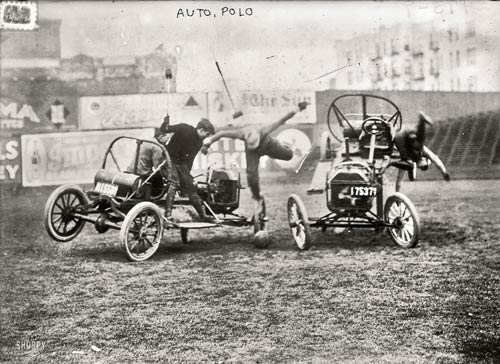
Looks like someone depressed their halting caliper a bit too quickly.
Update: From the NY Times, a report from 1912 on auto polo. The same page of the newspaper also contains a report of two gentleman who crossed the United States in a car without getting a single flat tire.
The two front tires contained Oregon air when they reached Massachusetts.
(via harrisj)
A Continuous Lean found some great Life magazine photos of Sherman Billingsley, the owner of a famous NYC nightclub called The Stork Club, which club was frequented by celebrities, artists, and the well-to-do from 1929 to 1965. In the photos, Billingsley is pictured at his club giving secret hand signals to his assistant while sitting with guests.
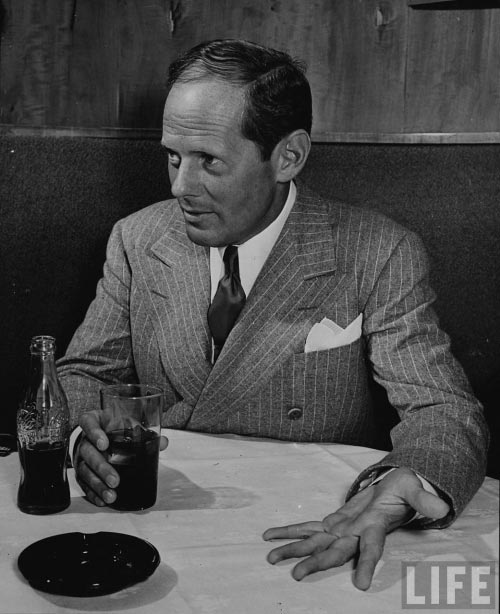
Closeup of Stork Club owner Sherman Billingsley [with his] palm up on table, one of his signals to nearby assistant which means “Bring a bottle of champagne,” while sitting w. patrons over his usual Coca Cola, in the Cub Room.
Billingsley’s signals cleverly allowed the club to provide seamless good service to his favored patrons while also letting him be the bad guy with less favorable customers without them knowing it. Billingsley went on to be the third base coach for the Yankees in the late 60s. (Untrue.)
Is your lack of fancy camera equipment — you know, the $3000 21-megapixel DSLR with HD video and f/1.4 lens — holding you back from making good photographs? Maybe the problem is with your thinking. Many of the great documentary photographers of the 20th century (Henri Cartier-Bresson, Robert Frank, Garry Winogrand, etc.) got by just fine with equipment about as flexible as the average point-and-shoot.
Low-light sensitivity? Ha! Your point-and-shoot may only be noisy at ISO 200 and below, but these guys were working with things like Kodachrome 25, eight times worse. Depth-of-field? Ha! Partially because of the style of the times, and partially because they didn’t want to deal with careful manual focus, most photojournalism of the time tended to have everything in focus — “f/8 and be there” was the rule.
I also enjoyed the advice for getting good photos of your kids with a point-and-shoot camera: “encourage them to play somewhere well-lit.” (via gulfstream)
The Big Picture collected a bunch of photos of people at work, spinning silk yarn, on a shoe assembly line, sanding and buffing an Oscar statue, checking flour-making equipment, inspecting cigars, assembling model trains, and making toilet bowls.
Peter Miller has done a number of projects that involve directly exposing Polaroid instant film. Static Fields:
These Polaroids were illuminated by their own electrocution. They are cameraless images, which are immediate records of the bolts of electricity that passed through them.
Lightning Bugs:
My brother helped me catch these, we let them loose on the Polaroids in the basement. Polaroids are positives. This is a record of lightning bug dance-steps. Look closely and you can see the shadows of their legs.
Polaroid Self Portrait:
Polaroids are removed from their case in a darkroom, laid flat and exposed as a single, light sensitive array. After they are exposed, they are reinserted into the pack and -with the lens now covered- can be processed by simply pressing the camera’s shutter and processing the film by ejecting it from the camera.
This photo by Bobby Yip of Reuters captures the current zeitgeist pretty well.
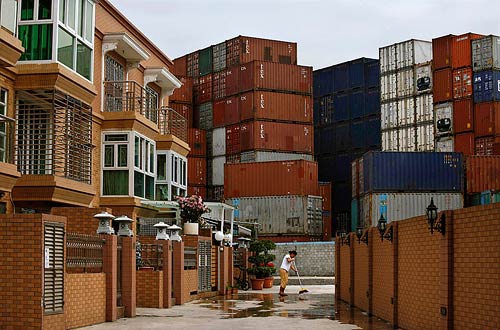
Unused shipping containers were piled up at a storage depot in Hong Kong Wednesday. The government is looking for places to store hundreds of thousands of unused containers expected to flood Hong Kong in the coming months due to China’s slow exports.
The world has so much stuff we don’t need that we don’t know where to put it all. Perhaps people will be living in those stacks of containers before too long. (via wsj)
Photographer Jesse Chan-Norris caught the aftermath of an attempted murder in Manhattan this morning. From his Flickr page:
At 5:40am I was jolted out of sleep by a noise. BANG. BANG. BANG. BANG. BANG. I raced outside, I looked down, I saw the black car with its door open. I saw another car next to it. I saw the body in the middle of the street. I stood. I gawked.
Another photo of Lincoln taken a couple months before he died, featuring a surprisingly contemporary hairstyle.

Abe looks downright rebellious in that photo. (via flickr blog)
The Kaplan Daguerreotype of Abraham Lincoln is purported to be the earliest known photo of the 16th President, taken in the early 1840s when he was in his early 30s. The young man in the photo doesn’t bare an obvious resemblance to a photo taken of Lincoln a few years later but the forensic evidence is compelling.
Numerous accounts have revealed that Lincoln underwent a noticeable change in his physical appearance beginning in January 1841 as a result of a grave emotional crisis. This coincides with his reported failure to go through with his scheduled marriage to Mary Todd, leaving her literally waiting for him at the altar. (They were married the following year.) This emotional crisis, just one of a series of such episodes to plague him throughout his life, was the cause of Lincoln losing a considerable amount of weight.
The Places We Live features panoramic photos of slums, narrated by the people who live there (through translators). Really really engrossing. To access the stories in the restricting Flash interface, skip the intro, click on a city, and then on one of the households in the upper left corner. There’s a book too. (via snarkmarket)
Street photographer Bill Cunningham didn’t have a ticket to the Inauguration nor did he have an assignment from the NY Times to cover it; he just bought a train ticket, went down on his own, and brought back these photos. Be sure to listen to Cunningham’s wonderful narration; he even gets choked up when describing the moment of Obama’s swearing-in. I wish all journalism were this professionally personal (if that makes any sense). (via greg.org)
In his latest post for his NY Times blog, Errol Morris talks with three photographers — one each from Reuters, AP, and AFP — and has them select their ten favorite photos of George W. Bush.
He popped out that door, and when the door opened and he came through it, the look on his face was like no look I’d ever seen on George Bush’s face in my life. […] And I said, “If he wasn’t just back there behind that door crying, I don’t know what that look on his face is.” Because he just looks absolutely devastated as he comes through this door after essentially ending his eight year presidency. And it’s just really striking. He just looks absolutely devastated.
The interview with the last photographer is the least interesting because he refuses to interpret any of the photographs but his set of photographs includes at least 3 photographs that I had never seen before and that weren’t “published extensively in the United States”.
The Printed Picture is an exhibition of physical specimens made using all the different ways that type and image can be printed on paper, metal, glass, etc, with a special emphasis on dozens of photography techniques, from albumen prints to dagguereotypes to color photography. On view at MoMA until June 1.
I know that Polaroid announced last year that they were ceasing production of their instant film and that people have begun to hoard film as it becomes more difficult to find. To NYC hoarders: there are 30-40 10-packs of Polaroid 600 film at the CVS on the corner of Nassau and Fulton. Didn’t catch the price but they’re at the photo processing counter past the registers. Or you could just wait it out.
Newer posts
Older posts


Socials & More