kottke.org posts about parenting
At the end of this month Jeff Atwood is leaving Stack Exchange, a company he cofounded with Joel Spolsky. In a post on his blog, he explains why:
Startup life is hard on families. We just welcomed two new members into our family, and running as fast as you can isn’t sustainible for parents of multiple small children. The death of Steve Jobs, and his subsequent posthumous biography, highlighted the risks for a lot of folks. […] Stack Overflow and Stack Exchange have been wildly successful, but I finally realized that success at the cost of my children is not success. It is failure.
In his post, Jeff points to a similar post by another entrepreneur, Brad Wardell.
In the last several years, the company has been successful enough to generate a substantial amount of capital. And with it, I have been fortunate to bring in people with great talent. And so I started thinking of all the amazing things we would do. I would put in crazy hours to do it, of course, but we would go and do amazing things.
Then Steve Jobs died.
And suddenly I realized something. What is the objective here? My oldest child just turned 15. My other two are no longer little either. And I have been missing out on them.
And another from Eric Karjaluoto:
For a long time, work was my only thing. I worked evenings, weekends, and Christmas. At those rare times when I wasn’t at work in body, I was there in spirit, unable to speak or think of much else. I wanted so badly to climb the mountain that I stopped asking why I was doing it.
I admire [Jobs] for the mountains he climbed. At the same time, I wonder if he missed the whole point, becoming the John Henry of our time. He won the race, but at what cost?
Me? I may turn out to be a failure in business, but I refuse to fail my kids.
This mirrors my main reaction to Jobs’ death and Isaacson’s book as well. I wasn’t working 80 hours a week or leading a growing company or even spending very little time with my kids but I was pushing pretty hard on Stellar, pushing it towards a potential future of insane working hours, intense stress, and a whole lot less time with my family (and selfishly, less time for myself). Since Jobs died, I’ve been pushing a little less hard in that direction.
Four is hardly a trend but it is interesting that the death and biography of the greatest businessman of our generation — someone who was responsible for so many world-changing products and ideas, who shaped our world through sheer force of will & imagination, etc. etc. — is inspiring some people to turn away from the lifestyle & choices that made Jobs so successful & inspiring in the public sphere and to attempt the path that Jobs did not.
Adapted from her upcoming book Bringing Up Bébé: One American Mother Discovers the Wisdom of French Parenting, Pamela Druckerman shares why French parents are superior in this WSJ article.
The French, I found, seem to have a whole different framework for raising kids. When I asked French parents how they disciplined their children, it took them a few beats just to understand what I meant. “Ah, you mean how do we educate them?” they asked. “Discipline,” I soon realized, is a narrow, seldom-used notion that deals with punishment. Whereas “educating” (which has nothing to do with school) is something they imagined themselves to be doing all the time.
One of the keys to this education is the simple act of learning how to wait. It is why the French babies I meet mostly sleep through the night from two or three months old. Their parents don’t pick them up the second they start crying, allowing the babies to learn how to fall back asleep. It is also why French toddlers will sit happily at a restaurant. Rather than snacking all day like American children, they mostly have to wait until mealtime to eat. (French kids consistently have three meals a day and one snack around 4 p.m.)
We have a French pediatrician who advised us to do almost exactly what is in this article and we’ve had pretty good success with it. It’s not all roses (kids are kids after all) and a lot of work, especially for the first couple of years, because you have to be consistent and steady and firm (but also flexible) and I know I haven’t always done a great job, but the dividends have been totally worth it so far.
Jonathan Liu over at GeekDad compiled a list of the five best toys of all time.
2. Box
Another toy that is quite versatile, Box also comes in a variety of shapes and sizes. Need proof? Depending on the number and size you have, Boxes can be turned into furniture or a kitchen playset. You can turn your kids into cardboard robots or create elaborate Star Wars costumes. A large Box can be used as a fort or house and the smaller Box can be used to hide away a special treasure. Got a Stick? Use it as an oar and Box becomes a boat. One particularly famous kid has used the Box as a key component of a time machine, a duplicator and a transmogrifier, among other things.
Love it. (via @jsnell)
This is one of my favorite Flickr photos:
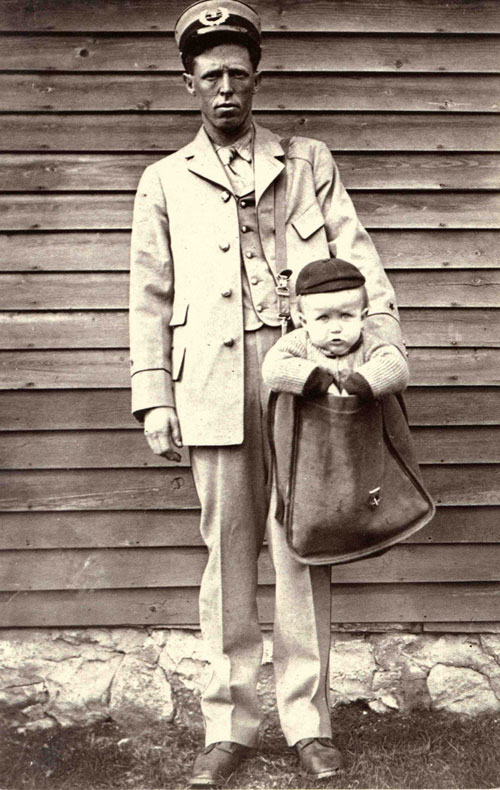
This city letter carrier posed for a humorous photograph with a young boy in his mailbag. After parcel post service was introduced in 1913, at least two children were sent by the service. With stamps attached to their clothing, the children rode with railway and city carriers to their destination. The Postmaster General quickly issued a regulation forbidding the sending of children in the mail after hearing of those examples.
Great new site from Rion featuring online videos, photos, books, and other media that’s appropriate for little kids.
There’s just so much science, nature, music, arts, technology, storytelling and assorted good stuff out there that my kids (and maybe your kids) haven’t seen. It’s most likely not stuff that was made for them…
But we don’t underestimate kids around here.
With obvious exceptions, media “made for kids” is mindnumbingly dumb. YouTube, Flickr, and Vimeo are amazing resources of not-made-for-kids but totally-appropriate-for-kids stuff like what Rion is posting here. I’ve often wanted a Wikipedia For Little Kids (for the iPad) that’s almost exclusively video- and image-based that I could let Ollie loose on to learn about stuff. (via @swissmiss)
Playgrounds built in the last 20 years may be safer and result in fewer lawsuits, but the kids who use them may be missing out on some critical emotional development.
“Children need to encounter risks and overcome fears on the playground,” said Ellen Sandseter, a professor of psychology at Queen Maud University in Norway. “I think monkey bars and tall slides are great. As playgrounds become more and more boring, these are some of the few features that still can give children thrilling experiences with heights and high speed.”
After observing children on playgrounds in Norway, England and Australia, Dr. Sandseter identified six categories of risky play: exploring heights, experiencing high speed, handling dangerous tools, being near dangerous elements (like water or fire), rough-and-tumble play (like wrestling), and wandering alone away from adult supervision. The most common is climbing heights.
“Climbing equipment needs to be high enough, or else it will be too boring in the long run,” Dr. Sandseter said. “Children approach thrills and risks in a progressive manner, and very few children would try to climb to the highest point for the first time they climb. The best thing is to let children encounter these challenges from an early age, and they will then progressively learn to master them through their play over the years.”
(via @tcarmody)
Now, I’m not here to judge anyone, but I’m totally judging: this is insane. A gender cake party goes like this:
My husband and I would like to do a cake party to find out the sex of our baby. So basically we will have the ultrasound tech put the sex of the baby in an enveloppe and we will give that enveloppe to our cake maker. The inside of the cake will either be pink or blue so when we cut into it our family, friends, as well as ourselves will find out what were having. We planned on having our close family and freinds over for this big moment….sounds lovely right?
The Morning News has a piece today on KidZania, a theme park for kids where they work and buy stuff just like grown-ups.
But at the heart of the concept and the business of KidZania is corporate consumerism, re-staged for children whose parents pay for them to act the role of the mature consumer and employee. The rights to brand and help create activities at each franchise are sold off to real corporations, while KidZania’s own marketing emphasizes the arguable educational benefits of the park.

Each child receives a bank account, an ATM card, a wallet, and a check for 50 KidZos (the park’s currency). At the park’s bank, which is staffed by adult tellers, kids can withdraw or deposit money they’ve earned through completing activities — and the account remains even when they go home at the end of the day. A lot of effort goes into making the children repeat visitors of this Lilliputian city-state.
A US outpost of KidZania is coming sometime in 2013.
The gender-specific colors we have today for kids — pink for girls and blue for boys — didn’t come about until the 1940s…before that, pink was recommended as a color for boys.
But nowadays people just have to know the sex of a baby or young child at first glance, says Jo B. Paoletti, a historian at the University of Maryland and author of Pink and Blue: Telling the Girls From the Boys in America, to be published later this year. Thus we see, for example, a pink headband encircling the bald head of an infant girl.
Why have young children’s clothing styles changed so dramatically? How did we end up with two “teams” — boys in blue and girls in pink?
“It’s really a story, what happened to neutral clothing,” says Paoletti, who has explored the meaning of children’s clothing for 30 years. For centuries, she says, children wore dainty white dresses up to age 6. “What was once a matter of practicality — you dress your baby in white dresses and diapers; white cotton can be bleached-became a matter of ‘Oh my God, if I dress my babies in the wrong thing, they’ll grow up perverted,’” Paoletti says.
It is nearly impossible, even in NYC, to find girls clothes that are not pink unless you pay through the nose for imported European kids clothes. See also vocabulary in boys and girls toy advertising. (via megnut, who is fighting to keep our kids in gender neutral clothing)
This is the first part of a four-part interview with Chris Ware, in which he discusses comics, working, and family. Ware on becoming a father:
Yeah, it kind of fixed every mental problem that I had within an hour. So I highly recommend it if anybody out there is thinking of having children, you should really, I mean, it’s the only reason we’re here, and if you have any doubts in your mind about yourself or where your life is going, it’ll be answered easily and almost instantaneously. It’s a clich’e to say, but it also immediately sets you aside from yourself and you’re no longer the star of your own mind, which is really not a very good state of mind to be in. Unfortunately, in my country it is one that seems to be encouraged until about the age of 60 or something, now. I really think the main export of America is this sort of fountain of youth that we somehow manage to tap into, like with pop music — it’s not out of the question to see 50-year-old men still dressing like teenagers and I just feel like, “What happened?” It’s like we won World War II and now we can be idiots for the rest of time.
I don’t know about an hour, but yeah, similar experience here. Here’s part 2, part 3, and part 4.
Parents these days go crazy worrying about their kids’ progress: Should she be reading? Should he be writing? She can’t catch a ball! The kid down the street can say her numbers up to 100 but mine only knows 1 through 14. Magical Parenthood posted an article about what a four-year-old should know and it doesn’t have anything to do with how well your kid can spell.
1. She should know that she is loved wholly and unconditionally, all of the time.
2. He should know that he is safe and he should know how to keep himself safe in public, with others, and in varied situations. He should know that he can trust his instincts about people and that he never has to do something that doesn’t feel right, no matter who is asking. He should know his personal rights and that his family will back them up.
3. She should know how to laugh, act silly, be goofy and use her imagination. She should know that it is always okay to paint the sky orange and give cats 6 legs.
This advice for parents is gold:
That being the smartest or most accomplished kid in class has never had any bearing on being the happiest. We are so caught up in trying to give our children “advantages” that we’re giving them lives as multi-tasked and stressful as ours. One of the biggest advantages we can give our children is a simple, carefree childhood.
Photographer Phillip Toledano didn’t particularly want to be a father. But then he and his wife had a daughter.
Loulou seemed like such an alien thing, that the first time I heard her sneeze, I was filled with joy.
It was the first human thing I’d seen her do that made any sense to me.
Imagine listening to someone speaking a foreign language, and then suddenly you hear the word “McDonald’s.”
I was somewhat of a reluctant father as well. I think it’s ok to feel that this stranger in your life maybe isn’t the greatest thing ever. Newborns are hard; you do feel like chucking them out the window at times. Your interaction with others, especially with your spouse, becomes weird and one-sided and not at all about your needs and desires. But that’s how it is…you fake it ‘til you make it. Of course, I love my kids to pieces now and it’s difficult to remember when that wasn’t the case.
How do you simplify your life and possessions when kids are in the mix?
Don’t feel guilty. Modern parents are made to feel as if they are depriving their children of “the best” if they don’t sign them up for every lesson, take them to every movie, or buy them every brain-enhancing toy. Advertising companies are paying billions of dollars to make you think this. It is not reality… it is a fictional version of reality they are selling. Let it go. Don’t “buy” into it. You are not depriving your children; you are enhancing their mental and emotional development by letting the real world around them captivate and interest them. Do you think the Smiths’ kids are really better off because they spend all their free time in front of a television or playing with a DSI?
(via @brainpicker)
Kamikaze pilot Masanobu Kuno wrote a farewell letter to his young son and daughter the day before he flew to his death in the Battle of Okinawa. From the translation:
Your father will become a god and watch you two closely. Both of you, study hard and help out your mother with work. I can’t be your horse to ride, but you two be good friends.
I should have a “crying at work” tag for posts like this.
That parents hate parenting is verified by study after study, but most parents think the opposite is true.
From the perspective of the species, it’s perfectly unmysterious why people have children. From the perspective of the individual, however, it’s more of a mystery than one might think. Most people assume that having children will make them happier. Yet a wide variety of academic research shows that parents are not happier than their childless peers, and in many cases are less so. This finding is surprisingly consistent, showing up across a range of disciplines. Perhaps the most oft-cited datum comes from a 2004 study by Daniel Kahneman, a Nobel Prize-winning behavioral economist, who surveyed 909 working Texas women and found that child care ranked sixteenth in pleasurability out of nineteen activities. (Among the endeavors they preferred: preparing food, watching TV, exercising, talking on the phone, napping, shopping, housework.) This result also shows up regularly in relationship research, with children invariably reducing marital satisfaction. The economist Andrew Oswald, who’s compared tens of thousands of Britons with children to those without, is at least inclined to view his data in a more positive light: “The broad message is not that children make you less happy; it’s just that children don’t make you more happy.” That is, he tells me, unless you have more than one. “Then the studies show a more negative impact.” As a rule, most studies show that mothers are less happy than fathers, that single parents are less happy still, that babies and toddlers are the hardest, and that each successive child produces diminishing returns. But some of the studies are grimmer than others. Robin Simon, a sociologist at Wake Forest University, says parents are more depressed than nonparents no matter what their circumstances-whether they’re single or married, whether they have one child or four.
I appreciated the description of being a parent as living in “a clamorous, perpetual-forward-motion machine almost all of the time”. Bang on.
Newer posts
Older posts





Socials & More