kottke.org posts about guns
In an op-ed piece for the NY Times, Dr. David Newman bears witness to the effects of gun violence he sees at his hospital.
I have sworn an oath to heal and to protect humans. Guns, invented to maim and destroy, are my natural enemy.
(via @ftrain)
In 2007, Kyle Cassidy published a book called Armed America: Portraits of Gun Owners in Their Homes. He asked his subjects a simple question: Why do you own a gun?
Cassidy traveled over 20,000 miles, crisscrossing the country to meet with gun owners in their homes. Cassidy’s photo essays create a powerful, thought provoking and sometimes startling view of gun ownership in the U.S. These “everyman” portraits, and the accompanying views of gun owners, fashion a riveting and provocative hardcover book.
From book’s web site, a sampling of images and answers:
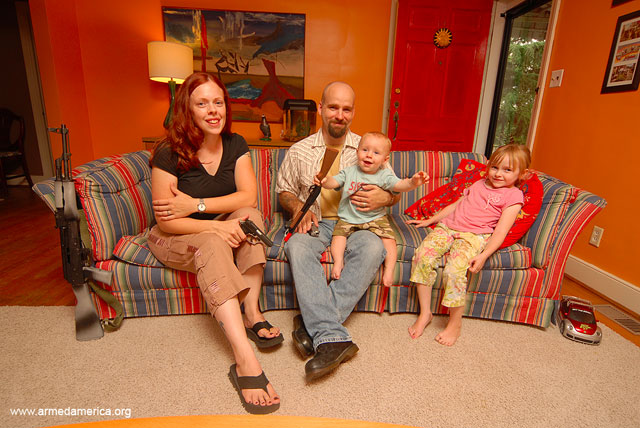
Paul: My family had guns the whole time I was a kid. then i went off and joined the army and went away and come back. I have guns now largely for the same reason I have fire extinguishers in the house and spare tires in the car. I’m a self reliant kind of guy. and there could come a time when I need to protect my family and i’m a self reliant kind of guy.
Beth: I have one for self protection. I was raised to never rely on anyone else to protect me or watch my back. It took me a year to pick out one that I liked.
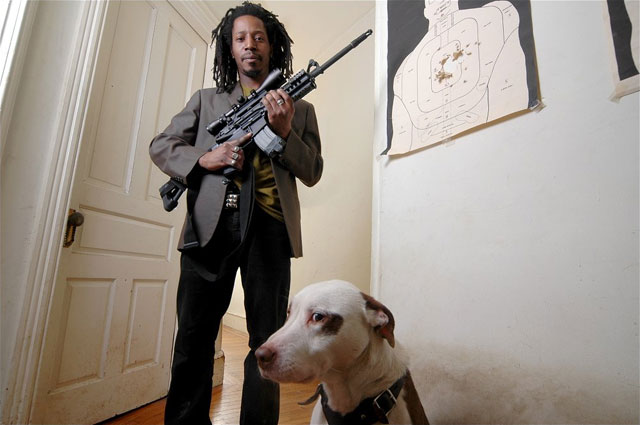
Bashir: I just think it’s a good thing to have

Joe: The first time I was introduced to guns was when I was 5 years old; hunting with my dad, grandfather and uncle. I remember my dad shooting a ringneck pheasant and a rabbit. I carried those two animals until I thought my arms were going to fall off. As a little guy, that made a great impression on me. I’ve hunted all of my life; in Pennsylvania, Idaho, Colorado and Maine. I have a tremendous respect for life, especially wildlife. It never ceases to amaze me how much satisfaction I get from just simply being in the Great Outdoors, whether I make a kill or not.
(via virtual memories)
NYC Mayor Michael Bloomberg has been one the most powerful voices calling for increased gun control in the wake of the Newtown shootings…see here and here. But earlier this year, NYC sold spent shell casings to an ammunition dealer.
In June, the City of New York sold 28,000 pounds of spent shell casings to a an ammunition dealer in Georgia, where they were to be reloaded with bullets. Anyone with $15 can buy a bag of 50, no questions asked, under Georgia law. As The New York Times reported, the city has previously sold shell casings — which are collected at the police target shooting range — to scrap metal dealers, but in this case the highest bidder was the ammunition store.
The city destroys guns but sells spent casing to be recycled. When challenged on this point, Bloomberg got testy:
Then one of the most experienced and professional of New York television reporters, Mary Murphy of WPIX, asked Mr. Bloomberg if the city was going to change its policy and not sell shell casings to ammunition dealers. Mr. Bloomberg set forth into a minisermon about how it was an act of integrity.
“This is the public’s money that we are stewards of, and deliberately deciding to sell things at lower prices than the marketplace commands makes no sense at all, and if you think about it, would create chaos and corruption like you’ve never seen,” he said.
Ms. Murphy pressed on: “Does it send the wrong message though?”
The mayor scolded her as if she were an errant schoolgirl.
“Miss, Miss,” Mr. Bloomberg said. “Either you want to ask a question and I give you an answer, or please come to the next press conference and stand in the back.”
Hmm.
In an editorial for the NY Times in 1993 called Guns Don’t Kill People. Bullets Do., US Senator Daniel Patrick Moynihan described a bill he introduced in the Senate which would have levied a 10,000% tax on hollow-point bullets.
“So far this year, 342 New Yorkers have been killed by stray bullets. And in the past few days, two young women were shot in their pregnant bellies.” A. M. Rosenthal wrote that on this page last Tuesday, the day of the Long Island shooting. By Thursday there were 11 more homicides. If we are to stop it, or come anywhere close, we have to get hold of the ammunition.
On Nov. 3, I introduced a bill that would levy a 10,000 percent tax on Winchester hollow-tipped “Black Talon” bullets, specifically designed to rip flesh. (Colin Ferguson, the suspect in the Long Island shootings, had some 40 of them.)
The tax would effectively raise the price of Black Talons from $20 a box to $2,000. On Nov. 22, 19 days after my bill was introduced, Winchester announced that it would cease sale of Black Talons to the public. Which suggests that the munitions manufacturers are more responsive than the automobile companies were a generation ago. It is also important to note that in 1986 Congress banned the Teflon-coated “cop killer” bullet, which penetrates police body armor. The Swedes are now making a new kind of armor-piercing round. We got that banned in the Senate version of this year’s crime bill without a murmur.
The Long Island shootings Moynihan refers to resulted in the deaths of six people and the injury of nineteen more. (via @Rebeccamead_NYC)
James Fallows suggests talking about “gun safety” and not “gun control”.
I will henceforth and only talk about “gun safety” as a goal for America, as opposed to “gun control.” I have no abstract interest in “controlling” someone else’s ability to own a gun. I have a very powerful, direct, and legitimate interest in the consequences of others’ gun ownership — namely that we change America’s outlier status as site of most of the world’s mass shootings. No reasonable gun-owner can disagree with steps to make gun use safer and more responsible. This also shifts the discussion to the realm of the incremental, the feasible, and the effective.
Ezra Klein asked Akhil Reed Amar, a constitutional scholar, about the Second Amendment. Amar responded with two artworks that illustrate how the meaning of the Second Amendment has shifted over the years.
In a nutshell, almost everything ordinary Americans think they know about the Bill of Rights, including the phrase ‘Bill of Rights,’ comes from the Reconstruction period. Not once did the Founders refer to these early amendments as a bill of rights. We read everything through the prism of the 14th amendment — including the right to bear and keep arms.
The Fourteenth Amendment has a lot of parts, among them the definition of citizenship, Civil War debt, due process, and equal protection. Amar wrote more about the interplay between the 2nd and 14th Amendments for Slate in 2008.
But the 14th Amendment did not specifically enumerate these sacred privileges and immunities. Instead, like the Ninth, the 14th invited interpreters to pay close attention to fundamental rights that Americans had affirmed through their lived experience-in state bills of rights and in other canonical texts such as the Declaration of Independence and landmark civil rights legislation. And when it came to guns, a companion statute to the 14th Amendment, enacted by Congress in 1866, declared that “laws … concerning personal liberty [and] personal security … including the constitutional right to bear arms, shall be secured to and enjoyed by all the citizens.” Here, in sharp contrast to founding-era legal texts, the “bear arms” phrase was decisively severed from the military context. Women as well as men could claim a “personal” right to protect their “personal liberty” and “personal security” in their homes. The Reconstruction-era Congress clearly understood that Southern blacks might need guns in their homes to protect themselves from private violence in places where they could not rely on local constables to keep their neighborhoods safe. When guns were outlawed, only outlaw Klansmen would have guns, to paraphrase a modern NRA slogan. In this critical chapter in the history of American liberty, we find additional evidence of an individual right to have a gun in one’s home, regardless of the original meaning of the Second Amendment.
Emily Badger highlights some trends in gun ownership, gun violence, and public opinion related to gun control over the past several decades.
A handful of charts paint a remarkable picture of some key shifts over the past 30 or 40 years. During that time, gun violence nationally has declined significantly even as aberrant mass shootings have grown less so; public sentiment for regulating the weapons has fallen steeply, too. Mother Jones has estimated that we’re approaching a demographic reality where our population of firearms will outpace our population of people. But hard data on the total number of civilian-owned guns in America is hard to come by, and so much of what we know on the topic is based upon what gun owners themselves say in surveys.
In a clip from an old stand-up routine, Chris Rock advocates for bullet control.
I think all bullets should cost $5,000.
(via @joffley)
Philip Bump for The Atlantic:
But there are two things that are needed for a gun to work: the gun and the ammunition. Limiting guns may be hopeless. So why don’t we focus on the bullets?
People have made their own guns for a long time. A ZIP gun, a crude device used in prisons and by street gangs, can be cobbled together with only a little more effort than Defense Distributed’s plastic offering. A gun can be made from any number of common household objects. But making bullets is much, much trickier. A bullet needs much more specific consideration of materials and weight and requires something that is much harder to come by: a propellant. You can make your own gunpowder, of course, but refining the process to create effective munitions is as tricky as building a simple bomb. Doable, but dangerous.
Eliot Spitzer has a pair of suggestions related to gun control: pressure the owners of gun companies and regulate the sale of bullets.
There may be too many guns to rid the streets of guns, but there are not that many bullets, especially in the calibers needed for the types of weapons used in these shootings. Let’s create a regime that makes sale of bullets to anybody not licensed to carry a gun illegal, makes resale illegal, micro-stamps bullets so they can be traced. No Second Amendment issues here.
There is some movement on the first issue already. Cerberus, a private equity firm that owns a large gun company, is selling the company because of pressure from their investors.
The private equity firm said it had made the investments in gun manufacturers on behalf of its clients, which include pension funds and other institutional investors. Cerberus added that it was the role of legislators to shape the country’s gun policy.
“We believe that this decision allows us to meet our obligations to the investors whose interests we are entrusted to protect without being drawn into the national debate that is more properly pursued by those with the formal charter and public responsibility to do so,” Cerberus said.
This is where the phrase “passing the buck” comes from.
Today NYC mayor Michael Bloomberg urged the President and Congress to take action on gun violence. Here are three of his six specific suggestions:
Pass the legislation of Fix Gun Checks Act that would require a criminal background check for all gun sales including all private sales and online sales
Ban deadly, military-style assault weapons and high-capacity magazines, which were previously banned under the now expired Federal assault weapons ban
Pass legislation to make gun trafficking a felony
From Devin Coldewey at Techcrunch, a look at how technology might disrupt the arms industry. Is a plan for a 3-D printable gun a gun? And if so, how do you control the movement of those pre-guns?
If we as a country, and indeed we as a global community, are going to seriously address the question of gun control, we need to address the issue of fabricated weapons and weapon plans, or else the discussion will be moot. This is because the proliferation of 3D printed weaponry changes both the definition of “gun” and of what it means to “control” it.
This morning at 11am, Ken Layne collected a number of incidents of gun violence that have occurred in the US since the Newtown shootings on Friday. They include:
In Mississippi, one man is dead and two are injured (including the dead man’s father) “after an argument over a man ‘doing donuts’ — or spinning his truck in circles — in a field.”
Two police officers were shot dead in Kansas on Sunday morning. They were investigating a “suspicious vehicle.”
A 42-year-old destitute maniac fired 50 rounds at the Fashion Island luxury mall in Newport Beach, California, on Saturday evening. No one was injured.
Layne also noted “this is not a comprehensive list of the U.S. gun violence over the past 48 hours”.
From Stone, the NY Times’ blog of philosophers writing about current events, a post by Firmin DeBrabander about what sort of society (polite? uncivil? safe?) an armed society is.
Arendt offers two points that are salient to our thinking about guns: for one, they insert a hierarchy of some kind, but fundamental nonetheless, and thereby undermine equality. But furthermore, guns pose a monumental challenge to freedom, and particular, the liberty that is the hallmark of any democracy worthy of the name — that is, freedom of speech. Guns do communicate, after all, but in a way that is contrary to free speech aspirations: for, guns chasten speech.
This becomes clear if only you pry a little more deeply into the N.R.A.’s logic behind an armed society. An armed society is polite, by their thinking, precisely because guns would compel everyone to tamp down eccentric behavior, and refrain from actions that might seem threatening. The suggestion is that guns liberally interspersed throughout society would cause us all to walk gingerly — not make any sudden, unexpected moves — and watch what we say, how we act, whom we might offend.
(via @TomJunod)
A 2006 paper that appeared in Injury Prevention analyzed the possible results of the 1996 gun law reforms in Australia. The most striking result: in the 18 years before tougher laws were passed, there were 13 mass shootings in Australia…and none in the 10.5 years afterwards.
Results: In the 18 years before the gun law reforms, there were 13 mass shootings in Australia, and none in the 10.5 years afterwards. Declines in firearm-related deaths before the law reforms accelerated after the reforms for total firearm deaths (p = 0.04), firearm suicides (p = 0.007) and firearm homicides (p = 0.15), but not for the smallest category of unintentional firearm deaths, which increased. No evidence of substitution effect for suicides or homicides was observed. The rates per 100 000 of total firearm deaths, firearm homicides and firearm suicides all at least doubled their existing rates of decline after the revised gun laws.
Conclusions: Australia’s 1996 gun law reforms were followed by more than a decade free of fatal mass shootings, and accelerated declines in firearm deaths, particularly suicides. Total homicide rates followed the same pattern. Removing large numbers of rapid-firing firearms from civilians may be an effective way of reducing mass shootings, firearm homicides and firearm suicides.
Newer posts
Older posts





Socials & More