kottke.org posts about fractals
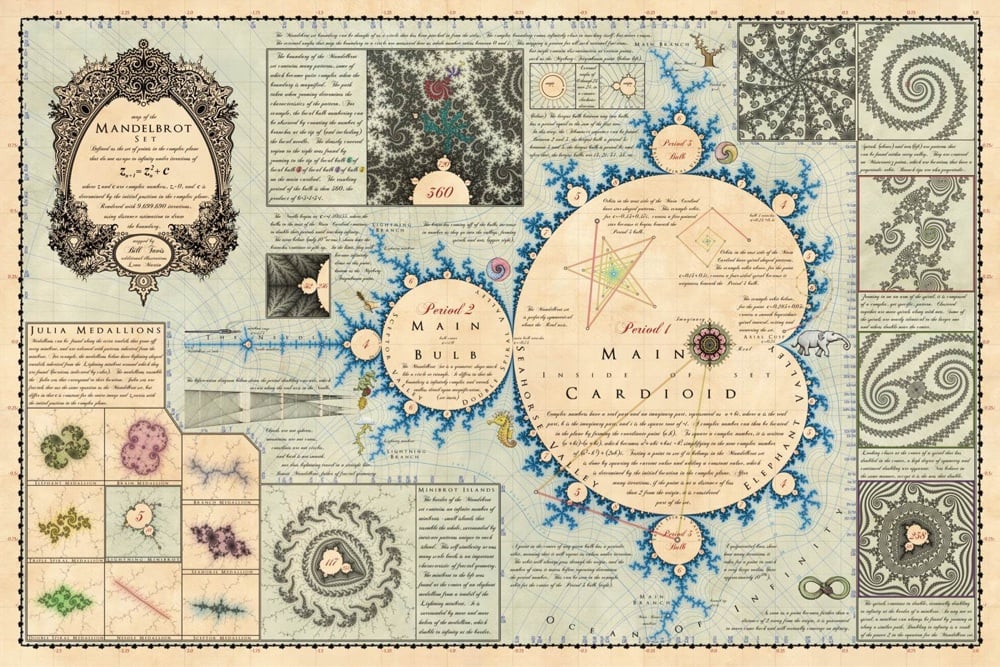
Bill Tavis designed this lovely vintage-style map of the familiar fractal shape, the Mandelbrot set. He is selling a poster version of the map, starting at the very reasonable price of $24. I don’t usually highlight the price on this sort of thing, but an unauthorized seller on Amazon was selling poor-quality counterfeits of the map and even though it wasn’t his fault, Tavis offered to replace any of the crappy maps for free. Great map, and apparently a great human who made it.
I found Tavis’s map when I was searching for the creator of this similarish map that I found on Twitter (bigger here).
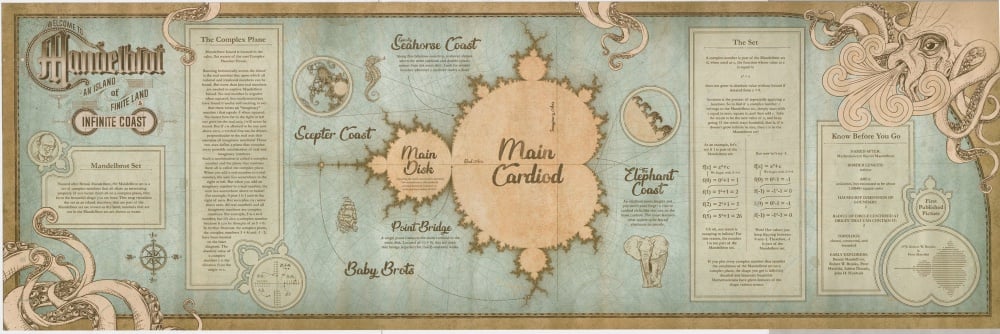
Anyone know who made this version? Jonny Laser made the map in the second image for VSauce (scroll down a bit). (thx, kirsten)

Nidhal Selmi combined the fractal Sierpinski triangle with the impossible Penrose triangle to create the M.C. Escher-like the Selmi triangle.
Adam Neely made a song that is constructed of smaller versions of itself, resulting in a musical fractal that sounds the same at full speed and at 1000 times slower. How does it work? Harmonic polyrhythms.
E=mc^2 tells us that mass and energy are the same thing, just on massively different scales. This is similar to the musician’s theory of relativity which says that rhythm, melody, and harmony are the same thing, just on similarly massively different scales.
So by slowing things way down or speeding things way up, you can convert between harmony and rhythm. (via waxy)
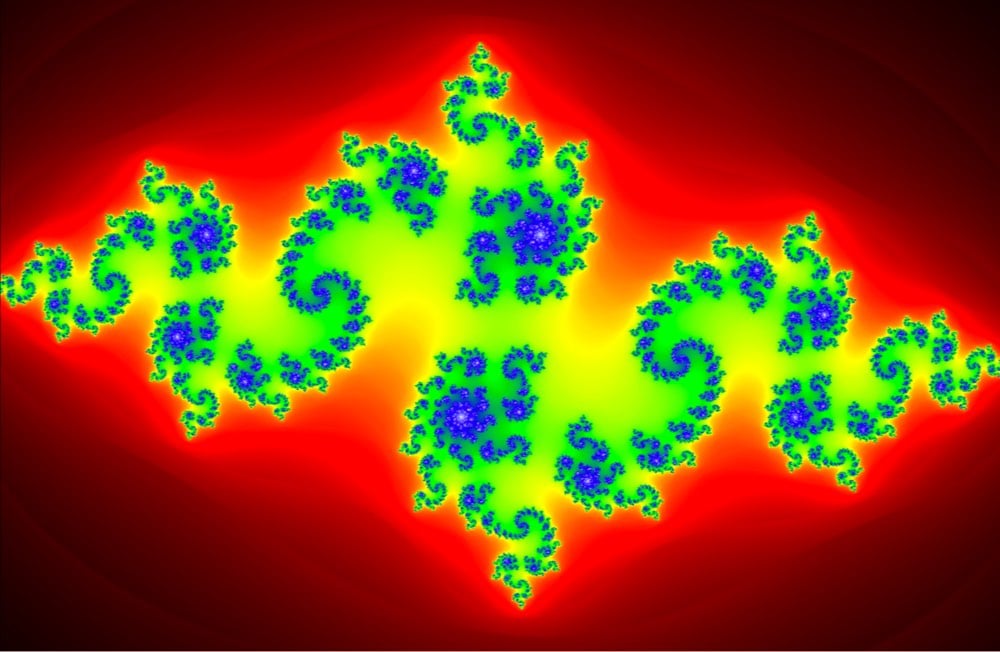
Yay! It’s Fractal Friday! (It’s not, I just made that up.) But anyway, courtesy of Christopher Night, you can play around with this Julia set fractal. It works in a desktop browser (by moving the mouse) or on your phone (by dragging your finger).
The Julia set, if you don’t remember, goes thusly: Let f(z) be a complex rational function from the plane into itself, that is, f(z)=p(z)/q(z) f(z)=p(z)/q(z), where p(z) and q(z) are complex polynomials. Then there is a finite number of open sets F1, …, Fr, that are left invariant by f(z) which, uh, is um… yay! Fractal Friday! The colors are so pretty!


When you look at some plants, you can just see the mathematics behind how the leaves, petals, and veins are organized.
If you remember back more than 12 years ago1 to when Jared Tarbell created these beautiful Buddhabrot images using Processing, then you’ll enjoy this ultra high-resolution exploration of the Buddhabrot fractal.
This looked crazy cool on my 5K iMac. The render took 10 days! (via digg)
From 3Blue1Brown, a quick video showing some space-filling curves.

Fractal Gears is fun to play around with…just keep hitting that randomize button for Sierpinski triangle-esque gear mechanisms.

This web app allows you to explore the Mandelbrot set interactively…just click and zoom. I had an application like this on my computer in college, but it only went a few zooms deep before crashing though. There was nothing quite like zooming in a bunch of times on something that looked like a satellite photo of a river delta and seeing something that looks exactly like when you started. (via @stevenstrogatz)
Hunter Loftis has built a terrain rendering engine in only 130 lines of Javascript. Here’s what the output looks like:
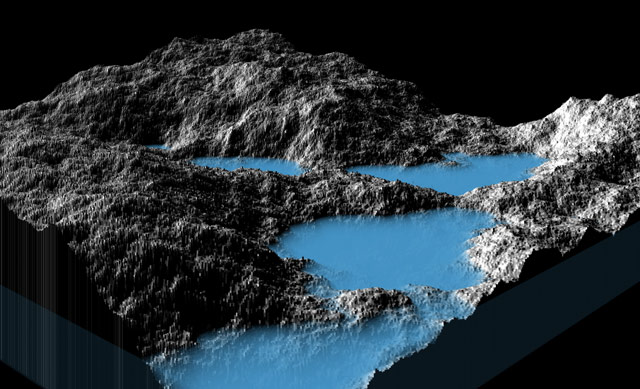
Programmers tend to be lazy (I speak from experience), and one nice side effect of laziness is really brilliant ways to avoid work. In this case, instead of spending mind-numbing hours manually creating what would likely be pretty lame rocky surfaces, we’ll get spiritual and teach the computer what it means to be a rock. We’ll do this by generating fractals, or shapes that repeat patterns in smaller and smaller variations.
I don’t have any way to prove that terrain is a fractal but this method looks really damn good, so maybe you’ll take it on faith.
You can try it out here…reload to get new landscapes. Callum Prentice built an interactive version. This obviously reminds me of Vol Libre, a short film by Loren Carpenter from 1980 that showcased using fractals to generate terrain for the first time.
A short time before his death, Benoît B. Mandelbrot filmed an interview with Errol Morris. Morris charmingly starts off my asking Mandelbrot where “the fractal stuff” came from.
Note: as always, the “B.” in “Benoît B. Mandelbrot” stands for “Benoît B. Mandelbrot”. (via @sampotts)

More than you’ve ever wanted to know about the Sierpinski triangle.
Throughout my years playing around with fractals, the Sierpinski triangle has been a consistent staple. The triangle is named after Wacław Sierpiński and as fractals are wont the pattern appears in many places, so there are many different ways of constructing the triangle on a computer.
All of the methods are fundamentally iterative. The most obvious method is probably the triangle-in-triangle approach. We start with one triangle, and at every step we replace each triangle with 3 subtriangles:
The discussion even veers into cows at some point…but zero mentions of the Menger sponge though? (via hacker news)
Nicholas Rougeux is building an approximation of a Menger sponge, a 3-D fractal shape with no volume and infinite surface area, out of Post-It notes.

It looks about 90% complete…but as a Menger sponge, can you ever really call it finished? (thx, zach)

No words. They should have sent a poet. (via capndesign)
Older posts


Socials & More