



Global warming + evolution = species explosion!!!

Advertise here with Carbon Ads
This site is made possible by member support. 💞
Big thanks to Arcustech for hosting the site and offering amazing tech support.
When you buy through links on kottke.org, I may earn an affiliate commission. Thanks for supporting the site!
kottke.org. home of fine hypertext products since 1998.
Beloved by 86.47% of the web.
kottke.org posts about evolution
Three of the candidates in the recent Republican presidential debate said they don’t believe in evolution: Colorado Representative Tom Tancredo, Kansas Senator Sam Brownback, and former Arkansas governor Mike Huckabee. Hard to believe that this is 2007 and not 1807. John McCain said he did believe in evolution but that “I also believe, when I hike the Grand Canyon and see it at sunset, that the hand of God is there also”.
Update: An earlier version of this post wrongly stated that Mitt Romney raised his hand when asked about disbelieving evolution…Tom Tancredo was the third person. (thx to several who wrote in about this)
Humans are the animal world’s best distance runners…we can run long distances relatively fast without overheating. “Once humans start running, it only takes a bit more energy for us to run faster, Lieberman said. Other animals, on the other hand, expend a lot more energy as they speed up, particularly when they switch from a trot to a gallop, which most animals cannot maintain over long distances.” (via beebo)
Men look at crotches
Among the many interesting things in Online Journalism Review’s article about using eyetracking to increase the effectiveness of news article design is this odd result:
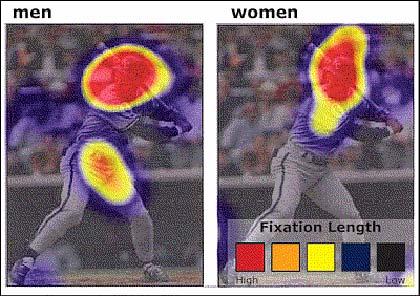
Although both men and women look at the image of George Brett when directed to find out information about his sport and position, men tend to focus on private anatomy as well as the face. For the women, the face is the only place they viewed. Coyne adds that this difference doesn’t just occur with images of people. Men tend to fixate more on areas of private anatomy on animals as well, as evidenced when users were directed to browse the American Kennel Club site.
That is absolutely fascinating. I’d love to hear an evolutionary biologist’s take on why that is.
I’m also heartened by the article’s first featured finding: that tighter writing, more white space, and jettisoning unnecessary imagery helps readers read faster and retain more of what they’ve read.
Why do we believe in God?
The cover story in this week’s NY Times Magazine is called Darwin’s God and covers, from an evolutionary biology standpoint, why people believe in God. Most scientists studying the matter believe that humans have a built-in mechanism for religious belief. For instance, anthropologist Scott Atran sometimes conducts an intriguing experiment with his students:
His research interests include cognitive science and evolutionary biology, and sometimes he presents students with a wooden box that he pretends is an African relic. “If you have negative sentiments toward religion,” he tells them, “the box will destroy whatever you put inside it.” Many of his students say they doubt the existence of God, but in this demonstration they act as if they believe in something. Put your pencil into the magic box, he tells them, and the nonbelievers do so blithely. Put in your driver’s license, he says, and most do, but only after significant hesitation. And when he tells them to put in their hands, few will. If they don’t believe in God, what exactly are they afraid of?
Or rather, why are they afraid? One possible reason is that humans are conditioned to be on the lookout for “agents” and we tend to find them even when they’re not there:
So if there is motion just out of our line of sight, we presume it is caused by an agent, an animal or person with the ability to move independently. This usually operates in one direction only; lots of people mistake a rock for a bear, but almost no one mistakes a bear for a rock.
What does this mean for belief in the supernatural? It means our brains are primed for it, ready to presume the presence of agents even when such presence confounds logic. “The most central concepts in religions are related to agents,” Justin Barrett, a psychologist, wrote in his 2004 summary of the byproduct theory, “Why Would Anyone Believe in God?” Religious agents are often supernatural, he wrote, “people with superpowers, statues that can answer requests or disembodied minds that can act on us and the world.”
Another reason for the instinctive religious impulse may be that people are able to put themselves in other peoples’ minds, to think about how another person might be feeling or thinking:
Folkpsychology, as Atran and his colleagues see it, is essential to getting along in the contemporary world, just as it has been since prehistoric times. It allows us to anticipate the actions of others and to lead others to believe what we want them to believe; it is at the heart of everything from marriage to office politics to poker. People without this trait, like those with severe autism, are impaired, unable to imagine themselves in other people’s heads.
The process begins with positing the existence of minds, our own and others’, that we cannot see or feel. This leaves us open, almost instinctively, to belief in the separation of the body (the visible) and the mind (the invisible). If you can posit minds in other people that you cannot verify empirically, suggests Paul Bloom, a psychologist and the author of “Descartes’ Baby,” published in 2004, it is a short step to positing minds that do not have to be anchored to a body. And from there, he said, it is another short step to positing an immaterial soul and a transcendent God.
There’s lots more in the article…it’s well worth a read.
Nicholas Kristof’s “Modest Proposal for a Truce on Religion,” and responses by Sam Harris, Richard Dawkins, and Daniel Dennett. “Mr. Kristof has simply become acclimatized to the convention that you can criticize anything else but you mustn’t criticize religion.”
Interesting hypothesis: young Hollywood starlets are dieting to retain exaggerated child-like features that, evolutionarily speaking, are more attractive to adults. The technical term for this is neoteny.
Richard Dawkins: Why there almost certainly is no God. “We cannot, of course, disprove God, just as we can’t disprove Thor, fairies, leprechauns and the Flying Spaghetti Monster. But, like those other fantasies that we can’t disprove, we can say that God is very very improbable.”
A classic article by Stephen Jay Gould on the changing biological features of Mickey Mouse. Over the years, Mickey has become more well-behaved and his appearance more juvenile (larger eyes, short pudgy legs, relatively large head, short snout, etc.). “When we see a living creature with babyish features, we feel an automatic surge of disarming tenderness.”
Carl Zimmer on the origin of whales, baleen and non. “Baleen whales evolved baleen long after splitting off from other whales. Their baleen-free ancestors apparently thrived as leopard-seal-like hunters for millions of years.”
The AAAS, the organisation which publishes Science magazine, has produced a book called The Evolution Dialogues. “Meant specifically for use in Christian adult education programs, it offers a concise description of the natural world, as explained by evolution, and the Christian response, both in Charles Darwin’s time and in contemporary America.” (thx, mike)
Public acceptance of evolution is relatively low in the US and is getting lower. “American Protestantism is more fundamentalist than anybody except perhaps the Islamic fundamentalist.”
Update: Here’s a graph of the results. Yikes.
Natural deselection
Tom Coates recently checked out the Royal College of Art Summer Show in London and ran across this project by Tim Simpson:

…three plants compete to reach the light that feeds and nourishes them. The first one to succeed survives. The other two are automatically cut down in their prime.
First plant to grow close to the proximity sensors wins. A simple and elegant idea.
Socials & More