kottke.org posts about early color photography
Culled primarily from the Charles W. Cushman collection, a selection of color photographs of NYC taken in the 40s, 50s, and 60s: Downtown 1941, Downtown 1960, Lower East Side, and Miscellaneous. Here’s a shot of Canal St in 1942 (with cobblestones!):
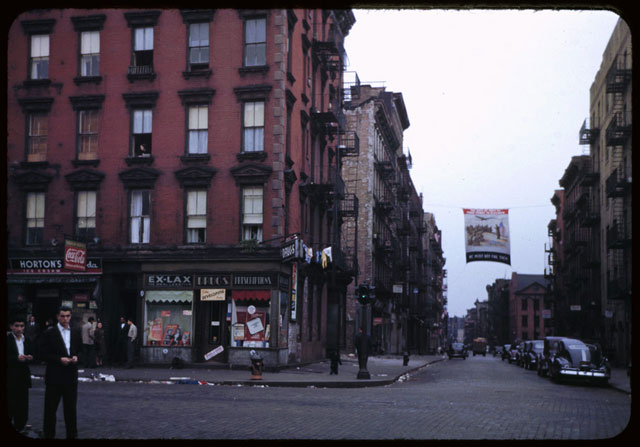
Does anyone know which corner this is? (Here’s another view.) I poked around on Google Maps for a bit trying to find it, but I fear that building is long gone…Canal St, particularly the western part, is much changed since the 1940s.

Well, not so much The Beatles as The Quarrymen, a band formed by John Lennon and some schoolmates that was the precursor to The Beatles. (via @brainpicker)
The color photography of Sergei Mikhailovich Prokudin-Gorskii, who plied his trade in Russia in the early 1900s, is making the rounds online again. It’s always worth a look. Prokudin-Gorskii made color photographs using a clever filtering system years before color photography would be widely available. As a result, his work goes on the list of things that seem contemporary but really aren’t.


As Mike notes, I first linked to Prokudin-Gorskii’s work more than 8 years ago (!!).
Update: Clayton James Cubitt reminded me that Prokudin-Gorskii took a color portrait of Leo Tolstoy in 1908. (thx, clayton)
André Zucca’s color photographs of Paris during the German occupation of WWII have provoked controversy because Zucca worked for a German propaganda magazine. But Richard Brody argues that Zucca’s photographs are true to the Paris of the time and don’t just show the “cheerful ease” of the city’s residents.
Certainly, Zucca couldn’t get the whole story: he photographed Jews wearing the star but couldn’t show the roundups or the deportation to Auschwitz; he could show German soldiers but couldn’t show the arrest, torture, and execution of resisters. He couldn’t, but nobody could; the problem wasn’t that he worked for a propaganda rag: photographers who actively worked for the Resistance couldn’t do it either. But what he did do was to capture the paradoxes of the Occupation, where horror and pleasure coexisted in shockingly close proximity, where the active resistance to Nazi occupation was in fact far less prevalent than the feigned daily oblivion of those who kept their heads down and tried to cope.
More of Zucca’s photos are here.
I’m fascinated by early color photography…it takes a time we think of being in black & white and makes it accessible and modern. In the hands of Auguste and Louis Lumière, the “lowly, lumpy potato” made color photography possible in the early 1900s. The photos were called autochromes.
The Lumière brothers gathered up their potatoes and ground them into thousands of microscopic particles; they separated this powder into three batches, dying one batch red-orange, one violet and one green; the colored particles were thoroughly mixed and sifted onto a freshly varnished, clear glass plate while the lacquer remained tacky; excess potato bits were swept from the plate, which was pressed through steel rollers to flatten the colored grains, transforming each into a minuscule color filter measuring from .0006 to .0025 millimeters across. Gaps between the colored particles were filled in with carbon black, the plate was varnished again and a thin, light-sensitive emulsion of silver bromide was brushed over that. Now the plate was ready for the camera. When the shutter was opened, light filtered through the translucent potato grains, and a multicolored image was imprinted on the emulsion. After the negative plate was developed in the lab, it was washed and dried, covered with another piece of glass to protect the emulsion and bound with gummed tape. Et voilà! A color photograph unlike any seen before.
Here’s a slideshow of some photos taken by this process. Here’s some autochromes of Mark Twain from 1908.
More early color photography (not necessarily autochromes): Sergei Mikhailovich Prokudin-Gorskii’s stunning photographs of Russia circa 1909-1915, photos of WWI, photos of WWII, and photos of America in the late 30s/early 40s (color corrected). (thx, david)
The Library of Congress has an online photography exhibit called Bound for Glory: America in Color, 1939-1943 (thx, shay). The photos were a little low contrast, so I color corrected a few of them in Photoshop:
My goal was not to blow out the contrast or unnecessarily accentuate colors, but attempt to duplicate what these photos would look like had they been taken with a contemporary camera and processed using contemporary techniques and materials.
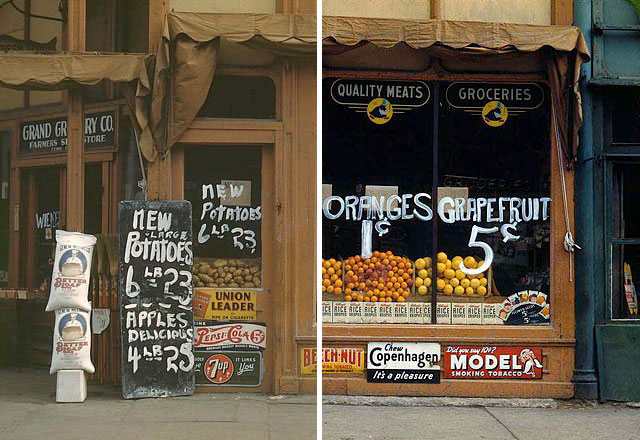
Bound for Glory and Color Corrected »
These color photographs of circa-1915 Tsarist Russia by Sergei Mikhailovich Prokudin-Gorskii are amazing (particularly these two).
Newer posts





Socials & More