kottke.org posts about biology
Scientists have created a really fast bacterial computer that can solve, among other things, a specialized case of the travelling salesman problem.
Programming such a computer is no easy task, however. The researchers coded a simplified version of the problem, using just three cities, by modifying the DNA of Escherichia coli bacteria. The cities were represented by a combination of genes causing the bacteria to glow red or green, and the possible routes between the cities were explored by the random shuffling of DNA. Bacteria producing the correct answer glowed both colours, turning them yellow.
But just as vacuum tube and silicon chip-based computers became capable of more abstract calculations, perhaps the bacteria computer will follow the same developmental trajectory.
The NY Times on the progress being made in explaining how life arose on Earth.
With these four recent advances — Dr. Szostak’s protocells, self-replicating RNA, the natural synthesis of nucleotides, and an explanation for handedness — those who study the origin of life have much to be pleased about, despite the distance yet to go. “At some point some of these threads will start joining together,” Dr. Sutherland said. “I think all of us are far more optimistic now than we were five or 10 years ago.”
This week in the New Yorker, Elizabeth Kolbert tells us that up until modern times, there have been five big mass extinctions of life on Earth. Most biologists now agree that we are in the midst of the sixth big mass extinction, one caused by humans.
Currently, a third of all amphibian speicies, nearly a third of all reef-building corals, a quarter of all mammals, and an eighth of all birds are classified as “threatened with extinction.” These estimates do not include the species that humans have already wiped out or the species for which there are insignificant data. Nor do the figures take into account the projected effects of global warming or or ocean acidification. Nor, of course, can they anticipate the kinds of sudden, terrible collapses that are becoming almost routine.
See also a related audio clip by Kolbert, the Holocene extinction event, and colony collapse disorder.
Chemist John Sutherland has discovered a process by which ordinary chemicals could spontaneously form RNA molecules, the suspected building blocks of the first life on Earth.
Scientists have long suspected that the first forms of life carried their biological information not in DNA but in RNA, its close chemical cousin. Though DNA is better known because of its storage of genetic information, RNA performs many of the trickiest operations in living cells. RNA seems to have delegated the chore of data storage to the chemically more stable DNA eons ago. If the first forms of life were based on RNA, then the issue is to explain how the first RNA molecules were formed.
On the Zeitgedächtnis, or time-sense, of honeybees.
Flowers of a given species all produce nectar at about the same time each day, as this increases the chances of cross-pollination. The trick works because pollinators, which in most cases means the honeybee, concentrate foraging on a particular species into a narrow time-window. In effect the honeybee has a daily diary that can include as many as nine appointments — say, 10:00 a.m., lilac; 11:30 a.m., peonies; and so on. The bees’ time-keeping is accurate to about 20 minutes.
Bone is a springy and salty wonder that is proving much more functional within the human body than originally thought.
The skeleton is a multipurpose organ, offering a ready source of calcium for an array of biochemical tasks, and housing the marrow where blood cells are born. Yet above all the skeleton allows us to locomote, which means it gets banged up and kicked around. Paradoxically, it copes with the abuse and resists breaking apart in a major way by microcracking constantly. “Bone microcracks, that’s what it does,” Dr. Ritchie said. “That’s how stresses are relieved.” […] But like all forms of health care, bone repair doesn’t come cheap, and maintaining skeletal integrity consumes maybe 40 percent of our average caloric budget.
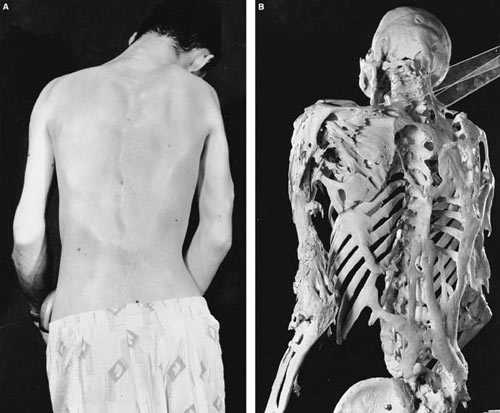
The article leads off with the story of Harry Eastlack, whose body repaired itself with bone-building cells no matter what the injury, essentially giving him a not-so-Wolverine-like second skeleton. Here’s a photo I found of Eastlack’s skeleton, which is housed at the Mutter Museum of the College of Physicians.
Have Spanish scientists found a cure for colony collapse disorder, which affects millions of honeybees around the world? The sole cause, according to the scientists, is a fungal parasite called nosema ceranae. This finding doesn’t jibe with the recent Scientific American article written by two American CCD investigators. They say that nosema is one factor out of many.
In the gut contents we found spores of nosema, single-celled fungal parasites that can cause bee dysentery. The spore counts in these and in subsequent samples, however, were not high enough to explain the losses. Molecular analysis of Hackenberg’s bees, performed by the other of us (Cox-Foster), also revealed surprising levels of viral infections of various known types. But no single pathogen found in the insects could explain the scale of the disappearance.
(via waxy)
Update: Some beekeepers have solved bee death problems in their hives by using comb with smaller cell sizes.
In case you weren’t aware, and I wasn’t for a long time, the foundation in common usage by beekeepers results in much larger bees than what you would find in a natural hive. I’ve measured sections of natural worker brood comb that are 4.6mm in diameter. This 4.6mm comb was drawn by a hive of commercial Carniolans and this 4.7mm comb was drawn on the first try by a package of commercial Carniolans. What most beekeepers use for worker brood is foundation that is 5.4mm in diameter. If you translate that into three dimensions, instead of one, that produces a bee that is about half again as large as is natural. By letting the bees build natural sized cells, I have virtually eliminated my Varroa and Tracheal mite problems.
The cell size in commercially available combs has been increased over the years to increase the honey yield. (thx, brian)
In an article for Scientific American, two scientists who are working on the causes of colony collapse disorder (CCD) say that they and other researchers have made some progress in determining what’s killing all of those bees.
The growing consensus among researchers is that multiple factors such as poor nutrition and exposure to pesticides can interact to weaken colonies and make them susceptible to a virus-mediated collapse. In the case of our experiments in greenhouses, the stress of being confined to a relatively small space could have been enough to make colonies succumb to IAPV and die with CCD-like symptoms.
It’s like AIDS for bees…the lowered immunity doesn’t kill directly but makes the bees more susceptible to other illness. One the techniques researchers used in investigating CDD is metagenomics. Instead of singling out an organism for analysis, they essentially mixed together a bunch of genetic material found in the bees (including any bacteria, virii, parasites, etc.) and sliced it up into small pieces that were individually deciphered. They went through those pieces one by one and assigned them to known organisms until they ran across something unusual.
The CSI-style investigation greatly expanded our general knowledge of honeybees. First, it showed that all samples (CCD and healthy) had eight different bacteria that had been described in two previous studies from other parts of the world. These findings strongly suggest that those bacteria may be symbionts, perhaps serving an essential role in bee biology such as aiding in digestion. We also found two nosema species, two other fungi and several bee viruses. But one bee virus stood out, as it had never been identified in the U.S.: the Israeli acute paralysis virus, or IAPV.
Every year, a professor from Liberty University takes his Advanced Creation Studies biology class to the Smithsonian Museum of Natural History to check out the opposition.
“There’s nothing balanced here. It’s completely, 100 percent evolution-based,” said DeWitt, a professor of biology. “We come every year, because I don’t hold anything back from the students.”
Creationists, who take their view of natural history straight from the book of Genesis, believe that scientific data can be interpreted to support their idea that God made the first human, Adam, in an essentially modern form 6,000 to 10,000 years ago.
A 2006 poll by the Pew Forum on Religion & Public Life found that 42 percent of Americans believe humans have always existed in their present form. At universities such as Liberty, founded by the late Jerry Falwell, those views inform the entire science curriculum.
(via clusterflock)
This review of Superorganism, a new book by Bert Hölldobler and Edward O. Wilson, is chock full of fascinating facts about ant societies and how they organize themselves.
The progress of ants from this relatively primitive state to the complexity of the most finely tuned superorganisms leaves no doubt that the progress of human evolution has largely followed a path taken by the ants tens of millions of years earlier. Beginning as simple hunter-gatherers, some ants have learned to herd and milk bugs, just as we milk cattle and sheep. There are ants that take slaves, ants that lay their eggs in the nests of foreign ants (much like cuckoos do among birds), leaving the upbringing of their young to others, and there are even ants that have discovered agriculture. These agricultural ants represent the highest level of ant civilization, yet it is not plants that they cultivate, but mushrooms.
My grandpappy used to say to me, “Them dolphins is smart. The chefs of the sea they are!”** Scientists have observed bottlenose dolphins preparing cuttlefish for consumption.
Considering they can’t wield a knife or cleaver, dolphins make impressive butchers. Researchers in Australia recently observed a bottlenose performing a precise series of manoeuvres to kill, gut and bone a cuttlefish. The six-step procedure gets rid of the invertebrate’s unappetising ink and hard-to-swallow cuttlebone.
** This is not true.
Remarkable photo of a gynandromorphic cardinal with bilateral asymmetry, meaning that the left side of the bird is male and the right side is female…a red/brown split right down the middle.
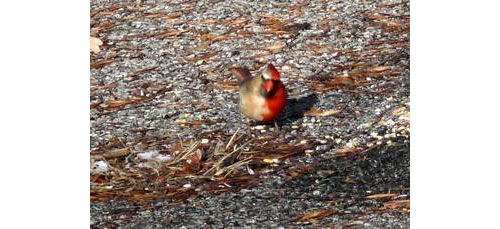
Not Photoshopped, although the phenomenon is more common with butterflies. (thx, jason)
Update: Here’s a two-tone lobster caught in Maine in 2006. (thx, nicole & jim)
Steven Johnson really likes a book called Eating the Sun: How Plants Power the Planet by Oliver Morton; he calls it his favorite book (so far) of 2008. From a Publishers Weekly review:
The cycle of photosynthesis is the cycle of life, says science journalist Morton (Mapping Mars). Green leaves trap sunlight and use it to absorb carbon dioxide from the air and emit life-giving oxygen in its place. Indeed, plants likely created Earth’s life-friendly oxygen- and nitrogen-rich biosphere. In the first part, Morton, chief news and features editor of the leading science journal, Nature, traces scientists’ quest to understand how photosynthesis works at the molecular level. In part two, Morton addresses evidence of how plants may have kick-started the complex life cycle on Earth. The book’s final part considers photosynthesis in relation to global warming, for, he says, the Earth’s plant-based balance of carbon dioxide and oxygen is broken: in burning vast amounts of fossil fuels, we are emitting more carbon dioxide than the plants can absorb. But Morton also explores the possibility that our understanding of photosynthesis might be harnessed to regain that balance.
Scientists are saying that we can make ourselves a whoolly mammoth for as little as $10 million. All it takes is a mammoth genome, a lot of painstaking work, and much computing power.
If the genome of an extinct species can be reconstructed, biologists can work out the exact DNA differences with the genome of its nearest living relative. There are talks on how to modify the DNA in an elephant’s egg so that after each round of changes it would progressively resemble the DNA in a mammoth egg. The final-stage egg could then be brought to term in an elephant mother, and mammoths might once again roam the Siberian steppes.
The article also notes that if this works for the mammoth, it might also be possible to do the same for a Neanderthal. What an age we live in.
DARPA is soliciting research proposals for people wishing to solve one of twenty-three mathematical challenges, many of which deal with attempting to find a mathematical basis underlying biology.
What are the Fundamental Laws of Biology?: This question will remain front and center for the next 100 years. DARPA places this challenge last as finding these laws will undoubtedly require the mathematics developed in answering several of the questions listed above.
(via rw)
Newer posts
Older posts


Socials & More