kottke.org posts about Steven Levitt
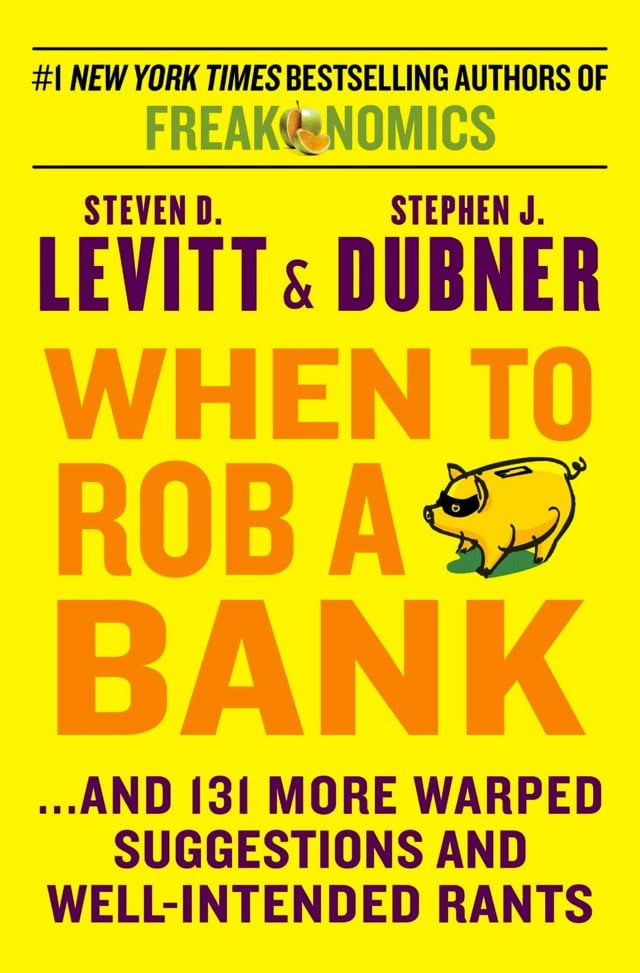
A new book from the guys who brought you Freakonomics (which is ten years old…ten years): When to Rob a Bank: …And 131 More Warped Suggestions and Well-Intended Rants.
Over the past decade, Steven D. Levitt and Stephen J. Dubner have published more than 8,000 blog posts on Freakonomics.com. Many of them, they freely admit, were rubbish. But now they’ve gone through and picked the best of the best. You’ll discover what people lie about, and why; the best way to cut gun deaths; why it might be time for a sex tax; and, yes, when to rob a bank. (Short answer: never; the ROI is terrible.) You’ll also learn a great deal about Levitt and Dubner’s own quirks and passions, from gambling and golf to backgammon and the abolition of the penny.
FWIW, here are the posts about the sex tax and when to rob a bank. (via mr)
Steven Levitt and Stephen Dubner, the co-authors of the immensely popular Freakonomics, are back with their third book in the series: Think Like a Freak. In it, rather than discussing what they think, they talk about how they think.
Levitt and Dubner offer a blueprint for an entirely new way to solve problems, whether your interest lies in minor lifehacks or major global reforms. As always, no topic is off-limits. They range from business to philanthropy to sports to politics, all with the goal of retraining your brain. Along the way, you’ll learn the secrets of a Japanese hot-dog-eating champion, the reason an Australian doctor swallowed a batch of dangerous bacteria, and why Nigerian e-mail scammers make a point of saying they’re from Nigeria.
The book is out on May 12, but of course you can preorder, etc.
Update: Excerpt in the WSJ.
In a New Yorker book review this week, Elizabeth Kolbert tears Levitt and Dubner a new one over the geoengineering chapter of SuperFreakonomics, calling the pair’s thinking on the issue “horseshit”.
Given their emphasis on cold, hard numbers, it’s noteworthy that Levitt and Dubner ignore what are, by now, whole libraries’ worth of data on global warming. Indeed, just about everything they have to say on the topic is, factually speaking, wrong. Among the many matters they misrepresent are: the significance of carbon emissions as a climate-forcing agent, the mechanics of climate modelling, the temperature record of the past decade, and the climate history of the past several hundred thousand years.
Freakonomists Steven Levitt and Stephen Dubner probably got the ball rolling back in 2006 with their article about how people get really good at something. Malcolm Gladwell threw his hat into the ring with Outliers and the 10,000-Hour Rule. More recently, David Brooks stepped up to the plate and delivered a review of two recent books on how genius is made, not born: Daniel Coyle’s The Talent Code and Geoff Colvin’s Talent is Overrated. I even stuck my oar in briefly; the deliberate practice concept fascinates me, tangentially related as it is to relaxed concentration. From Brooks’ article:
The key factor separating geniuses from the merely accomplished is not a divine spark. It’s not I.Q., a generally bad predictor of success, even in realms like chess. Instead, it’s deliberate practice. Top performers spend more hours (many more hours) rigorously practicing their craft.
Athletes have long been ridiculed for the cliches they use when talking about how they won, particularly during post-game interviews. You know them by heart:
We just have to keep working hard.
It just comes down to staying focused.
We gave it 110% tonight.
We worked hard in practice all week.
We never gave up.
If the writers above (and the researchers their writings are based on) are correct, maybe the jocks have it right: it all comes down to preparation, working harder, and wanting it more than the other guy. Simple…except for that pesky 10,000 hours thing.
Very interesting paper on the economics of prostitution by Steven Levitt and Sudhir Venkatesh.
The transaction-level data we collected suggests that street prostitution yields an average wage of $27 per hour. Given the relatively limited hours that active prostitutes work, this generates less than $20,000 annually for a women working year round in prostitution. While the wage of a prostitute is four times greater than the non-prostitution earnings these women report (approximately $7 per hour), there are tremendous risks associated with life as a prostitute. According to our estimates, a woman working as a prostitute would expect an annual average of a dozen incidents of violence and 300 instances of unprotected sex.
The authors also noted that a prostitute was “more likely to have sex with a police officer than to get officially arrested by one”. (via marginal revolution)
From the abstract of a new paper on the influence of the Ku Klux Klan by Roland Fryer and Steven Levitt:
Surprisingly, we find few tangible social or political impacts of the Klan. There is little evidence that the Klan had an effect on black or foreign born residential mobility, or on lynching patterns. Historians have argued that the Klan was successful in getting candidates they favored elected. Statistical analysis, however, suggests that any direct impact of the Klan was likely to be small. Furthermore, those who were elected had little discernible effect on legislation passed.
The full paper is available on Fryer’s web site. (via mr)
Steven Levitt notes a passage from Edward Conlon’s Blue Blood about the difference in pay between the police and homeless panhandling heroin addicts. The answer might surprise you.
Stephen Dubner and Steven Levitt (aka the Freakonomics guys) on the first-world phenomenon of doing menial labor as a hobby. Examples: knitting, cooking, gardening, lawn care. More on the Freakonomics site.
Profile of economist Kevin Murphy, who none other than Steven Levitt calls “the smartest guy in the field”.
Video of a Steven Levitt talk on the economics of gangs and why gangbanger is not such a good vocation (for one thing, the job pays less than McDonald’s). The board of directors stuff made me think of the co-op on The Wire.
Interesting story from Steven Levitt: stuck in a Vegas poker tournament with a $3000 first prize but needing to go to the airport to catch the last flight of the night, he starts playing very aggressively in order to win big or lose everything so that he can leave. (via gulfstream)
Lee Siegel has a Malcolm Gladwell problem and, he argues, so do the rest of us. From a commenter (who gets his Dubner mixed up with his Levitt): “Gladwell is destroying literature as we know it”. (via 3qd)
The Stev(ph)ens Dubner and Levitt report on some recent research suggesting that people who are good at things got good at them primarily through practice and not because of innate talent.
Their work, compiled in the “Cambridge Handbook of Expertise and Expert Performance,” a 900-page academic book that will be published next month, makes a rather startling assertion: the trait we commonly call talent is highly overrated. Or, put another way, expert performers — whether in memory or surgery, ballet or computer programming — are nearly always made, not born. And yes, practice does make perfect. These may be the sort of cliches that parents are fond of whispering to their children. But these particular cliches just happen to be true.
The talent myth described here seems to be distinct from that which Malcolm Gladwell talks about in relation to talented people and companies, but I’m sure parallels could be drawn. But back to the original article…I was particularly taken with the concept of “deliberate practice”:
Deliberate practice entails more than simply repeating a task — playing a C-minor scale 100 times, for instance, or hitting tennis serves until your shoulder pops out of its socket. Rather, it involves setting specific goals, obtaining immediate feedback and concentrating as much on technique as on outcome.
“Deliberate practice” reminds me of a video game a bunch of my friends are currently hooked on called Brain Age. Available for the handheld Nintendo DS, Brain Age is based on a Japanese brain training “game” developed by Dr. Ryuta Kawashima. The game measures the “age” of your brain based on your performance of simple tasks like memorizing a list of words or addition of small numbers. As you practice (deliberately), you get faster and more skilled at solving these mini-games and your brain age approaches that of a smarty-pants, twitchy-fingered teenager.
Speaking of talented teenagers, this week’s New Yorker contains an article (not online) on Ivan Lendl’s golfing daughters. In it, Lendl agrees that talent is created, not born:
“Can you create athletes, or do they just happen?” [Lendl] asked me not long ago. “I think you can create them, and I think that Tiger Woods’s father proved that. People will sometimes ask me, ‘How much talent did you have in tennis?’ I say, ‘Well, how do you measure talent?’ Yeah, sure, McEnroe had more feel for the ball. But I knew how to work, and I worked harder than he did. Is that a talent in itself? I think it is.”
Translation: there’s more than one way to be good at something. There’s something very encouraging and American about it, this idea that through hard work, you can become proficient and talented at pretty much anything.
Older posts





Socials & More