After many days of analysis by scientists and internet sleuths alike, it’s likely that the thing pictured whizzing by the skydiver in this video is not a meteorite but a plain old rock that got packed in with his parachute. Phil Plait reports:
I actually became convinced last night, when BA Tweep Helge Bjorkhaug sent me a link to a slowed-down version of the video. Immediately before the rock flies past, I saw a second piece of debris just to the right of the skydiver’s parachute strap. It was in several frames, and clearly real.
So yeah, bummer, not a meteorite. But as Plait notes, that’s how science works.
That’s how you get to the truth, folks. Open inquiry, honest investigation, and acceptance of the line of evidence no matter where it leads.
The other day, Bill Nye debated Ken Ham about evolution and creationism. At the event, Matt Stopera asked self-identifying creationists to write question/notes to those who “believe” in evolution. Here’s one:
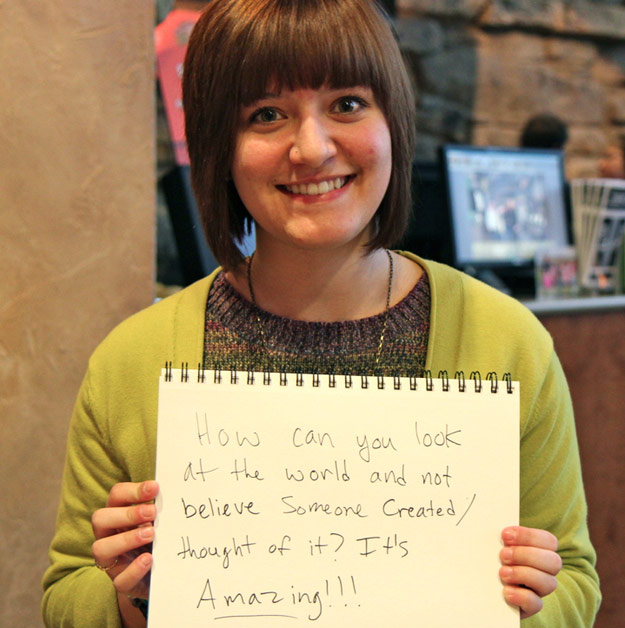
Phil Plait of Bad Astronomy responded to each of the 22 notes/questions from the creationists. Here’s his answer to the comment above:
I agree; it is amazing! I’ve written about this many times. But we know that complexity can arise naturally through the laws of physics. It doesn’t take very complex rules to create huge diversity. Look at poker; a simple set of rules creates a game that has so many combinations it’s essentially infinite to human experience. We can figure out the rules of nature by studying the way processes follow them, and deduce what’s going on behind the scenes. And whenever we do, we see science.
This makes me think of Richard Feynman’s ode to the scientific beauty of a flower:
I have a friend who’s an artist and has sometimes taken a view which I don’t agree with very well. He’ll hold up a flower and say “look how beautiful it is,” and I’ll agree. Then he says “I as an artist can see how beautiful this is but you as a scientist take this all apart and it becomes a dull thing,” and I think that he’s kind of nutty. First of all, the beauty that he sees is available to other people and to me too, I believe. Although I may not be quite as refined aesthetically as he is … I can appreciate the beauty of a flower. At the same time, I see much more about the flower than he sees. I could imagine the cells in there, the complicated actions inside, which also have a beauty. I mean it’s not just beauty at this dimension, at one centimeter; there’s also beauty at smaller dimensions, the inner structure, also the processes. The fact that the colors in the flower evolved in order to attract insects to pollinate it is interesting; it means that insects can see the color. It adds a question: does this aesthetic sense also exist in the lower forms? Why is it aesthetic? All kinds of interesting questions which the science knowledge only adds to the excitement, the mystery and the awe of a flower. It only adds. I don’t understand how it subtracts.
From Phil Plait at Bad Astronomy, a list of ten things you might not know about black holes. Some of this I knew, but this one is incredible:
If you were to rope off the solar system out past Neptune, enclose it in a giant sphere, and fill it with air, it would be a black hole!
See also this recent tweet from physicist Brian Greene:
Remove all the space within the atoms making up the human body, and every person that’s ever lived would fit inside a baseball.
(via @daveg & @rosecrans)
Phil Plait of Bad Astronomy takes on Steve Jobs’ claim that iPhone 4’s pixels are too small for the human eye to see individually. I have confidence in Plait’s conclusions:
I know a thing or two about resolution as well, having spent a few years calibrating a camera on board Hubble.
He may as well have pulled Marshall McLuhan out from behind a movie poster.




Socials & More