kottke.org posts about Boston
This is a lovely little short film about the many snowy owls that migrate down from the Arctic and settle at Boston’s Logan airport and the man who safely captures & relocates the owls away from the airport. I love this story about what a fierce hunter the snowy owl is:
A snowy owl, several years ago, took a peregrine falcon. This peregrine came in — it was a young bird — came in, harassed the snowy owl while the snowy owl was roosting and sleeping. Bopped him off the back of the head, woke the owl up. [The peregrine] proceeded to take off and flew into a flock of starlings. It grabbed one of the starlings, it took the starling to the ground. And little did it know but that the snowy owl was right onto its tail. That snowy owl came in and grabbed that peregrine falcon and had him for dinner.
(via, sorta, kottke.org)
There’s nothing more entertaining than watching Boston-area natives do over-the-top Bawston accents, but it’s always a precarious undertaking. If you don’t get the accent right…yeesh. When Hyundai named their new automated parking feature “Smart Park”, those two words demanded that they give the Boston angle a shot, and the team of Chris Evans, John Krasinski, and Rachel Dratch delivered. The bit that really set the hook for me was when Krasinski called Evans “kid”.
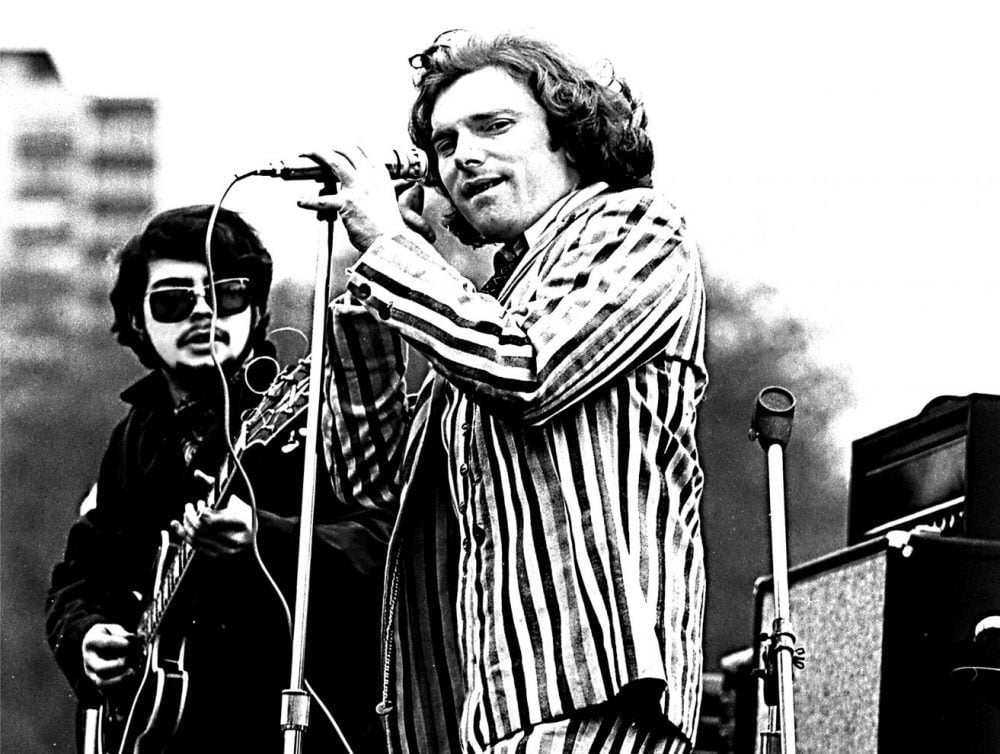
Van Morrison wrote his spare, stringed magnum opus Astral Weeks during his time among the late 60s LSD-fueled counterculture in Boston. Ryan H. Walsh’s new book Astral Weeks: A Secret History of 1968 covers the nine months Morrison spent in Cambridge, as well as a cast of characters both known and not. Among those orbiting Morrison were commune/cult leader Mel Lyman, members of the Velvet Underground, who played the Boston Tea Party club 15 times that year, and Carly Simon’s younger brother, Peter.
The common thread among the myriad personalities and communities profiled by Walsh is a yearning for transcendence and rebirth. These are also the central themes of Van Morrison’s “Astral Weeks.” Morrison’s route to the spiritual plane was through music, not drugs. (A notorious drunk during his time in Boston, he is said to have eschewed dope after “burning [his] brain on hash” when he was younger.) The singer seems to have been guided by his subconscious in creating “Astral Weeks.” Some of the songs emerged from dreams and reveries. Morrison was a student of the occult who believed in automatic writing.
From stories of gigs on Cape Cod where Morrison and his band improvised what became “Moondance,” to him quietly crooning about Cambridgeport “like he’s talking about a misty hobbit village,” Walsh’s book seems to give context for Boston being more culturally significant within the late 60s era than most people give it credit for.
(Image of Van Morrison performing at Spring Sing on Boston Common in 1968 via WBUR.)
You know how the old saying goes: When life hands you rising sea levels due to anthropogenic climate change, build canals. The city of Boston is considering such a scenario.
By 2100, climate scientists predict, sea levels around Boston will rise as much as 7.5 feet; in just a few decades water levels will be 2.5 feet higher than they are today. That could mean significant flooding not only during big storms but twice daily during high tides, as well as at times of normal rainfall.
The precise amount of sea-level rise is uncertain, but state and municipal leaders say they are taking the threat seriously, even if they are not yet at the stage of redesigning whole neighborhoods.
“We’re not going to start digging the canals tomorrow,” said Brian Swett, Boston’s chief of energy, environment, and open space. “But the report makes the important point that you can’t solve 6 feet of sea level rise simply by building a bigger dam on the Charles River.”
Aaron Cohen, a frequent contributor to kottke.org famous for his late-night (and, I would assume, drunken) extreme sports posts, is putting on a pair of events in Boston in February. The first is Up Up Down Down, a mini-conference on side projects. Which is such a great idea for a conference.
The second event is Whiskey Rebellion, “a showcase of American brown spirits”. The tasting list includes more than 75 whiskies and bourbons. This one is sold out (unsurprisingly) but there appears to be a waiting list. My schedule for that weekend is up in the air, but I hope I can make it to one or both of these.
James Surowiecki, the author of The Wisdom of Crowds, wrote about what was right and wrong about Reddit’s crowdsourced hunt for the Boston bombing suspects.
The truth is that if Reddit is actually interested in using the power of its crowd to help the authorities, it needs to dramatically rethink its approach, because the process it used to try to find the bombers wasn’t actually tapping the wisdom of crowds at all — at least not as I would define that wisdom. For a crowd to be smart, the people in it need to be not only diverse in their perspectives but also, relatively speaking, independent of each other. In other words, you need people to be thinking for themselves, rather than following the lead of those around them.
When the book came out in 2004, I wrote a short post that summarizes the four main conditions you need for a wise crowd. What’s striking about most social media and software, as Surowiecki notes in the case of Reddit, is how most of these conditions are not satisfied. There’s little diversity and independence: Twitter and Facebook mostly show you people who are like you and things your social group is into. And social media is becoming ever more centralized: Facebook, Twitter, Tumblr, Medium, Pinterest, etc. instead of a decentralized network of independent blogs. In fact, the nature of social media is to be centralized, peer-dependent, and homogeneous because that’s how people naturally group themselves together. It’s a wonder the social media crowd ever gets anything right.
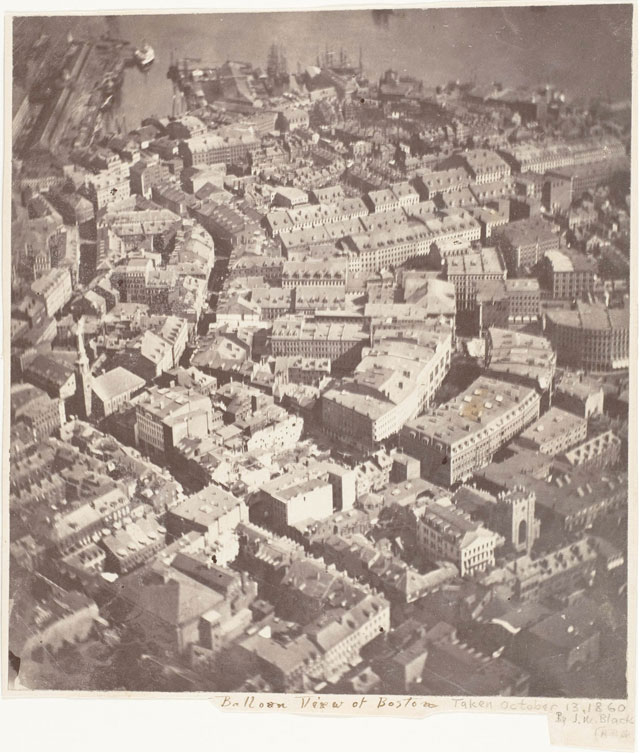
While French balloonist Gaspard-Félix Tournachon first photographed Paris by air in 1858, those photos were lost, and this photograph of Boston from 1860 by James Wallace Black is the earliest known aerial photo. The title is ‘Boston, as the Eagle and the Wild Goose See It.’ If I had to guess where in Boston this is, I’d say somewhere along Atlantic Ave.
Update: Several people have identified the steepled building at center left as the Old South Meeting House, which Wikipedia confirms: “Depicts area resembling Old South Meeting House; Milk Street; India Wharf, Central Wharf; and vicinity.” Looks a bit different these days.
But more importantly, a photo of Providence, RI taken by Black in August of 1860 predates his Boston photograph by two months. The print, which is part of the MoMA’s collection, is badly damaged but it looks like some detail would be discernable in person.
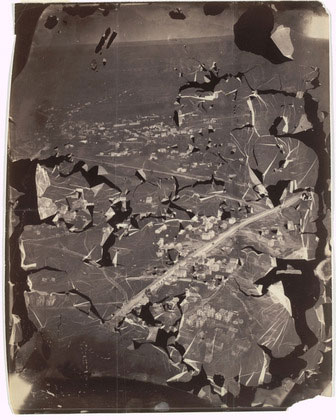
So for some sufficiently flexible definition of “surviving”, Black’s photo of Providence is the oldest surviving aerial photo. (thx, david)
Yesterday, the FBI announced major advances in solving the biggest art heist in history. The break in occurred at the Isabella Stewart Gardner Museum in 1990 when a night watchman opened the door to men dressed as police. Works by Vermeer, Rembrandt, Degas, and Manet valued at over $500M were taken and have not been seen since.
“The FBI believes with a high degree of confidence in the years after the theft the art was transported to Connecticut and the Philadelphia region and some of the art was taken to Philadelphia where it was offered for sale by those responsible for the theft. With that confidence, we have identified the thieves, who are members of a criminal organization with a base in the mid-Atlantic states and New England,” Richard DesLauriers, special agent in charge of the Boston office of the FBI, said.
The guard who opened the door, Richard Abath, was looked at pretty closely again last week, though he’s not mentioned specifically this week.
Infinite Boston is a photo tour of some of the Boston locations that inspired locations in David Foster Wallace’s Infinite Jest.
In July of what might have been Year of Glad, one year ago this week, I traveled to Boston, Massachusetts with the express purpose of visiting as many of the landmarks and lesser known precincts that appear in, or provide inspiration for, the late David Foster Wallace’s 1996 novel Infinite Jest as I could manage on a Thursday-Sunday trip. My reasons for doing so will become apparent at a later date, but for now I am pleased to present what I am calling “Infinite Boston”: a ruminative travelogue and photographic tour of some fifty or so of these locations, comprising one entry each non-holiday weekday, from now until sometime in early autumn.
The 2011 Red Bull Cliff Diving World Series is in Boston this weekend and divers are jumping off the Institute of Contemporary Art into Boston Harbor. Here’s a slide show of the divers practicing yesterday.

(Thanks, Jessie)
A photo tour of the Boston-area locations mentioned in Infinite Jest. From the photographer:
Perhaps most interestingly, although “Enfield” is not a real town, it seems to substitute for Chestnut Hill. We found a school at the top of one of the larger hills in Chestnut Hill, which we believe is the location for ETA.
Perhaps someday there will be IJ walking tours of Boston that same way there are Ulysses -based tours of Dublin or Sex and the City tours of NYC.
A fake tilt-shift photo of Fenway Park in Boston makes the ballpark look like a scale model. I seemingly will never tire of this gimmick. (via let’s go mets)
Who wins the Super Bowl of Food: New York City or Boston? Ed Levine says it’s no contest: New York all the way.
What has Boston bestowed upon us, foodwise? Brown bread, baked beans, Boston cream pie, and Parker House rolls. Pretty slim pickins’, don’t you think? How far would you go out of your way for some baked beans or some brown bread? I’d only go a block or two at the most. Now if you expanded the geographic food purview of the Patriots to all of New England, that might be an interesting discussion, because then New England clam chowder, lobster rolls, and fried clams would enter into the fray.
Ed’s a bit hard on Boston here…there’s some excellent food to be found in the city and its surrounds.
After more than 15 years and $14.8 billion, Boston’s Big Dig project officially ends today.
A study by the Turnpike Authority found the Big Dig cut the average trip through Boston from 19.5 minutes to 2.8 minutes.
Given the number of people moving through the area each day and how much time is saved, $14.8 billion doesn’t seem like such a huge amount.
I’m sure native Bostonians will find much to argue about in this list of Boston slang. (via cyn-c)
Older posts



Socials & More