
A Literary Map of the United States
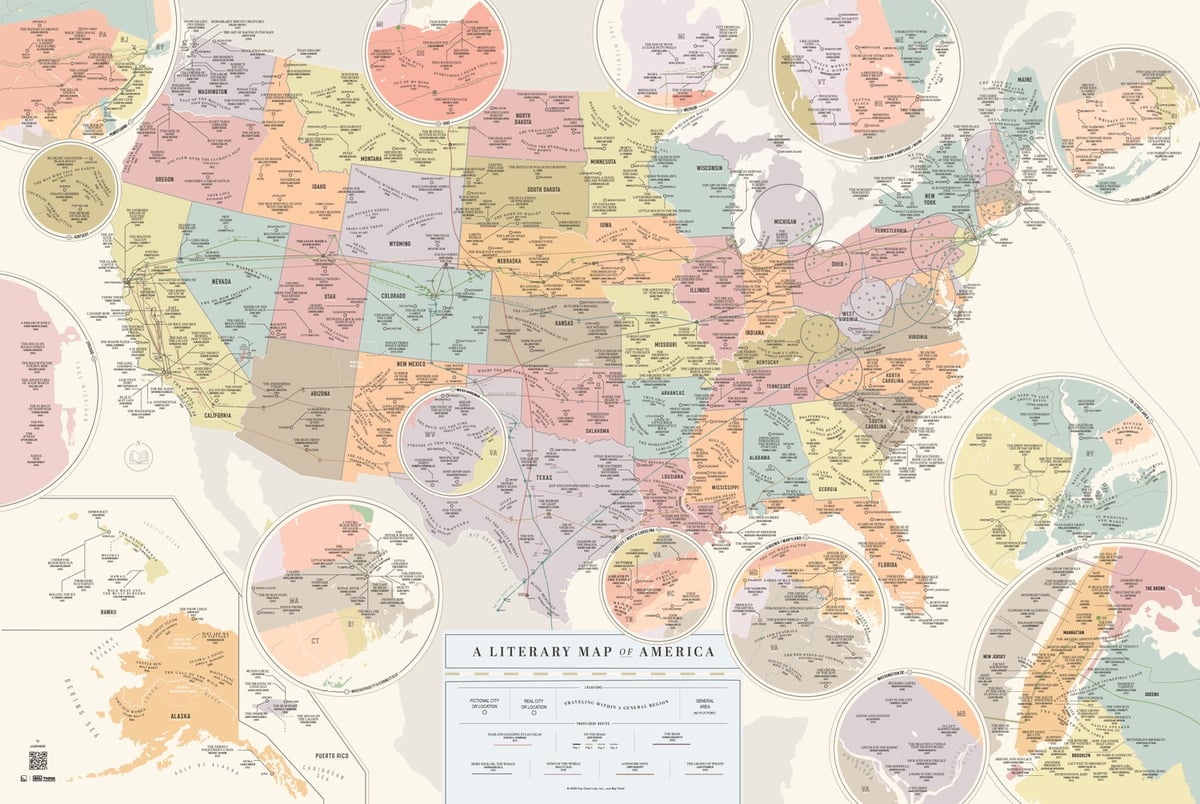
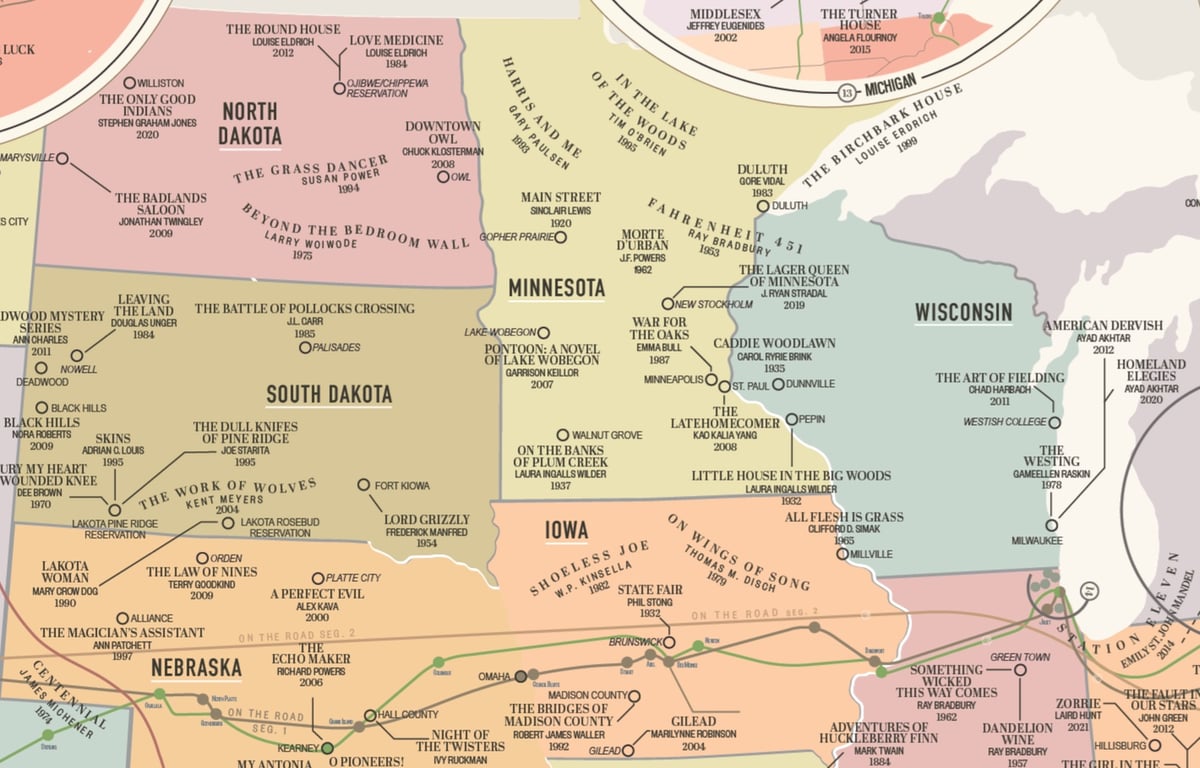
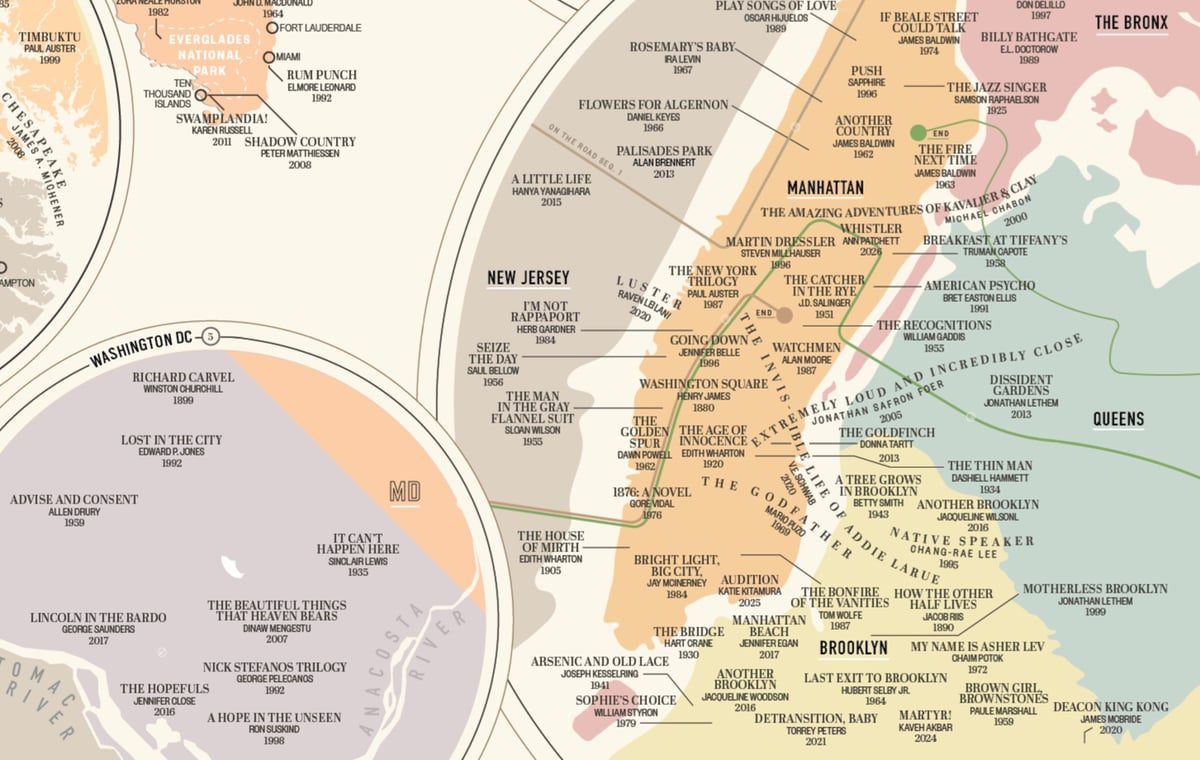
From Big Think and Pop Charts, A Literary Map of America that “highlights the real and imagined settings of hundreds of books”. Frank Jacobs takes a closer look at some of the imaginary places on the map, including Sleepy Hollow, Lake Wobegon, Brokeback Mountain, and F. Scott Fitzgerald’s East Egg and West Egg.
There are many ways to read this map: as a peculiar road map of the United States, a potted history of the same, a metatext of American literature, a guide to American literary genres and their centers of gravity, and more. I will get to at least some of them later, but for now, I want to examine the effect that scholars call broadly “imaginative geography,” more precisely “toponymic capture,” and more elegantly “authorial inscription.” It is the process by which a writer’s vision of a place becomes so dominant that it effectively overwrites that place’s prior identity in the public imagination.
We could say other parts of America have been “colonized” by other texts the same way King’s horror stories have influenced our perception of Maine. A gentler metaphor, from Rebecca Solnit’s Infinite City, is of cultural and literary memory as an “overlay.” It resides above physical geography like a transparency on an overhead projector, a slightly shifting but persistent presence.
In Landmarks, the English nature writer Robert Macfarlane develops the idea that a sufficiently powerful text doesn’t just describe a landscape, but alters the mind that subsequently encounters it. He uses the verb phrase “to see through” to define it: you see the Suffolk coast through W.G. Sebald, the Mississippi through Mark Twain, the South (as a particularly “Gothic” place) through Faulkner.
Comments 0
If you feel like this comment goes against the grain of the community guidelines or is otherwise inappropriate, please let me know and I will take a look at it.
In order to comment or fave, you need to be a kottke.org member. Check out your membership options.
Note: If you are a member and tried to log in, it didn't work, and now you're stuck in a neverending login loop of death, try disabling any ad blockers or extensions. Or try logging out and then back in. Still having trouble? Email me!