



Using a Railway as a Massive Flatbed Scanner
By taking a camera, pointing it out the window of a train, and keeping track of how fast the train is moving, you can create very wide panoramic scans of the scenery.
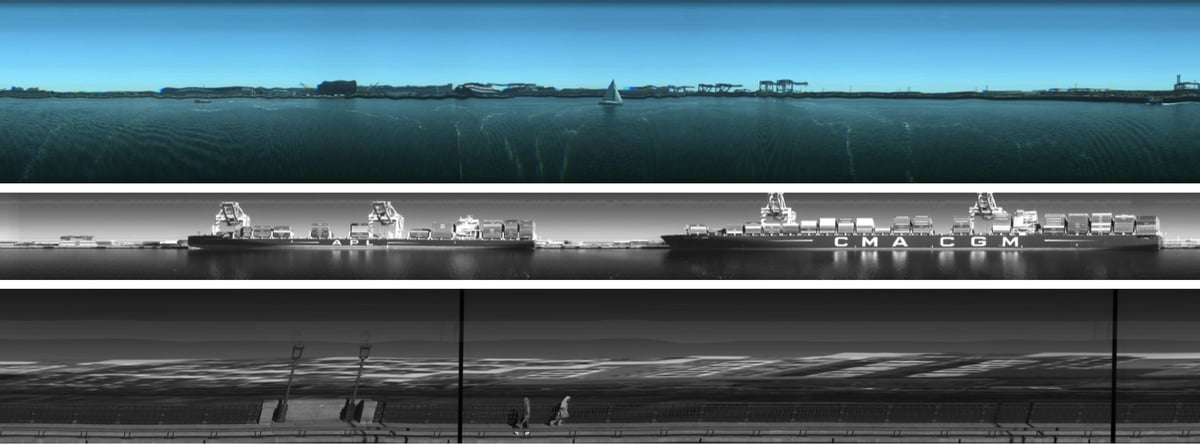
It’s a little more complicated than that — all the details are here — but you’re essentially using the train (or ferry) as a massive flatbed scanner.
I knew from the start that I’d need to measure the speed somehow, but I was naïvely hoping that I wouldn’t need to measure it that well and could simply fudge it. This image, however, shows that even small variations of speed matter. This was my first glimpse into how much of a pain dealing with speed would turn out to be.
I love little hacky projects like these.

Comments 5
thread
latest
popular
I worked with a guy who used one of these cameras to take photos of trains (and various other things). Super smart dude; huge amount of work involved in getting the equipment and processing to spit out usable photos.
Ooh, this is great! Reminds me of Adam Magyar's slit-scan photos.
Which in turn reminds me of rollout photography (pre-digital), which was developed/adapted to photograph cylindrical Maya vessels -- the film advanced at a speed synced to the speed of the turntable the vessel sat on, producing a complete flat image of a cylindrical 3D object.
This was very cool. She links [1] to another talk that starts similarly and then goes in a vey different, very weird direction that I enjoyed quite a bit.
1. https://media.ccc.de/v/emf2026-205-1-the-xelatype-a-journey-through-time-and-space
“I’d become very, very aware of this frozen moment that was very unreal to me. The photographs didn’t really have life in the way a drawing or painting did, and I realised it couldn’t because of what it is. Compared to Rembrandt looking at himself for hours and hours and scrutinising his face and putting all these hours into the picture that you’re going to look at – naturally there’s many more hours there than even you can give it. A photograph is the other way round. It’s a fraction of a second, frozen, so the moment you’ve looked at it for even four seconds, you’re looking at it for far more than the camera did. And it dawned on me that this was visible, and the more you become aware of it the more this is a terrible weakness. Drawings and paintings do not have this.”
David Hockney (source)
These flat-bed-scanner photos are another way to experiment with putting time into photography, kind of like Hockney’s joiner collages. Very cool!
If you feel like this comment goes against the grain of the community guidelines or is otherwise inappropriate, please let me know and I will take a look at it.
In order to comment or fave, you need to be a kottke.org member. Check out your membership options.
Note: If you are a member and tried to log in, it didn't work, and now you're stuck in a neverending login loop of death, try disabling any ad blockers or extensions. Or try logging out and then back in. Still having trouble? Email me!