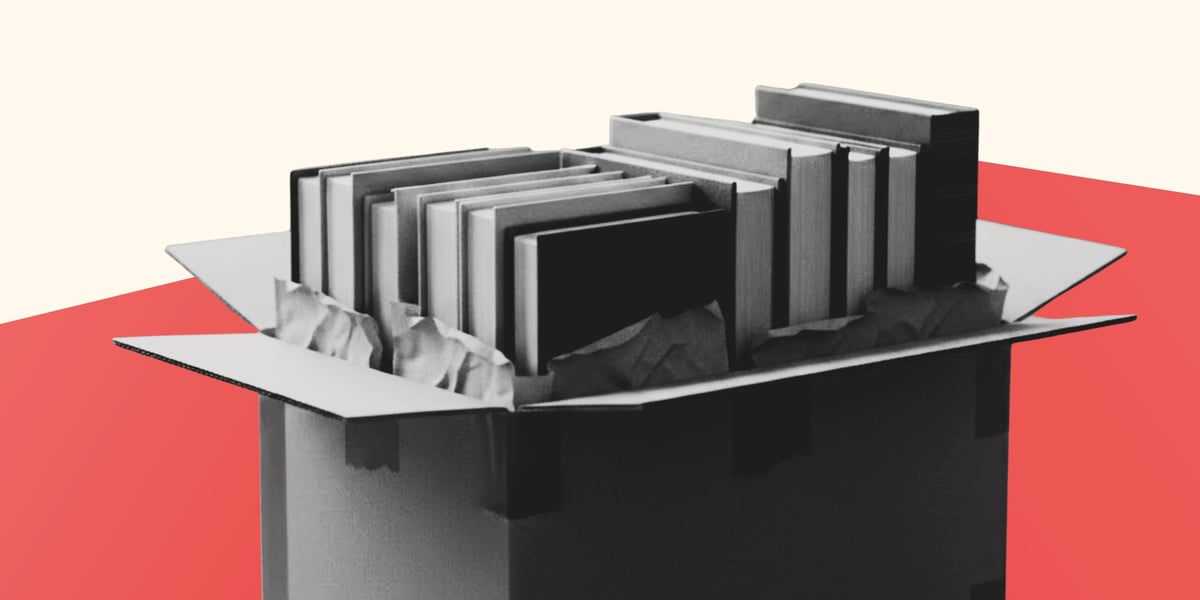
How — and Why — to Cull Your Book Collection. “6. I have to give up on some of my little projects.” (I am mid-cull right now, making some tough calls. But also: many books I haven’t so much as touched in 10 years.)

Advertise here with Carbon Ads
This site is made possible by member support. 💞
Big thanks to Arcustech for hosting the site and offering amazing tech support.
When you buy through links on kottke.org, I may earn an affiliate commission. Thanks for supporting the site!
kottke.org. home of fine hypertext products since 1998.
Beloved by 86.47% of the web.
Comments 18
thread
latest
popular
This:
“5. Sometimes new information really can change my feelings about an author.
Which is to say I’ve kept the two Alice Munro story collections that are dearest to me, but the rest are being donated.”
this spring I packed up a box of well loved Gaiman, Rowling, and yes Monroe etc. and put them in the basement. Seeing them everyday was making me sad now, no matter how once they’d given me joy.
I got rid of almost all of my Gaiman. Not quite ready to part with Sandman, but I have it stored where I can't see it.
I am trying to find a way to see how much it would cost me to replace, rather than cull, some (most?) of the books with ePub versions that I could also send to my Kindle. It's the _text_ I love, not the physical objects
Thanks for sharing that. I have never thought of that before, so it is interesting to hear someone say it out loud.
Books are like trees for me. Even if you could provide me with oxygen and shade by building a perfect "tree machine," I would never be able to learn to love an eTree. But I am sentimental (and have room, almost, for all my books)
In fact, some books, the ones I love the most, are purchased in various editions, old and new, signed and unsigned, hardback and dog-eared paperbacks...
And the text doesn't die when you stop owning it. Whether it's data on a local drive or in the cloud, is it any less yours? I don't know the answer but I'm fascinated by the question of what it means to "own" bits of data. Besides, worst case, if I want to re-read a book I really like, why not send the author more money? ¯\_(ツ)_/¯
I did something similar years ago. I found ePub versions of most but not all of the 3,000 books that donated.
There are good library apps, like libby, that allow you to "borrow" many books for free. There's also piracy, which is free, too.
We've been mostly doing our culling lately by focusing on the books our kids are aging out of. We still are keeping many kids books that are favorites, but we've needed to free up space for all the new books we all bring home.
A lot of my books are graphic design related, related to odd subjects I had to research before the internet (vintage cigarette packs, firecracker packaging) or related to hobbies I no longer have (sneaker collecting). I’ve actually sold quite a few of these kinds of books. My literary books I just donate to the local library. I do need a culling though.
Living in a small Brooklyn apartment, my wife and I have to be ruthless about books. These days I feel as though I have rewired my entire value system to the point that passing a book along to be enjoyed elsewhere is more appealing than keeping a copy on the shelf where it won't.
I think of it as putting the object where it can cause the most happiness. Feels good!
A counterpoint: books aren’t consumables. Just because you haven’t looked at a book in years doesn’t mean it has been exhausted or used up, that it can never speak to you again. There are books I returned to after ten years, serendipitously pulling something random from a shelf, which hit completely different because those years changed me. Browsing a library is an unlooked-for way to encounter yourself.
RE: ebooks, there’s plenty of out-of-print works you can’t find — I don’t mean rare books, but books that never made it commercially, or so niche they wouldn’t make it into mass-scanning, or minor works of major authors, anthologies… digital libraries are necessarily incomplete, DRM means you don’t even own access to the text. There’s also things like large-format art books, which are unsatisfying to view on any screen.
Pruning the garden is healthy, but looking at a bookshelf as a trophy case to be tidied is to miss a big reason to keep unread books around: to be there when you need them, like a pantry — or a medicine cabinet. Throw out the expired stuff, sure, but it’s good to keep up a solid cache of supplies for your future self too.
My cookbook collection has spilled off the shelves and is in piles around the house. I could easily cull most of the mass market books but my collection of antiquarian and vintage cookbooks needs to be insured and preserved. I'm more worried about what will happen to those when I die.
You might want to look into possibly donating them to the Schlesinger library at Harvard/Radcliffe -- amazing repository of cookbooks etc.
If anyone does need or want to cull, here's a method I've found useful (it can be used for things besides books too): don't pick out things to get rid of, pick out things to keep.
I once needed to do a dramatic purge. I went through all my shelves and pulled off books I felt I could get rid of and ended up pulling about six books. That wasn't going to fly. So I put them back on the shelves and went through again, this time pulling off every book I felt I could NOT get rid of. When I was done, about half my books were still left on the shelves, and I got rid of them. I've missed maybe one or two of them, which is pretty good, given the hundreds I got rid of.
Not sure I subscribe to the notion of 'making books a part of your personality'. That sounds more like affectation than authenticity.
Despite the fact that I have thousands of books myself, with many shelves double-stacked, I agree with this. For me, the importance of a book is usually in its words and the ideas and in sights it presents or generates. Apart from a very few very special volumes (of which I probably have none), I feel that the container of those words, ideas, insights rarely has any independent merit.
I feel that books are a consequence of interest and curiosity, not an end in themselves. Owning books doesn't make you automatically interesting. I have a ridiculous number of physical books though, but I'd argue that a great number of the photobooks I own are objets d'art in their own right and go beyond being a container given the level of design consideration inherent in their production.
As a retired professional orgnaizer, I tend to be really skeptical about articles regarding downsizing. But this one on culling some of the books — prior to a move, in the author's case — is actually pretty good.
https://lithub.com/how-and-why-to-cull-your-book-collection/
h/t @kottke @[email protected]
If you feel like this comment goes against the grain of the community guidelines or is otherwise inappropriate, please let me know and I will take a look at it.
In order to comment or fave, you need to be a kottke.org member. Check out your membership options.
Note: If you are a member and tried to log in, it didn't work, and now you're stuck in a neverending login loop of death, try disabling any ad blockers or extensions. Or try logging out and then back in. Still having trouble? Email me!