




An Astonishing Graph
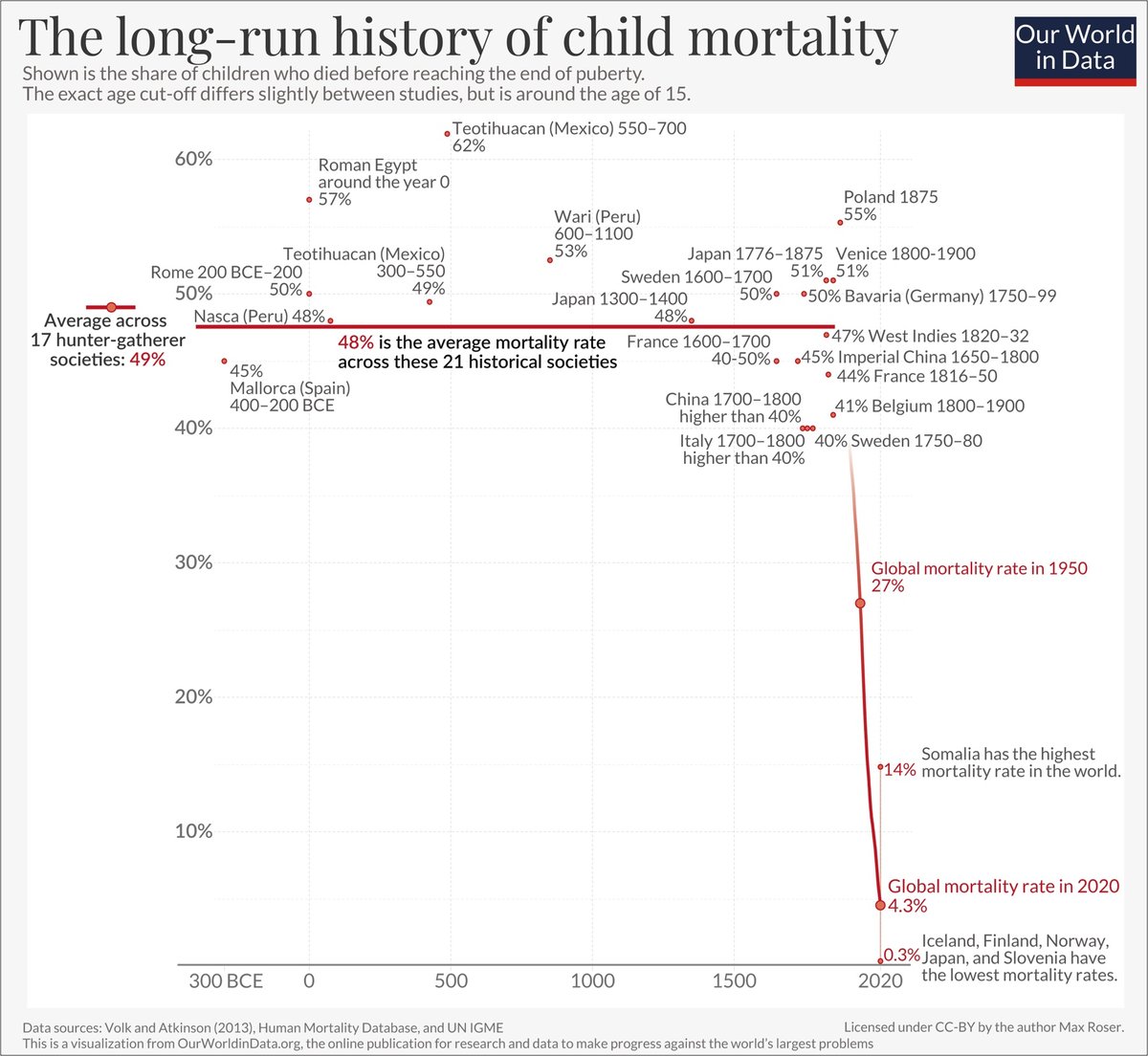
For most of human history, around 50% of children used to die before they reached the end of puberty. In 2020, that number is 4.3%. It’s 0.3% in countries like Japan & Norway.
This dramatic decline has resulted from better nutrition, clean water, sanitation, neonatal healthcare, vaccinations, medicines, and reductions in poverty, conflicts, and famine.
Before ~1800, almost every parent lost a child; now it’s such an uncommon experience that people have forgotten and want to ban vaccines.
Comments 12
thread
latest
popular
Anyone who doesn’t get this should visit a Victorian era cemetery and see how many kids are buried there.
Also not uncommon to see a ~19 year old woman buried next to an unnamed baby.
My father passed away during COVID. He was 95. Afterwards, we discovered he had siblings he didn't even know about because they were born and died before he was even born. All babies.
I think of that every day I pass by the local cemetary in my Massachusetts town: so many tiny grave markers for each family. Even my father’s family in the 1910’s lost 2 children of 7. It infuriates me to no end the ahistorical loss of memory of polio, measles, etc., that were eliminated within the last 60 years. There is a special place in hell for RFK Jr. and his ilk.
My grandmother was born in 1898, she had two sisters. Between the three of them they had ten children, all born after 1925. Two of those children died before they reached the age of five. Another caught polio and had lifelong problems from it. Things were awful only 100 years ago. As a point of comparison, the same grandmother had 13 grandchildren, all of us lived to celebrate turning 60 years old. Modern medicine is a miracle.
This explains *most* of why human lifespan has increased in the past 100 years. It's not that we have better healthcare to keep older people alive. It's that we have better public health to keep people from dying young. If we spent $5 trillion on more public health (like we do now on healthcare, ie hospitals and medicine), imagine how much less disease and longer better lives we would *all* enjoy.
Also: "People have forgotten and want to ban vaccines" is well phrased.
Just to drive home what should be obvious here: A huge part of the improvement in life expectancy over the last century (give or take) is due to increased life expectancy for newborns.
When you start doing the family tree, you quickly run across a long list of ancestors who died in infancy or childhood. Sometimes (just to complicate the tree), the family recycled the child's first name for a later birth.
For an exploration in turning the grief of a lost child into art I recommend the movie Hamnet.
It's difficult to image being a parent and having a reasonable expectation that half your children will die before age 14 or whatever. It really changes the sense of a "normal" parenting life.
Also really curious about what happened in Teotihuacan to see a marked increase in child mortality from 49% to 62% with 550 AD as the midpoint? Urbanization without sanitation?
Many forms of "progress" tend to be slow and less visible. The long and steady development of medicine, antibiotics for diseases , pre-natal care, indoor plumbing are the real causes for lower child mortality rates. Those improvements are still happening. Life is getting better..
If you feel like this comment goes against the grain of the community guidelines or is otherwise inappropriate, please let me know and I will take a look at it.
This thread is closed for new comments & replies. Thanks to everyone for participating!