




This site is made possible by member support. 💞
Big thanks to Arcustech for hosting the site and offering amazing tech support.
When you buy through links on kottke.org, I may earn an affiliate commission. Thanks for supporting the site!
kottke.org. home of fine hypertext products since 1998.
Beloved by 86.47% of the web.
Entries for February 2017
The land, the sea, and the heavens above
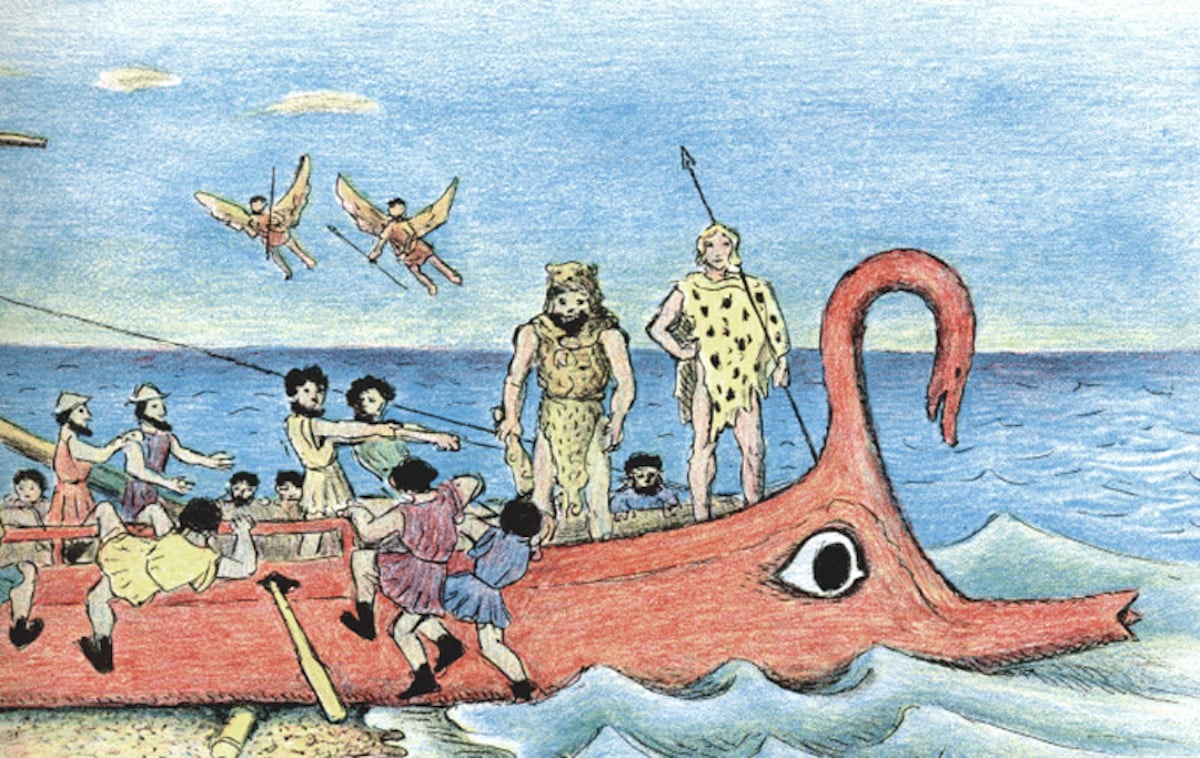
Geoff Manaugh at BLDGBLOG has written a terrific riff on historian John R. Gillis’s new book The Human Shore: Seacoasts In History. After a phrase from Steve Mentz, it’s called “Fewer Gardens, More Shipwrecks”:
“Even today,” Gillis claims, “we barely acknowledge the 95 percent of human history that took place before the rise of agricultural civilization.” That is, 95 percent of human history spent migrating both over land and over water, including the use of early but sophisticated means of marine transportation that proved resistant to archaeological preservation. For every lost village or forgotten house, rediscovered beneath a quiet meadow, there are a thousand ancient shipwrecks we don’t even know we should be looking for…
We are more likely, Gillis and Mentz imply, to be the outcast descendants of sunken ships and abandoned expeditions than we are the landed heirs of well-tended garden plots.
Seen this way, even if only for the purpose of a thought experiment, human history becomes a story of the storm, the wreck, the crash—the distant island, the unseen reef, the undertow—not the farm or even the garden, which would come to resemble merely a temporary domestic twist in this much more ancient human engagement with the sea.
The Hebrew Bible famously begins human history with a garden, followed by agriculture, then a flood, then cities, then wandering in exodus — but that story’s probably completely inverted. (The fact that the story’s written in a script likely borrowed by seafaring merchants is a tell.)
Even after agricultural urban civilization settles in, there are continued raids from “sea peoples”, Vikings, Mongols, and the British Empire — wanderers over land and sea who periodically crash into the farmers’ cities and make them their own, through trade and/or plunder.
Robert Graves thought all Greek mythology (and maybe all mythologies) dramatized the conflict between new and old gods, particularly the matriarchal gods of agriculture with the patriarchal gods of the sky and sea. In all the stories, he thought, you could find a trace of the suppressed gods, a counter-narrative that was never completely erased.
Here, too, we get our opposing views of nature: the regular, settled rhythms of Hades and Demeter, and the inhuman danger of Zeus and Poseidon — Walden vs. Moby-Dick.
Maybe the most successful myths are the ones that reconcile the two strands, legitimizing the victorious shipwrecked wanderers by explaining that the gardens they conquered were always theirs to begin with — that they had brought civilization and enlightenment to the farmers, whose songs their children sung, without knowing where they had come from.
(Top image from D’aulaire’s Book of Greek Myths)
Black-owned bookstores and the black power movement
Historian Joshua Clark Davis has a terrific essay on how civil rights organizations, especially black power and black nationalist groups, helped spur a boom in black-owned bookstores in the US in the sixties and seventies. In turn, these bookstores became key organizing centers, arts hubs, and distributors of black literature and political information.
As late as 1966, most American cities—including major centers of black population such as Atlanta, Washington, D.C., Oakland, and New Orleans—had not had a single black-oriented bookstore. Each of the country’s largest cities and centers of black population, including New York, Philadelphia, Chicago, Detroit, and Los Angeles, could claim one or in some cases two black-interest bookstores, most of which struggled to stay in business. Just a few years later, however, black bookstores were booming. Between 1965 and 1979, the number of black-themed bookstores in the United States skyrocketed from around a dozen to somewhere between seventy-five and one hundred. Most of these stores were owned and operated by activists with ties to a wide range of black radical groups, including the Black Panther Party, SNCC, the Congress of Afrikan Peoples, the East, and a variety of lesser-known groups in local communities across the country.
Indeed, the very idea that black people needed their own bookstores drew directly on black-nationalist values of institutional and community control. In the late 1960s and ’70s, black-owned bookstores thrived alongside other activist businesses that emerged out of the era’s social movements, including feminist storefronts, environmentalist natural food stores, and countercultural head shops that promoted the drug legalization and anti-war causes.
Davis’s book From Head Shops to Whole Foods: The Rise and Fall of Activist Entrepreneurs looks at this wider post-60s world of counterculture commerce, and how those roots grew into some very unexpected branches. Exciting stuff.
How to cover news in a media-hostile environment
Reuters editor-in-chief Steve Adler wrote a message to staff called “Covering Trump the Reuters Way.” After noting that “Reuters is a global news organization that reports independently and fairly in more than 100 countries, including many in which the media is unwelcome and frequently under attack,” he lays down some do’s and do-not-do’s1:
Do’s:
—Cover what matters in people’s lives and provide them the facts they need to make better decisions.
—Become ever-more resourceful: If one door to information closes, open another one.
—Give up on hand-outs and worry less about official access. They were never all that valuable anyway. Our coverage of Iran has been outstanding, and we have virtually no official access. What we have are sources.
—Get out into the country and learn more about how people live, what they think, what helps and hurts them, and how the government and its actions appear to them, not to us.
—Keep the Thomson Reuters Trust Principles close at hand, remembering that “the integrity, independence and freedom from bias of Reuters shall at all times be fully preserved.”
Don’ts:
—Never be intimidated, but:
—Don’t pick unnecessary fights or make the story about us. We may care about the inside baseball but the public generally doesn’t and might not be on our side even if it did.
—Don’t vent publicly about what might be understandable day-to-day frustration. In countless other countries, we keep our own counsel so we can do our reporting without being suspected of personal animus. We need to do that in the U.S., too.
—Don’t take too dark a view of the reporting environment: It’s an opportunity for us to practice the skills we’ve learned in much tougher places around the world and to lead by example - and therefore to provide the freshest, most useful, and most illuminating information and insight of any news organization anywhere.
These are good rules. (That one about giving up on access and hand-outs is downright fire.) They’re particularly good rules for a place like Reuters, that has a specific style, tradition, and role in the news ecosystem.
But they’re not necessarily good rules for everybody. Different news organizations are going to need to fill different roles in the ecosystem, different spaces on the multiple axes of personal, political, intellectual, and business commitments. If Gawker were still here in its full glory, Nick Denton could write up “Covering Trump the Gawker Way” and it would probably be a totally different but equally valuable list of guidelines.
The other thing news organizations (and other companies too) will need to figure out in L’Age D’Trump are their commitments to their staff. Reporters and media organizations need legal protections so they can’t be prosecuted as criminals or sued by proxy billionaires for doing their job; but they also need to be able to talk freely about how to do their job and balance all of those commitments for themselves without being shown the door.
The pressure is going to be coming from a lot of directions, not always the obvious ones. When the stakes are this high, and the conditions this uncertain, it helps to allay as many uncertainties as possible. When the shit goes down, you need to know who’s going to have your back.
Cf. “Marge Gets A Job”↩
How to manage news burnout
Melody Kramer is one of the smartest, most thoughtful people I know in journalism. She has a new post up at Poynter talking about ways to design the news that take into account that news can be overwhelming.
People take breaks, go on vacations, have stretches where they can’t keep up, work weird hours, have different levels of interest and background knowledge, and so forth — but they still want to be informed, connected, and engaged.
How can we deal with that? Here’s one good idea:
We should allow people to check out or pause and return. I envision a website where someone can say how long they’d like to be away from the news and what kinds of news they’d like when they return. This could most easily be accomplished through newsletters. For example, a landing page might allow a user to say: “I am taking [XX] [days / weeks / months] off. When I come back, I’d like to be updated on [topics] on [this frequency.]”
Years ago, some of us called this “my time” or “TiVo time”: a personalized, time-shifted attention economy. (Actually, I don’t think anybody called it “TiVo time” but me. And maybe a few guys who worked for TiVo.)
And for a little while, say around 2000-2010, media consumption in the form of DVRs, IM chats, blogging (and commenting), RSS feeds, Netflix DVDs (by mail!), was sort of unconsciously driven by this principle. It was available in close-to-real-time, but you could dip in and out of the stream much more easily.
Then a lot of factors — including short-form social media, livestream video, Netflix bingeing, a resurgence of TV events, and maybe especially always-available mobile devices — pushed us back to a much more immediate and real-time immersion in media. This hasn’t always been to everyone’s benefit. Not all consumers’, and not all producers’ either.
Choosing between plunging in or checking out has become a much more all-or-nothing proposition. It doesn’t have to be that way. We know this. We already built a lot of the tech that lets us manage this. Now we just have to figure out the best ways to deploy it.
Socials & More