



Find out a bit about how your
Find out a bit about how your brain works at the Mind Hacks blog.

This site is made possible by member support. 💞
Big thanks to Arcustech for hosting the site and offering amazing tech support.
When you buy through links on kottke.org, I may earn an affiliate commission. Thanks for supporting the site!
kottke.org. home of fine hypertext products since 1998.
Beloved by 86.47% of the web.
Mia Hamm has played her final match with the US women’s national team. In the second half, she wore a jersey with her new last name (Garciaparra).
This homemade NYC subway map is more useful than the official one in some ways. The addition of Metro North, PATH, and the AirTrain routes is helpful.
Before weblogs ruled the realm, a typical way to publish content online was in a Web magazine format. Suck, Feed, Netly News, Smug, Stating the Obvious, etc. Sites like Salon, The New Yorker, Slate, and even most online newspapers publish in the magazine format, but sites like The Morning News and McSweeney’s Internet Tendency are more culturally similar to those early Web magazines (in sensibility and because there’s no offline component). Are there any other sites that you read that are still publishing regularly in this format?
Parents go on strike protesting their kids’ lack of help with household chores. How did they let their kids get this in control of the parent/child relationship? A strike isn’t going to reverse the effects of 17 years of bad parenting.
Search for “i love jews” and Google asks “Did you mean: i love jesus”.
Various “Dear cell phone user” messages from SHHH!: Society for HandHeld Hushing.
For all the corny potshots that Dreamworks takes at Disney in Shrek 2, they’re hard at work exploiting their own set of rapidly tiring cliches, an approach that eventually steered Disney’s reputation for creativity straight into the ground. I know it made lots of money and that the kids love green ogres (and green ogre Happy Meals), but the movie just wasn’t very good (apart from some Puss in Boots moments). Animation aside (are we done judging CG-heavy films largely by how cool they look yet?), Shrek 2 was just another lame romantic comedy with big name stars and barely funny pop culture references; it couldn’t have taken any more than 15-20 minutes to write the screenplay. Anthony Lane noted something similar in his review of The Incredibles and was spot on:
[Brad Bird] has bothered to think through the impact of his outlandish designs, whereas one of the depressing things about a big summer hit like “Shrek 2” was that it nodded at other recent movies, and commercial fads, purely on the ground that they were recent and would thus grab a temporary laugh. The “Shrek” pictures, like “Shark Tale,” will date fast, eaten by the rust of their own cynicism, while “The Incredibles,” silly as it is, retains just enough innocence to suggest that it might hang around.
Cambodian soldiers, first hiding and then lost in the jungle, return home after 25 years. They thought the war was still going all that time.
A new comet will be visible to the naked eye for the next couple of months.
A poorly designed coin-operated Donald Duck children’s ride. Complete with leering glance at rider’s bathing suit area.
A new way of traffic engineering: use minimal signage and make all traffic (foot, car, bike, etc.) use the same roadway. The result is that all traffic slows down and relies on communication between participants to negotiate the traffic space.
Disguise yourself as a Canadian when traveling abroad to avoid answering questions about US politics.
Even after 20 years, string theory hasn’t explained much of anything. But it hasn’t been disproven either.
Purple Hearts, a photo gallery of wounded soldiers sent home from Iraq.
Japanese are arranging group suicides over the Internet. But the social aspect of these “suicide clubs” can also keep people from killing themselves.
The Online Film Critics Society’s “Top 100 Overlooked Films of the 1990s”.
When we last chatted, you and I, about RSS advertising here on kottke.org two years ago, there were only a couple of sites experimenting with advertising in RSS files. Many sites are now putting ads in their RSS/Atom files and several companies — including Overture and Kanoodle — are offering or partnering with companies to offer consumers the ability to put ads in their RSS/Atom files.
When banner advertising first appeared on HTML pages, it took several years before browser makers (and 3rd party toolbar makers) gave users the ability to block advertising (both popups and banners).
Given that people who use newsreaders are still of the early adopter sort who are used to blocking ads with Firefox or fast-forwarding through commercials with their TiVos, it seems likely that blocking advertising in RSS/Atom files might soon become an issue. To get the ball rolling on this issue, I asked a few of the major newsreader developers if they would build ad blocking capabilities into their software. Here’s what they had to say:
Nick Bradbury, FeedDemon:
I’m not planning any features designed explicitly for blocking ads, but I am planning to add per-feed filters that could be used to filter out ads. For example, FeedDemon would enable you to filter the Boing Boing feed so that only items from a specific author, or items containing specific keywords (or negative keywords), would be shown (or not shown). So, while this is designed as a usability feature rather than an ad-blocking tool, I imagine that more than a few users would configure it to hide ads.
Brent Simmons, NetNewsWire:
The future of aggregators is, in part, about *importance*. Items most important to you should bubble to the top, and items less important should sink to the bottom or just get deleted.
This isn’t a function of one specific feature but of a group of features — smart lists, filters, scriptability, statistics, ratings, searching, and so on — that are important even if there were no such as thing as ads in RSS/Atom.
I don’t expect to get asked for ad-blocking-specific features, since I don’t think ad-blocking-specific features will be needed. These already-existing and already-planned features will be highly effective at ad-blocking.
Here’s a very simple example of something you can do right now with the many aggregators that let you use a custom style sheet for displaying news items. Say a feed includes graphical ads from some service. You could add a line to your style sheet that says that all graphics from that domain should not be displayed. This feature — custom style sheets — doesn’t exist to block ads, but it can easily be used to block ads.
The whole point of aggregators is about user control and smarts. Ad blocking is, and will be, just a side effect.
I don’t think that ads in RSS are a good idea, anyway. Here’s why:
1. If you have a feed with summaries, and the summaries are compelling enough to cause me to go read the full entry on the site — then I’ll actually go to the site and see the ads there. If you don’t have a feed, I may *never* go to your site. Even with full-content feeds I often open pages in my browser — and, again, I end up seeing the ads.
2. Using RSS/Atom feeds increases your readership among webloggers. A weblogger will then link to stories at your site rather than stories at sites that don’t have feeds. So feeds can help drive traffic to your site. Including ads in your feed increases the likelihood that people will unsubscribe, and you’ll miss out on this effect.
I suspect that people link to the New York Times far more often than they link to CNN, since CNN doesn’t have feeds. And I think this is significant. As a feed provider, your goal should be to get people to *link* to your pages: *that’s* how you build traffic and ad views.
Erik Barzeski, PulpFiction:
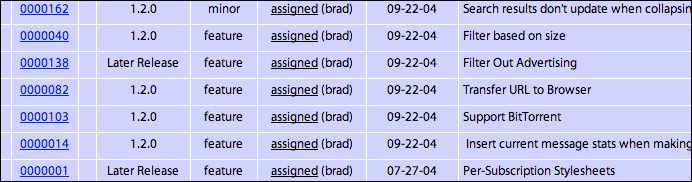
1) We filed this bug report (“filter out ads”) before PulpFiction’s 1.0 release.
2) there are different kinds of advertising. I’ve seen advertisements inside of feeds. I’ve seen posts that are nothing but ads (like every 10th post). And so on. PulpFiction’s browser already blocks pop-up ads (optionally), and we hope to let users remove regular ads. However, how difficult this may or may not be is yet to be seen.
3) At current levels I’m seeing, advertising - and filtering them out - simply isn’t worth the time. Especially as PulpFiction lets you switch over to simply using permalinks for viewing content if you wish (or switching to it with cmd-D). However, we appreciate that users have a very low threshhold for advertising tolerance, and as such we’re monitoring the situation closely.
But really, we have to _see_ more ads before we know just what to filter and remove.
Thanks to Erik, Nick, and Brent for taking the time to answer. I also emailed folks from NewsGator, SharpReader, and Bloglines but got no response…perhaps they and other newsreader makers will respond in the thread.
A few questions related to this issue:
I concur with Anthony Lane’s review of the House of Flying Daggers.
If you’re building a band/label site, don’t do these five things. That goes double for movie sites…the Flash/no deep-linking thing really chaps my ass.
Drawings of cartoon skeletons, including Hello Kitty, Fred Flintstone, and Betty Boop. Fantastic…link of the day as far as I’m concerned.
This is one of the best movies I’ve seen in a long time and I recommend it unequivocally. One of the most amazing things about Touching the Void (among many amazing things) was how engaging, gripping, and suspenseful it was (much more so than any fictional drama or horror film) even though you know from the very start how it all turns out. No M. Night Shyamalan Law & Order twist needed…just a great story and solid storytelling.
New York Times Book Review’s list of the 100 notable books of 2004.
Barry Lyndon, Stanley Kubrick, and his Zeiss 50mm f/0.7 lenses.
Some clever New Year’s greeting cards. “Mappy nude rear”, flappy blue ear”, etc.
Aubrey de Grey: “I think the first person to live to 1,000 might be 60 already.”.
Journalists, paid speaking engagements, and conflicts of interest.
China now has the largest mall in the world, but no one is buying anything.
Finding Neverland named best film of 2004 by National Board of Review of Motion Pictures. No Eternal Sunshine in the top 10?
Like Gigli, Jersey Girl suffered unfairly at the box office because of the whole Bennifer thing. I liked a couple of Kevin Smith’s previous films but the poor acting always bothered the heck out of me (I think he and George Lucas have a similar tendency to treat actors as props (but in different ways)), but the acting in Jersey Girl was surprisingly good. And the kid in the movie was great. Like most movie children, she was a bit precocious and interacted with the rest of the characters as if she were an adult, but it worked because she was essentially standing in for her mother in the eyes of Affleck’s character. Affleck has his moments as well…he can be a surprisingly good actor when he wants to be.
A list of 100 things to do before you die, with a scientific bent. My favorite: DIY DNA extraction using salt water, soap, and gin.
Marcel Duchamp’s urinal voted most influential piece of modern art in poll of experts. Picasso (x2), Warhol, and Matisse round out the top five.
What happens when you get a bunch of Guinness record holders together in the same room?. You learn that some guy scaled Mt. Fuji on a pogo stick.


Socials & More