




Blocking RSS advertising
When we last chatted, you and I, about RSS advertising here on kottke.org two years ago, there were only a couple of sites experimenting with advertising in RSS files. Many sites are now putting ads in their RSS/Atom files and several companies — including Overture and Kanoodle — are offering or partnering with companies to offer consumers the ability to put ads in their RSS/Atom files.
When banner advertising first appeared on HTML pages, it took several years before browser makers (and 3rd party toolbar makers) gave users the ability to block advertising (both popups and banners).
Given that people who use newsreaders are still of the early adopter sort who are used to blocking ads with Firefox or fast-forwarding through commercials with their TiVos, it seems likely that blocking advertising in RSS/Atom files might soon become an issue. To get the ball rolling on this issue, I asked a few of the major newsreader developers if they would build ad blocking capabilities into their software. Here’s what they had to say:
Nick Bradbury, FeedDemon:
I’m not planning any features designed explicitly for blocking ads, but I am planning to add per-feed filters that could be used to filter out ads. For example, FeedDemon would enable you to filter the Boing Boing feed so that only items from a specific author, or items containing specific keywords (or negative keywords), would be shown (or not shown). So, while this is designed as a usability feature rather than an ad-blocking tool, I imagine that more than a few users would configure it to hide ads.
Brent Simmons, NetNewsWire:
The future of aggregators is, in part, about *importance*. Items most important to you should bubble to the top, and items less important should sink to the bottom or just get deleted.
This isn’t a function of one specific feature but of a group of features — smart lists, filters, scriptability, statistics, ratings, searching, and so on — that are important even if there were no such as thing as ads in RSS/Atom.
I don’t expect to get asked for ad-blocking-specific features, since I don’t think ad-blocking-specific features will be needed. These already-existing and already-planned features will be highly effective at ad-blocking.
Here’s a very simple example of something you can do right now with the many aggregators that let you use a custom style sheet for displaying news items. Say a feed includes graphical ads from some service. You could add a line to your style sheet that says that all graphics from that domain should not be displayed. This feature — custom style sheets — doesn’t exist to block ads, but it can easily be used to block ads.
The whole point of aggregators is about user control and smarts. Ad blocking is, and will be, just a side effect.
I don’t think that ads in RSS are a good idea, anyway. Here’s why:
1. If you have a feed with summaries, and the summaries are compelling enough to cause me to go read the full entry on the site — then I’ll actually go to the site and see the ads there. If you don’t have a feed, I may *never* go to your site. Even with full-content feeds I often open pages in my browser — and, again, I end up seeing the ads.
2. Using RSS/Atom feeds increases your readership among webloggers. A weblogger will then link to stories at your site rather than stories at sites that don’t have feeds. So feeds can help drive traffic to your site. Including ads in your feed increases the likelihood that people will unsubscribe, and you’ll miss out on this effect.
I suspect that people link to the New York Times far more often than they link to CNN, since CNN doesn’t have feeds. And I think this is significant. As a feed provider, your goal should be to get people to *link* to your pages: *that’s* how you build traffic and ad views.
Erik Barzeski, PulpFiction:
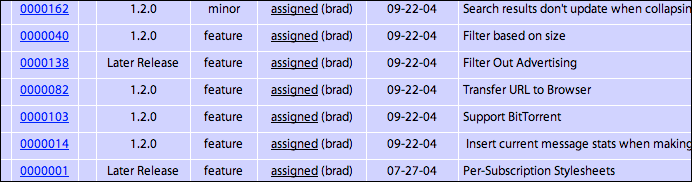
1) We filed this bug report (“filter out ads”) before PulpFiction’s 1.0 release.
2) there are different kinds of advertising. I’ve seen advertisements inside of feeds. I’ve seen posts that are nothing but ads (like every 10th post). And so on. PulpFiction’s browser already blocks pop-up ads (optionally), and we hope to let users remove regular ads. However, how difficult this may or may not be is yet to be seen.
3) At current levels I’m seeing, advertising - and filtering them out - simply isn’t worth the time. Especially as PulpFiction lets you switch over to simply using permalinks for viewing content if you wish (or switching to it with cmd-D). However, we appreciate that users have a very low threshhold for advertising tolerance, and as such we’re monitoring the situation closely.
But really, we have to _see_ more ads before we know just what to filter and remove.
Thanks to Erik, Nick, and Brent for taking the time to answer. I also emailed folks from NewsGator, SharpReader, and Bloglines but got no response…perhaps they and other newsreader makers will respond in the thread.
A few questions related to this issue:
- Do you (or will you) want ad blocking in the newsreader you use?
- Will the structure of RSS/Atom files make ad blocking easier than in HTML or not?
- Newsreader makers…how will you react to pressure from feed advertising companies like Overture or Kanoodle or companies that rely on feed advertising as a revenue stream to encourage you to keep ad blocking capabilities out of your software? Are you worried about getting sued by CNN or the NY Times (for example) if you allow users to block ads in their feeds?
- In the inevitable(?) arms race between ad blockers and advertisements, what happens to the separation between editorial content and advertising? Ads disguised as content are harder to block, but how can the reader distinguish them from content? Are you folks with ads in their RSS/Atom files concerned about that?
Socials & More