




Advertise here with Carbon Ads
This site is made possible by member support. 💞
Big thanks to Arcustech for hosting the site and offering amazing tech support.
When you buy through links on kottke.org, I may earn an affiliate commission. Thanks for supporting the site!
kottke.org. home of fine hypertext products since 1998.
Beloved by 86.47% of the web.
Entries for April 2003
Renamed Firebird browser running into problems with new name
Renamed Firebird browser running into problems with new name.
Second-guessing CNN? Look in the mirror
I’ve having a little trouble with all the righteous indignation worked up by journalists (and webloggers who fancy themselves as journalists, an affectation that’s at once cute and annoying) about Eason Jordan’s account of how CNN handled reporting from Iraq. The general consensus, summarized neatly by Dan Gillmor, is that “CNN should have left the country. It was not worth keeping a bureau open if the only way to do so was to make so many ethical and moral compromises.” The NY Times itself has a follow up article discussing some of the criticism. (More on Google News)
The reality is that exchanging access for information is a time-honored tradition among journalists, so much so that it can be considered a best practice. The embedded journalists in Iraq are a good example. Should they not have been there because they can’t report their exact locations, U.S. troop movements, etc.? Could you imagine how fast political reporting would dry up if reporters in D.C. reported absolutely everything they knew about? No one would talk to them ever again.
Tech journalists get all sorts of information about new products, buy outs, and the like that they can’t report for fear of losing access. If Microsoft flies you out to Redmond to play with all their new toys (some of which you get to take home) and you report on something they specifically asked you not to, you might not get invited back next time. Repeat that with three or four big companies and you’re out of a job.
Then there’s the issue of withholding information to save people’s lives. Glenn Reynolds blasted Jordan’s decision to withhold information in Iraq, but just three weeks ago, he criticised the BBC for publishing too much information about Salam Pax, the Baghdad blogger, and said “if [Salam] turns out to have been killed by Saddam’s goons, I’m going to very publicly blame the BBC.” Seems to me that if CNN had reported all the information it had known and had gotten several people killed in the meantime, they’d be under fire for that by the same folks. Whatever.
Lastly, where the hell was everyone else in Iraq, reporting all these atrocities? Where was FoxNews endangering the lives of their Iraqi employees’ families to get the truth out at all costs? Where was Rush Limbaugh sticking his neck out to topple Saddam’s regime with the truth? Out of your chairs, pundits. It’s hard to make the tough choices when you’re sitting comfortably on the sidelines. Could you make a decision to air a news report knowing that it will directly cause the brutal torture and death of someone’s entire family?
Obtaining and then reporting on information is a gray, muddy process. As much as we’d like to believe that journalists and journalism should be completely objective, the world doesn’t work like that. Compromises are necessary. Based on what I’ve read, my personal feeling is that CNN was put in a very difficult position in Iraq and did the best they could in reporting what was available to them given the circumstances. I join Mr. Jordan in expressing relief that these stories can finally be reported.
Phoenix browser renamed Firebird
Phoenix browser renamed Firebird. insert sports car joke here
The Elements of User Experience
For some years now, we web designers have been operating with a rough idea of exactly what it is we do. By mimicking the practices of other disciplines, sharing knowledge via web sites & mailing lists, reading industry magazines, following design gurus, and a whole lot of making it up as we go along, we’ve managed to get quite a bit done. That said, in order to move forward, there’s tremendous value in concisely presenting all that we’ve learned in one place, and that’s exactly what Jesse James Garrett has done with The Elements of User Experience (Amazon link).
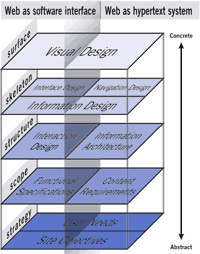
And he does this without pushing a trademarked process or holding himself up as a guru with all the answers. Instead, he simply describes the process that web designers have been using to get things done. I say “simply”, but that word belies the clarity and thoroughness of the book in its description of user experience design. One of the book’s most valuable contributions is the explanation of exactly how the various specialties fit into the larger process. Information design, information architecture, visual design, interface design, interaction design; they’re all represented in Jesse’s model of user experience design (shown at right).
Highly recommended for anyone involved in web design and developments, especially for managers and technical folk to get an idea of what us designers actually do. Here’s chapter 2 of the book in PDF format to get you started.
There are two chief types of buildings:
There are two chief types of buildings: ducks and decorated sheds.
News.com has a special report on
News.com has a special report on the 10th anniversary of Mosaic 1.0.
Manor House is a new reality show
Manor House is a new reality show in the style of Frontier House coming to PBS in April.
17,000 people trying to out-joke each other about
17,000 people trying to out-joke each other about pancakes…what does that sound like?.
What’s the best MetroCard option for you?
In trying to determine which MetroCard has the best value for its holder, Grant has done some great analysis of the various options (PDF) for the New York City subways and buses. After reading Barbara Ehrenreich’s Nickel and Dimed: On (Not) Getting By in America, this reason for people not buying the 30-day unlimited card for $63 even though it’s the best value rings true:
For some folks, being in a position where they don’t have the full price of a 30-Day Unlimited MetroCard on them, and won’t until payday, is so common as to almost be a non-story, yet it is often rarely mentioned. Even when people know they should buy the unlimited card because the per-ride cost would be cheaper, they simply can’t. They don’t have the capital.
In the book, Ehrenreich observed many people who were living month-to-month in motels because they couldn’t afford the lump sum payment (1st & last month’s rent and security deposit) for an apartment even though it would have been much cheaper in the long run. Grant’s MetroCard analyses and suggestion of establishing a MetroCard fund — into which you put a couple of bucks a day for the purpose of purchasing a 30-day unlimted ride card each month — are excellent. I wonder…what’s the best way of getting this information into the hands of the people who need it most?
Radiohead, Beastie Boys to headline Field Day festival in NYC
Tickets go on sale this week for the Field Day Festival being held on Long Island on June 7-8. The lineup includes Radiohead, The Beastie Boys, Royksopp, Sigur Ros, and Interpol…which is killing me because I can’t go due to a previously planned trip. Khan!!!!!!
C. Montgomery Blair?
Some unintentional editorializing by the Google News computer program:
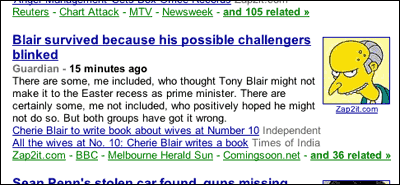
Excellent.
Norman on Tufte
Don Norman, author of The Design of Everyday Things, has mixed feelings about Edward Tufte:
Tufte is often wrong about what constitutes good communication. Indeed, I am surprised he likes the Napoleon map so much because it has, in his terms, superfluous chart chunk - those drawings of soldiers. This is indeed an excellent graphic, but much of his work does not have this character.
Tufte is not the only statistician who has addressed the problems of representing graphical material. In my opinion, Bertin is the best.
Tufte preaches. I entered into a discussion with him about this once and tried to present some experimental data that one of my students had collected. he refused even to look at it. That is, it isn’t that he looked at the data and disagreed with the interpretation or even the collection— that would be permissible. No, he refused even to look.
People who owe me $20
Rosecrans Baldwin & Andrew Womack
Dave Sifry
Rebecky
Dan Chan
Jeremy Hedley
Heather Champ
Paul Hammond
Patrick C
Dean Allen
Ben and Mena Trott
Michael Stillwell
Redrick deLeon
Eric Snowdeal
Maciej Ceglowski
Joshua Schachter
Rael Dornfest
Andy Baio
Update: No one on this list actually owes me $20. It’s a list of people whose online contributions I’ve been particularly enjoying lately.
The news they kept to themselves
Eason Jordan, an executive at CNN, tells the world what they couldn’t report about Iraq over the last two decades:
For example, in the mid-1990’s one of our Iraqi cameramen was abducted. For weeks he was beaten and subjected to electroshock torture in the basement of a secret police headquarters because he refused to confirm the government’s ludicrous suspicion that I was the Central Intelligence Agency’s Iraq station chief. CNN had been in Baghdad long enough to know that telling the world about the torture of one of its employees would almost certainly have gotten him killed and put his family and co-workers at grave risk.
We take freedom of the press for granted here in the US, but in many places in the world, both the value and consequences are significant.
The fastest umbrella in the West Village
My umbrella has a button. When that button is pushed in conjunction with a properly timed flick of the wrist, the umbrella flies open from its cocoon to its full-use position in half a second. It’s just an umbrella but I feel like a badass Arizona gunslinger skinning his Colt six gun when I get that wrist flick right. It’s all I can do not to yell, “Reach for the sky, you yella bellies!” Us 9-to-5ers have to take our excitement where we can get it.
An advertising company?
More evidence that Google is not a search engine company:
Danny Sullivan, who edits SearchEngineWatch.com, estimates that Google, with about 100,000 advertisers, is a “several-hundred-million-dollar” business. He may be guessing low. The newly revived search site Ask Jeeves, which carries ads from Google and pockets a portion of the fees, forecasts revenues of about $100 million this year. It operates around 13 million searches per day, compared with Google’s 200 million. It’s impossible to do a direct comparison, but Google clearly could be a $1 billion company soon.
Bend It Like Beckham
If it’s wrong of me as a 29yo man to lust after Keira Knightly, I don’t wanna be right.
Financial planning for when your military spouse is deployed
Financial planning for when your military spouse is deployed.
Socials & More