



Ben Fry has updated his salary vs. performance chart for the 2008 MLB season that compares team payrolls with winning percentage. The entire payroll of the Florida Marlins appears to be less than what Jason Giambi and A-Rod *each* made last year.

Advertise here with Carbon Ads
This site is made possible by member support. 💞
Big thanks to Arcustech for hosting the site and offering amazing tech support.
When you buy through links on kottke.org, I may earn an affiliate commission. Thanks for supporting the site!
kottke.org. home of fine hypertext products since 1998.
Beloved by 86.47% of the web.
kottke.org posts about sports
This season, baseball managers are being a bit more experimental in how they construct their batting and pitching lineups. For instance, the Yankees, Giants, and Dodgers started relief pitchers in games that they suspected might be shortened by rain in order to save the scheduled starter for the next game. The Braves shifted their pitcher to the outfield for one at-bat then brought him back to the mound for the next one.
The article is also notable for this quote from an Angels spokesperson, who said that Angels star Vladimir Guerrero is “somebody who’s not affected by things”. !!
The break on the knuckleball
MLB tracks every pitch thrown in a game using a system called PITCHf/x. You may have seen this system in action during televised games; it’s used to show the viewer where the pitch was located when it crossed the plate relative to the strike zone. On his baseball statistics blog, Josh Kalk takes these stats and lets you slice and dice them however you want.
One of the most interesting statistics measured is the break of a pitch…how much up-and-down and side-to-side motion a pitched ball goes through after leaving the pitcher’s hand. The break demonstrates why the knuckleball is such a difficult pitch to hit, particularly when used in conjunction with other pitch types. Here’s a graph showing the break on knuckleballer Tim Wakefield’s pitches so far this season:
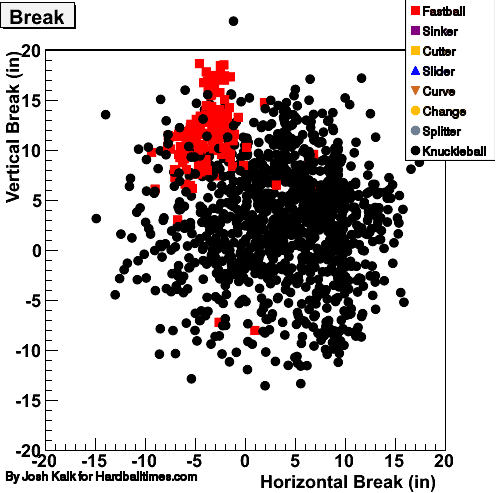
The ball is all over the place…the hitter doesn’t know where it’s going. Compare that to the break on the three different pitches thrown by fellow Red Sox player Daisuke Matsuzaka:
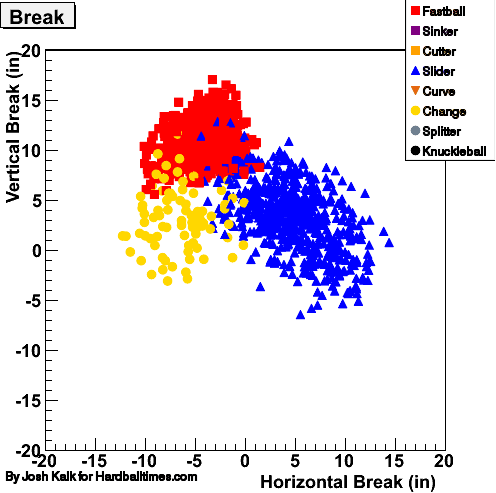
Now take a look at the graphs on the player cards for Wakefield and Matsuzaka. Wakefield’s pitches also have a wider range of velocities…Matsuzaka’s pitches range in speed from about 77 to 95 mph while Wakefield’s pitches range from 65 to 95 mph. And the graphs don’t even account for the multiple breaks that a knuckleball can make during a single pitch. The uncertainties of speed and break of a knuckleballer’s pitches combine to create a lot of trouble for batters…they neither know where the ball’s going nor when it’s going to arrive. (thx, fred)
P.S. So why is Wakefield not as effective as many other major league pitchers (his career stats aren’t that impressive), none of whom throw the knuckleball? One guess is that sometimes the knuckleball doesn’t break and essentially becomes a 60-65 mph meatball right down the middle of the plate, a pitch any decent hitter can put anywhere he wants.
Update: I thought that Wakefield’s upper velocity range was a little high. I’m getting a lot of feedback saying that Wakefield’s fastball is in the low 80s, not the mid-90s. Looks like we’ve got some screwy data here.
Also, another reason why knuckleballers are of limited effectiveness: it’s difficult to throw a strike on command, which can be a problem when you’re behind in the count and you have to throw your 80 mph fastball for a strike. (thx, jonathan & steve)
An ode to the knuckleball, a truly screwy pitch.
Few pitchers are able to throw the knuckler, giving those who can a cult-like status. It generally requires very large fingers. As Hall of Famer Willie Stargell explained it, “Throwing a knuckleball for a strike is like throwing a butterfly with hiccups across the street into your neighbor’s mailbox”.
Yankees third baseman Wade Boggs once used the knuckleball to retire the side in an inning during a rare appearance on the mound. When he’s got his stuff working, I love watching knuckleballer Tim Wakefield pitch.
A list of the top one articles by Neal Pollack about how sportswriters should stop writing about the NBA MVP race and, oh yeah, lists of stuff are dumb:
Sportswriters and pundits, on the other hand, are treating the MVP race with the gravitas of a presidential election. That’s because they make up the Electoral College. When they’re debating who’s going to win the award, they’re not really talking about who they think the best player is; they’re talking about whom they should pick as the best player. It’s the ultimate circle-jerk of sports-guy self-regard.
Six reasons why baseball is the best of all games, from a 1961 conversation.
First: the rules of the game are in equilibrium: that is, from the start, the diamond was made just the right size, the pitcher’s mound just the right distance from home plate, etc., and this makes possible the marvelous plays, such as the double play. The physical layout of the game is perfectly adjusted to the human skills it is meant to display and to call into graceful exercise. Whereas, basketball, e.g., is constantly (or was then) adjusting its rules to get them in balance.
Second: the game does not give unusual preference or advantage to special physical types, e.g., to tall men as in basketball. All sorts of abilities can find a place somewhere, the tall and the short etc. can enjoy the game together in different positions.
The comments are entertaining as well; the level of erudition is higher than most blog comment threads, but the insults and arguments are still there.
Video of the top 50 soccer goals. A dubbed-from-VCR YouTube video is probably not the best way to watch these, but that’s the hand we’ve been dealt.
Rather than returning to their original proportions, the muscles of the steroid users who’d stopped taking the drug looked remarkably similar to those of the subjects who were still using. They also had larger muscle fibers and more growth-inducing “myonuclei” in their muscle cells than the nonsteroid users.
Business guru Lenny Dykstra
Just got around to reading Ben McGrath’s New Yorker profile of Lenny Dykstra, the former baseball All-Star who has, somewhat improbably, become rich post-baseball as a business owner and day trader.
Dykstra last played in the majors in 1996, at age thirty-three. Improbably, he has since become a successful day trader, and he let me know that he owns both a Maybach (“the best car”) and a Gulfstream (“the best jet”).
But maybe not so improbably…Dykstra has a canny sense for business:
Dykstra chose car washes, he says, because of the automobile-centric culture in California, and because “it was a business that couldn’t be replaced by a computer chip.” He brought his own frustrated consumer experiences to bear in creating the business model, and eliminated many of the usual array of motor-oil choices-startup, high-mileage, various blends-from his inventory. “You get the shit out of the ground,” he said, referring to standard Castrol GTX, “or the shit made in the laboratory that’s the perfect lubricant” (Syntec). “Meaning, it’s either A or B. It’s not about the oil. It’s about the people. They got confused.” He stocked the places with baseball memorabilia and flat-screen TVs, and served free coffee (“the good kind”), so that customers would associate the experience with luxury rather than with cumbersome chores.
One of the characteristics of Dykstra the businessman is his constant use of baseball metaphors and comparisons. Here’s a listing from the article:
The Players Club, in contrast to the television installation, would be “major league,” he explained, and to that end he was assembling an editorial staff of “.300 hitters,” and lining up sponsors to match.
Dykstra’s business card gives an address for the “headquarters” of The Players Club, at 245 Park Avenue, which he describes as “big league-like, top five addresses in the world.”
Next, he took a call from a designer he wanted to hire for the magazine. “You worked for Esquire and In Style,” he said, delivering a pep talk. “That’s called the big leagues. It’s like in baseball. You can’t go above the major leagues. There’s not another league. We’re teeing it up high, dude.”
He quoted from Confucius, Dickens, and Billy Joel, and balanced straight stock picks (“Intel is the N.Y. Yankees of the chipmakers”) with musings about fatherhood and current events, like the war in Iraq, seldom passing up the opportunity to draw extended sports analogies.
“My approach in investing is much the same as my approach to hitting,” he wrote. “I would rather take a walk or single and reach first than shoot for a home run and strike out swinging.”
Dykstra hopes the magazine will help players recognize the importance of marriage and family. He drew three stick figures and named them Tom, Dick, and Harry. Above Tom, he drew a man and a woman-two parents. Dick got a father but no mother, and Harry the reverse. “Do you know the studies and what they’ve proven?” he asked. “You should look that up, dude. Like, bad things. It’s like the one-one count.” The one-one count is another of Dykstra’s baseball metaphors for life, meant to illustrate that some moments, and the choices they bring, are more fateful than others (i.e., the next pitch makes all the difference), or, in this case, that circumstances set in motion during the early stages of development are difficult to overcome later on. If a batter falls behind, one ball and two strikes, he’s in a hole from which, the statistics augur, he will not recover, even if he is Barry Bonds; and if he gets ahead, to two balls and one strike, he wrests control from the pitcher and takes charge of his own destiny. Having two parents puts you in control of life’s count, and enables you to become a .300 hitter.
Here’s an archive of Dykstra’s articles on trading for The Street.
Update: Not so fast, Nails. Seems as though Mr. Dykstra’s business sense was not that good; he recently filed for chapter 11 bankruptcy.
The 46-year-old has no more than $50,000 of assets and between $10 million and $50 million of liabilities, according to a petition filed Tuesday with the U.S. Bankruptcy Court in the Central District of California.
Dykstra’s filing comes in the wake of more than 20 lawsuits he faces tied to his activities as a financial entrepreneur, including The Players Club, a glossy magazine for athletes he had helped launch in 2008.
Sounds like he was a little over-leveraged. (thx, todd)
Bruce Bukiet is back with his annual mathematically modeled prediction of how the upcoming baseball season is going to play out. His results should be taken with a grain of salt; last year he picked the Yankees to win 110 games (they only won 94).
Speaking of the Yankees, Derek Jeter always seems to get a lot of credit for those four World Series victories in five years but a quick look at the OBP stats for those years shows that Bernie Williams was the engine driving that offense. Jeter’s a little overrated maybe?
Steve Nash directed his own Nike commercial. Nash’s original concept for the commercial is clever:
At first, the idea was to shoot on different mediums — camera phone, 8-millimeter, 16-millimeter (the eventual choice), security footage. My idea was the city was watching me. The genesis was a lot of people film me or take a picture of me in the city on cellphones. If it’s such an appetite to see me do normal things, it was an idea to do something people like.
(via truehoop)
Practicing relaxation
A post by Jonah Lehrer about thinking under pressure links deliberate practice with another of my favorite concepts, relaxed concentration. For novice golfers, thinking more about a putt increases their chances of making it. But for experts, thinking about the mechanics of the putt in the same way makes it less likely that they’ll sink it.
Rather than think about the mechanical details of their swing, [expert] golfers should focus on general aspects of their intended movement, or what psychologists call a “holistic cue word”. For instance, instead of contemplating things like the precise position of the wrist or elbow, they should focus on descriptive adjectives like “smooth” or “balanced”. An experimental trial demonstrated that professional golfers who used these “holistic cues” did far better than golfers who consciously tried to control their stroke.
Related: a reader recommended George Leonard’s Mastery as a good read about deliberate practice. (thx, jd)
Update: Another recommendation: Inner Tennis. kottke.org reader Stuart says:
Reading this book a couple of years ago quite honestly transformed my tennis game: I am good at deliberate practice, which had allowed me to become technically very sound, but until then I was completely unable to consciously enter a state of relaxed concentration and execute in a match situation: I was a classic “over thinker”. Gallwey’s book treats relaxed concentration as a skill to be deliberately practiced, and gives an approach to do so. Highly recommended, and fascinating for any (thoughtful) sportsman.
(thx, stuart)
Stephen Dubner wrote a short article on one of my favorite topics of the recent past: deliberate practice.
This means that, your level of natural talent notwithstanding, excellence is accomplished mainly through the tenets of deliberate practice, which are roughly:
1. Focus on technique as opposed to outcome.
2. Set specific goals.
3. Get good, prompt feedback, and use it.
(via clusterflock)
Around All-Star time a couple of weeks ago, Nike released a shoe called the Nike Trash Talk, “the first Nike performance basketball sneaker completely produced from manufacturing waste”. The shoe, worn by Steve Nash in a recent game, looks a bit like Frankenstein’s monster with all the exposed stitching; it’s a beautiful shoe and I want a pair. The problem is that it’s one of those limited edition deals…which means they’re already all sold out and sitting on the shelves of sneaker collectors next to hundreds of other boxes of shoes that will never be worn. I looked on eBay and found two pair but not in my size. What are my chances of getting a pair of these at approximately retail price? I’m not looking for a collectors item…I just want to wear them!

Socials & More