
Early photorealism
At the end of the 19th century, Henry Harrison created color photographs by painting them on-site.

This site is made possible by member support. 💞
Big thanks to Arcustech for hosting the site and offering amazing tech support.
When you buy through links on kottke.org, I may earn an affiliate commission. Thanks for supporting the site!
kottke.org. home of fine hypertext products since 1998.
Beloved by 86.47% of the web.
At the end of the 19th century, Henry Harrison created color photographs by painting them on-site.
They play video games, dance, fish, hang out with Wall-E, and all kinds of other stuff. I can’t decide which is my favorite…this one, this one, or this one? No, it’s gotta be this one:
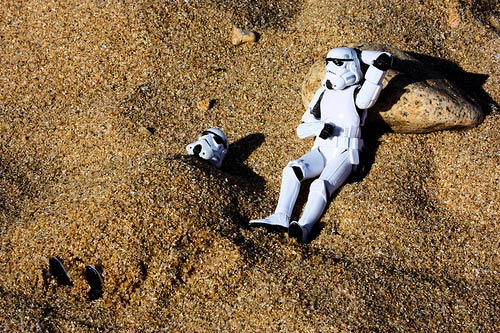
(via @ettagirl)
David Hume Kennerly took a photo of Dick Cheney and his family cooking a meal. Cheney is in the foreground on the right side of the frame, cutting some meat while some other family members chat and bustle in the background. Newsweek used the photo in their magazine, only they cropped out the family and just showed the former VP stabbing a bloody piece of meat with a knife to illustrate a Cheney quote about CIA interrogation methods. Kennerly cried foul.
The meat on the cutting board wasn’t the only thing butchered. In fact, Newsweek chose to crop out two-thirds of the original photograph, which showed Mrs. Cheney, both of their daughters, and one of their grandchildren, who were also in the kitchen, getting ready for a simple family dinner.
However, Newsweek’s objective in running the cropped version was to illustrate its editorial point of view, which could only have been done by shifting the content of the image so that readers just saw what the editors wanted them to see. This radical alteration is photo fakery. Newsweek’s choice to run my picture as a political cartoon not only embarrassed and humiliated me and ridiculed the subject of the picture, but it ultimately denigrated my profession.
This is hardly photo fakery. Crops aren’t lies. Full-frame photos aren’t the truth. Kennerley himself could have easily taken that exact picture in the moment. A spokesman for Newsweek defended the magazine’s action:
Yes, the picture has been cropped, an accepted practice of photographers, editors and designers since the invention of the medium. We cropped the photograph using editorial judgment to show the most interesting part of it. Is it a picture of the former vice president cutting meat? Yes, it is. Has it been altered? No. Did we use the image to make an editorial point — in this case, about the former vice president’s red-blooded, steak-eating, full-throated defense of his views and values? Yes, we did.
Given Cheney’s reputation, the cropped photo of him is not an outlandish or biased depiction of the man…in fact, it’s a pretty good visual metaphor of the former VP. If there’s one thing that both Cheney’s supporters and detractors can agree on, it’s that he’s a “red-blooded, steak-eating, full-throated [defender] of his views and values”.
I wonder what Errol Morris and Ricky Jay would make of this?
Update: Or maybe it is. (thx, frank)
Tommy Ton of Jak & Jil Blog caught the lineup of models before they walked the runway for Thom Browne.
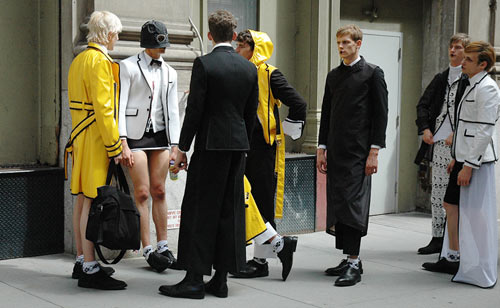
This photo alone could be the springboard for an entire novel.
Dazzling work by Hiroshi Sugimoto.
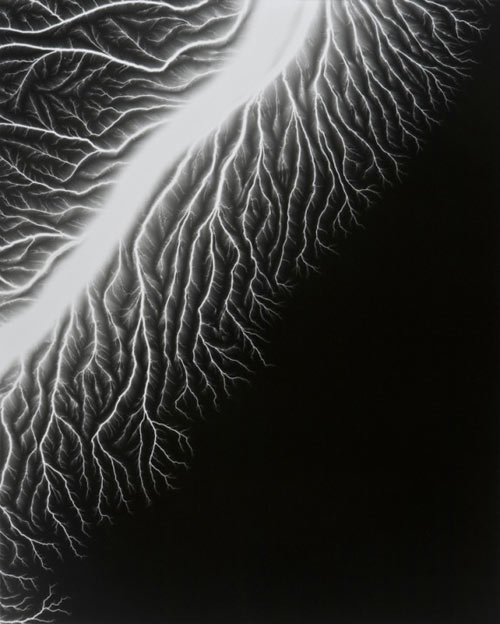
Hiroshi Sugimoto uses a 400,000-volt Van De Graaff generator to apply an electrical charge directly onto his film.
See also Peter Miller’s Polariod experiments.
Update: Robert Buelteman uses electricity to take photos of flowers.
The Royal Observatory has announced the winners of its Astronomy Photographer of the Year contest.
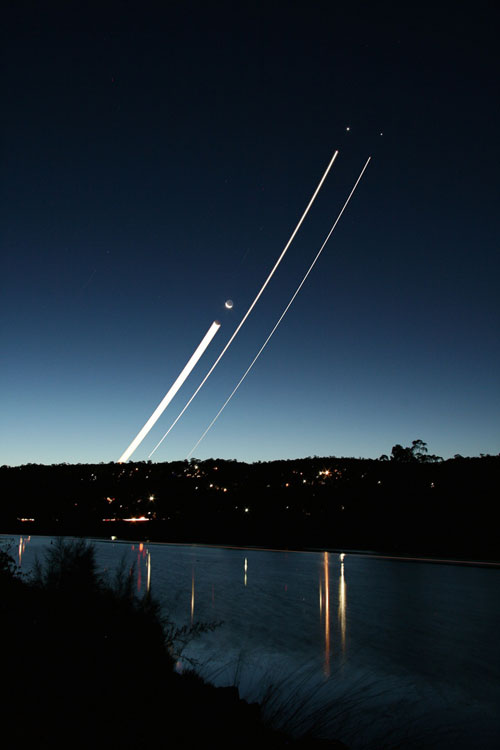
I had no idea that images this sharp and detailed could be taken with non-pro ground telescopes…particularly these shots of the Horsehead Nebula and the surface of the Moon. More winners listed here.
Update: Jonathan Crowe notes that the gear used to take these photos isn’t cheap.
The winner’s photo of the Horsehead Nebula (mpastro2001 also had a second photo in the top five) used a 12 1/2” Ritchey-Chretien telescope ($21,500) and an SBIG STL11000 camera ($7,195 and up) with an AO-L adaptive optics accessory ($1,795) on a Paramount ME mount ($14,500). Total cost for just the equipment mentioned here: $44,990.
The color photography of Sergei Mikhailovich Prokudin-Gorskii, who plied his trade in Russia in the early 1900s, is making the rounds online again. It’s always worth a look. Prokudin-Gorskii made color photographs using a clever filtering system years before color photography would be widely available. As a result, his work goes on the list of things that seem contemporary but really aren’t.


As Mike notes, I first linked to Prokudin-Gorskii’s work more than 8 years ago (!!).
Update: Clayton James Cubitt reminded me that Prokudin-Gorskii took a color portrait of Leo Tolstoy in 1908. (thx, clayton)
A collection of Michael Jackson tribute shirts worn to the recent Spike Lee-hosted birthday party for Jackson.
My pal Mouser is in Kazakhstan and took a bunch of photos of kids doing parkour on the beach. This shot is my favorite.
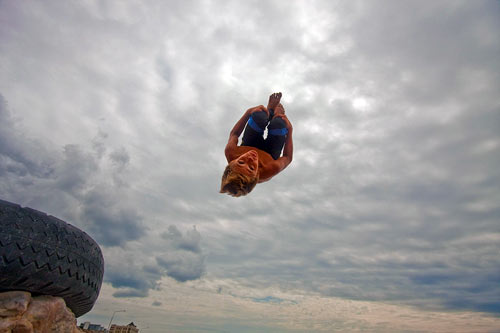
Will parkour eventually join soccer as one of the world’s most egalitarian sports? You don’t even need a homemade ball to play, just stuff to jump over, through, and off. The whole world’s a course.
Adam Lisagor notices that the iPhone 3GS camera might always be buffering images so that when you press that shutter button, you get the photo that you wanted, not the one delayed by slow software or a slow shutter. Adam’s observation gives me the opportunity to trot out one of my recent favorite informational factoids about the super high-speed cameras used to capture jumping great white sharks:
In order to get the jaw-dropping slow-motion footage of great white sharks jumping out of the ocean, the filmmakers for Planet Earth used a high-speed camera with continuous buffering…that is, the camera only kept a few seconds of video at a time and dumped the rest. When the shark jumped, the cameraman would push a button to save the buffer.
An assessment: what sort of photographer is the Google Street View car?
Initially, I was attracted to the noisy amateur aesthetic of the raw images. Street Views evoked an urgency I felt was present in earlier street photography. With its supposedly neutral gaze, the Street View photography had a spontaneous quality unspoiled by the sensitivities or agendas of a human photographer. It was tempting to see the images as a neutral and privileged representation of reality — as though the Street Views, wrenched from any social context other than geospatial contiguity, were able to perform true docu-photography, capturing fragments of reality stripped of all cultural intentions.
Tired of retouched women in magazines looking like “objects from Mars”, photographer Peter Lindbergh captured eight models without makeup or excessive retouching for Harper’s Bazaar’s September issue. (via fashionologie)
The NY Times’ Lens blog has a visual look back at the blackout of 2003.


Socials & More