kottke.org posts about crime
A wee bit of good news about American prisons for a change: after rising each year since the mid-1970s, the US incarceration rate has declined each of the past three years.
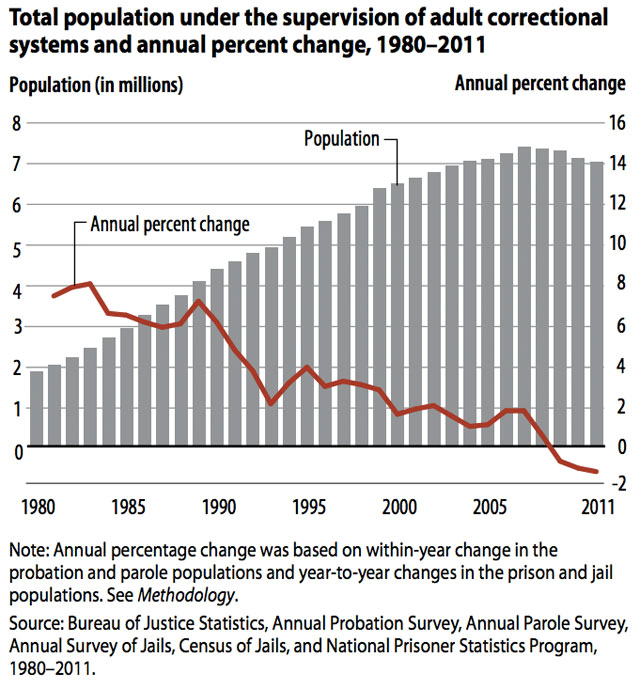
I hereby submit my nomination for the most underreported public policy story of the past year: The continuing decline in the number of Americans who are behind bars or on probation/parole. Both the change itself and low level of attention it has garnered are worthy of reflection.
At the time of President Obama’s inauguration, the incarceration rate in the United States had been rising every single year since the mid 1970s. The relentless growth in the proportion of Americans behind bars had persisted through good economic times and bad, Republican and Democratic Presidents, and countless changes in state and local politics around the country.
If a public policy trend with that much momentum had even slowed significantly, it would have been merited attention, but something far more remarkable occurred: The incarceration rate and the number of people under correctional supervision (i.e., including people on probation/parole) declined for three years in a row. At the end of 2011, the proportion of people under correctional supervision returned to a level not seen since the end of the Clinton Administration.
Commenters over at Marginal Revolution dug into the report a bit more and the decline may have a lot to do with things like state budget cuts and less to do with things like fewer/shorter prison sentences.
In recent years, we’ve seen a pretty steady drop in serious crime in many American cities. There are several theories to explain the drop — better policing strategies, shifting demographics, economic ups and downs — but none of them seems to provide a full and consistent explanation. In Mojo, Kevin Drum thinks he may have found the villain behind crime (and lower IQs and ADHD): Lead. “When differences of atmospheric lead density between big and small cities largely went away, so did the difference in murder rates.” I’m not sure if this is truly the answer, but it’s a very interesting read: America’s Real Criminal Element.
Unsurprisingly, people are continuing to die from guns in the US. Adam Lanza killed 28 people on December 14th, 2012 and since then, 393 more people have died.
In the latest issue of the New Yorker, Adam Green profiles Apollo Robbins, by most accounts the world’s best pickpocket. How he goes about engaging his prey is fascinating:
One day, over lunch at a Vietnamese restaurant in a Las Vegas strip mall, Robbins demonstrated his method on me. “When I shake someone’s hand, I apply the lightest pressure on their wrist with my index and middle fingers and lead them across my body to my left,” he said, showing me. “The cross-body lead is actually a move from salsa dancing. I’m finding out what kind of a partner they’re going to be, and I know that if they follow my lead I can do whatever I want with them.”
Robbins needs to get close to his victims without setting off alarm bells. “If I come at you head-on, like this,” he said, stepping forward, “I’m going to run into that bubble of your personal space very quickly, and that’s going to make you uncomfortable.” He took a step back. “So, what I do is I give you a point of focus, say a coin. Then I break eye contact by looking down, and I pivot around the point of focus, stepping forward in an arc, or a semicircle, till I’m in your space.” He demonstrated, winding up shoulder to shoulder with me, looking up at me sideways, his head cocked, all innocence. “See how I was able to close the gap?” he said. “I flew in under your radar and I have access to all your pockets.”
Hard to choose just one passage from this story, so I will also include this bit about attention:
But physical technique, Robbins pointed out, is merely a tool. “It’s all about the choreography of people’s attention,” he said. “Attention is like water. It flows. It’s liquid. You create channels to divert it, and you hope that it flows the right way.”
Robbins uses various metaphors to describe how he works with attention, talking about “surfing attention,” “carving up the attentional pie,” and “framing.” “I use framing the way a movie director or a cinematographer would,” he said. “If I lean my face close in to someone’s, like this” — he demonstrated — “it’s like a closeup. All their attention is on my face, and their pockets, especially the ones on their lower body, are out of the frame. Or if I want to move their attention off their jacket pocket, I can say, ‘You had a wallet in your back pocket — is it still there?’ Now their focus is on their back pocket, or their brain just short-circuits for a second, and I’m free to steal from their jacket.”
This routine is a pretty good demonstration of how Robbins diverts attention for the purpose of theft.
In an editorial for the NY Times in 1993 called Guns Don’t Kill People. Bullets Do., US Senator Daniel Patrick Moynihan described a bill he introduced in the Senate which would have levied a 10,000% tax on hollow-point bullets.
“So far this year, 342 New Yorkers have been killed by stray bullets. And in the past few days, two young women were shot in their pregnant bellies.” A. M. Rosenthal wrote that on this page last Tuesday, the day of the Long Island shooting. By Thursday there were 11 more homicides. If we are to stop it, or come anywhere close, we have to get hold of the ammunition.
On Nov. 3, I introduced a bill that would levy a 10,000 percent tax on Winchester hollow-tipped “Black Talon” bullets, specifically designed to rip flesh. (Colin Ferguson, the suspect in the Long Island shootings, had some 40 of them.)
The tax would effectively raise the price of Black Talons from $20 a box to $2,000. On Nov. 22, 19 days after my bill was introduced, Winchester announced that it would cease sale of Black Talons to the public. Which suggests that the munitions manufacturers are more responsive than the automobile companies were a generation ago. It is also important to note that in 1986 Congress banned the Teflon-coated “cop killer” bullet, which penetrates police body armor. The Swedes are now making a new kind of armor-piercing round. We got that banned in the Senate version of this year’s crime bill without a murmur.
The Long Island shootings Moynihan refers to resulted in the deaths of six people and the injury of nineteen more. (via @Rebeccamead_NYC)
Emily Badger highlights some trends in gun ownership, gun violence, and public opinion related to gun control over the past several decades.
A handful of charts paint a remarkable picture of some key shifts over the past 30 or 40 years. During that time, gun violence nationally has declined significantly even as aberrant mass shootings have grown less so; public sentiment for regulating the weapons has fallen steeply, too. Mother Jones has estimated that we’re approaching a demographic reality where our population of firearms will outpace our population of people. But hard data on the total number of civilian-owned guns in America is hard to come by, and so much of what we know on the topic is based upon what gun owners themselves say in surveys.
This morning at 11am, Ken Layne collected a number of incidents of gun violence that have occurred in the US since the Newtown shootings on Friday. They include:
In Mississippi, one man is dead and two are injured (including the dead man’s father) “after an argument over a man ‘doing donuts’ — or spinning his truck in circles — in a field.”
Two police officers were shot dead in Kansas on Sunday morning. They were investigating a “suspicious vehicle.”
A 42-year-old destitute maniac fired 50 rounds at the Fashion Island luxury mall in Newport Beach, California, on Saturday evening. No one was injured.
Layne also noted “this is not a comprehensive list of the U.S. gun violence over the past 48 hours”.
A 2006 paper that appeared in Injury Prevention analyzed the possible results of the 1996 gun law reforms in Australia. The most striking result: in the 18 years before tougher laws were passed, there were 13 mass shootings in Australia…and none in the 10.5 years afterwards.
Results: In the 18 years before the gun law reforms, there were 13 mass shootings in Australia, and none in the 10.5 years afterwards. Declines in firearm-related deaths before the law reforms accelerated after the reforms for total firearm deaths (p = 0.04), firearm suicides (p = 0.007) and firearm homicides (p = 0.15), but not for the smallest category of unintentional firearm deaths, which increased. No evidence of substitution effect for suicides or homicides was observed. The rates per 100 000 of total firearm deaths, firearm homicides and firearm suicides all at least doubled their existing rates of decline after the revised gun laws.
Conclusions: Australia’s 1996 gun law reforms were followed by more than a decade free of fatal mass shootings, and accelerated declines in firearm deaths, particularly suicides. Total homicide rates followed the same pattern. Removing large numbers of rapid-firing firearms from civilians may be an effective way of reducing mass shootings, firearm homicides and firearm suicides.
From a few years ago, Charlie Brooker’s Newswipe takes on the media’s reaction to mass killings, similar to what Roger Ebert was getting at.
(thx, daniel)
The New Yorker’s editor in chief David Remnick strongly urges President Obama to take decisive action on gun control.
Barack Obama has been in our field of vision for a long time now, and, more than any major politician of recent memory, he hides in plain sight. He is who he is. He may strike the unsympathetic as curiously remote or arrogant or removed; he certainly strikes his admirers as a man of real intelligence and dignity. But he is who he is. He is no phony. And so there is absolutely no reason to believe that his deep, raw emotion today following the horrific slaughter in Connecticut-his tears, the prolonged catch in his voice-was anything but genuine. But this was a slaughter-a slaughter like so many before it-and emotion is hardly all that is needed. What is needed is gun control-strict, comprehensive gun control that places the values of public safety and security before the values of deer hunting and a perverse ahistorical reading of the Second Amendment. Obama told the nation that he reacted to the shootings in Newtown “as a parent,” and that is understandable, but what we need most is for him to act as a President, liberated at last from the constraints of elections and their dirty compromises-a President who dares to change the national debate and the legislative agenda on guns.
The Onion takes on the CT school shootings in a series of articles. First, there’s Fuck Everything, Nation Reports:
Following the fatal shooting this morning at a Connecticut elementary school that left at least 27 dead, including 20 small children, sources across the nation shook their heads, stifled a sob in their voices, and reported fuck everything. Just fuck it all to hell.
All of it, sources added.
“I’m sorry, but fuck it, I can’t handle this-I just can’t handle it anymore,” said Deborah McEllis, who added that “no, no, no, no, no, this isn’t happening, this can’t be real.” “Seriously, what the hell is this? What’s even going on anymore? Why do things like this keep happening?”
From Right To Own Handheld Device That Shoots Deadly Metal Pellets At High Speed Worth All Of This:
“It’s my God-given right and a founding principle of this country that I be able to own a [piece of metal that launches other smaller pieces of metal great distances, one after the other], and if a few deaths here and there is the price we have to pay for that freedom, then so be it,” said Lawrence Crane of nearby Danbury, CT, who is such a staunch advocate of the portable deadly-pellet-flinging apparatuses that he keeps multiple versions of such mechanisms in his home, often carries one with him, and is a member of a club whose sole purpose is to celebrate these assembled steel things and the small bits of metal they send flying.
And Report: It Okay To Spend Rest Of Day Curled In Fetal Position Under Desk:
Following reports of a mass shooting at a Connecticut elementary school that left 20 children dead, sources just confirmed that it is totally fine to spend the entire rest of today curled up in the fetal position underneath your desk. Early reports also indicated that sitting on the floor while holding your knees to your chest and slowly rocking back and forth is not only acceptable, but, sources said, absolutely understandable.
Back in 2007, Gary Younge wrote an article for the Guardian about nine children who were killed with guns in one day in the US.
In many respects, then, Gerardo’s death set the scene for just another day in America. Over the following 24 hours, on this day picked at random, another eight children would lose their lives. Gerardo was the eldest; the youngest was two. Eight were black and one was Hispanic. They died in housing estates, suburbs and malls, at parties and on porches, in areas of average income and of above-average poverty. They were shot by a relative, friend, unknown assassin, a pizza delivery man, an off-duty police officer and by accident. It was Thanksgiving, the biggest travelling weekend of the year, when people are returning home after joining their families for the holiday. By the time the day was over, nine families were one member short.
And it’s not because they have guns. They’ve got money and political influence.
While the NRA wins court fights, laws allowing more guns in more public places continue to spread, often for reasons that defy logic. For example, take the reasoning offered by Alabama state Sen. Roger Bedford, a Democrat, when explaining to Bloomberg earlier this week why he introduced a bill that would allow people to keep their guns in their cars in the workplace parking lot. “This provides safety and protection for workers who oftentimes travel 20 to 50 miles to their jobs,” Bedford said. What does this mean? If there’s a workplace shooting, people need to be able to have their guns in the parking lot to turn the place into a true shootout? Or does he just mean that maybe people need to be able to shoot to kill while driving down the highway on the way to work?
More facts about guns in America from Ezra Klein, beginning with the sad fact that “shooting sprees are not rare in the United States”.
If roads were collapsing all across the United States, killing dozens of drivers, we would surely see that as a moment to talk about what we could do to keep roads from collapsing. If terrorists were detonating bombs in port after port, you can be sure Congress would be working to upgrade the nation’s security measures. If a plague was ripping through communities, public-health officials would be working feverishly to contain it.
Only with gun violence do we respond to repeated tragedies by saying that mourning is acceptable but discussing how to prevent more tragedies is not. But that’s unacceptable. As others have observed, talking about how to stop mass shootings in the aftermath of a string of mass shootings isn’t “too soon.” It’s much too late.
Josh Marshall at TPM asks: how do we fix this?
I don’t want to hear about these tragedies being rooted in evil or the human heart. We know the human heart is a substandard product. The brain frequently malfunctions. It’s offensive to put this forward as part of a discussion about policy as opposed to theodicy and meditation. We know that the vast, vast proportion of gun owners use them legally and safely. We also know that gun deaths are rare in many other countries quite similar to the USA for the simple reason they don’t have so many friggin’ guns all over the place. This is obvious. And guns just make it easy to kill a lot of people really quickly. Freely available body armor helps too.
Newer posts
Older posts






Socials & More