kottke.org posts about The Great Span
What a completely delightful video of 106-year-old Virginia McLaurin visiting the White House and meeting President and Mrs. Obama. This is the Webster’s definition of pure joy.
I don’t know much about McLaurin’s life story — she’s originally from South Carolina, first married at 14 — but when she was 10, the Civil War had ended only 55 years earlier. As a child, she likely knew and talked with people who were former slaves. And now she’s dancing with a black President in the White House. The Great Span continues to work its magic.
From Petapixel, a list of photographic firsts, including the first photograph (1826), the first digital photograph (1957), the first photo of the Sun (1845), and the first photograph of a US President (1843).
John Quincy Adams, the sixth President of the United States, was the first president to have his photograph taken. The daguerreotype was shot in 1843, a good number of years after Adams left office in 1829. The first to have his picture taken in office was James Polk, the 11th President, who was photographed in 1849.
Adams was born in 1767, which got me thinking about a long-standing interest of mine: who was the earliest born person ever photographed? The Maine Historical Society believes Revolutionary War vet Conrad Heyer was the earliest born. Born in 1749, he crossed the Delaware with Washington before sitting for this portrait in 1852.
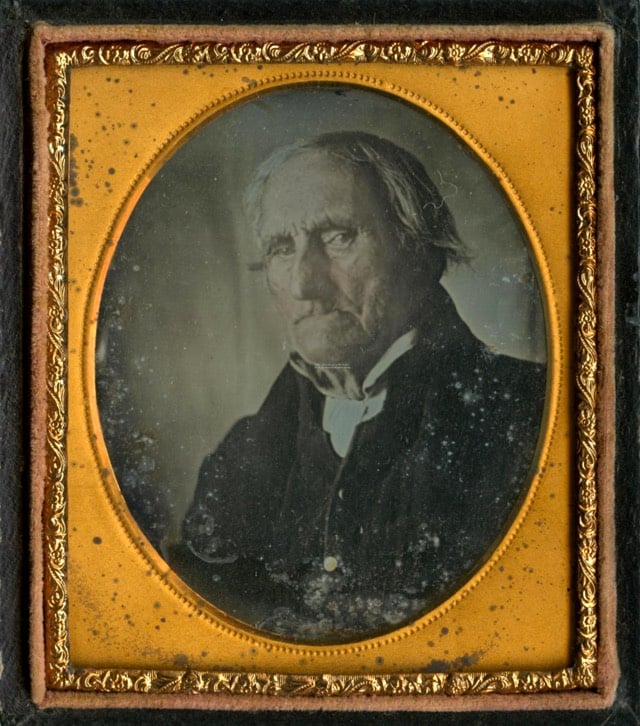
But according to the Susquehanna County Historical Society, John Adams (no apparent relation to the above Adams) was born in 1745 and was photographed at some point before he died in 1849. Other contenders with unverified ages include Revolutionary War vet Baltus Stone (born somewhere between 1744 and 1754 according to various sources) and a former slave named Caesar, photographed in 1851 at the alleged age of 114, which would mean he was born around 1737.
Still, that’s photographs of at least two people who were born in the 1740s, at least five years before the start of the French and Indian War. As children, it’s possible they could have interacted with people who lived through England’s Glorious Revolution in 1688 or even the English Civil War (1642-1651). The Great Span lives on.
Ran across one of my favorite little pieces of writing the other day: Sixty Men from Ur by Mark Sumner. It’s about how short recorded human history really is. The piece starts out by asking you to imagine if you view the history of life as the Empire State Building, all of human history is a dime on top.
Arthur M. Schlesinger, Jr., one the United States’ great historians, is less than two lifetimes removed from a world where the United States did not exist. Through Mr. Schlesinger, you’re no more than three away yourself. That’s how short the history of our nation really is.
Not impressed? It’s only two more life spans to William Shakespeare. Two more beyond that, and the only Europeans to see America are those who sailed from Greenland. You’re ten lifetimes from the occupation of Damietta during the fifth crusade. Twenty from the founding of Great Zimbabwe and the Visigoth sack of Rome. Make it forty, and Theseus, king of Athens, is held captive on Crete by King Minos, the Olmecs are building the first cities in Mexico, and the New Kingdom collapses in Egypt.
Sixty life times ago, a man named Abram left Ur of the Chaldees and took his family into Canaan. Abram is claimed as the founder of three great religions. A few lifetimes before that, and you’ve come out the bottom of that dime. You’re that close to it.
See also human wormholes and the Great Span, unlikely simultaneous historical events, and timeline twins.
Update: From Wired last year, Sam Arbesman writes about Kevin Kelly’s concept of touch generations.
I was recently listening to a lecture by Kevin Kelly where he introduces the concept of touch generations, the idea of a list of people based on when one person died and when the next was born: one person is in the next touch generation of someone else if they were born when the other person died. So Galileo and Newton, while unrelated, are in successive touch generations because Newton was born the year that Galileo died. Essentially, it’s a way of connecting lifetimes across the years.
That’s the subtitle of a book released in 2010 called The Last Leaf by Stuart Lutz. In the book are dozens of interviews with “last survivors or final eyewitness of historically important events”, including the last living pitcher to give up a home run to Babe Ruth in 1927, the last man alive to work with Thomas Edison, and the last American WWI soldier.
When we read about famous historical events, we may wonder about the firsthand experiences of the people directly involved. What insights could be gained if we could talk to someone who remembered the Civil War, or the battle to win the vote for women, or Thomas Edison’s struggles to create the first electric light bulb? Amazingly, many of these experiences are still preserved in living memory by the final survivors of important, world-changing events. In this unique oral history book, author and historic document specialist Stuart Lutz records the stories told to him personally by people who witnessed many of history’s most famous events.
See also human wormholes and the Great Span.
At the end of last week’s post about John Tyler’s grandsons still being alive (and indeed, NY Mag did an interview with one of them), I provided a couple of other examples of living persons bridging distant historical periods and asked:
Someone needs to come up with a term for this sort of thing (history bridges? no.)
On Twitter, David Galbraith suggested “timebenders”. After more thought, I came up with “human wormholes” but that’s not quite right either. Tony Hiss, in a book about his father Alger (the accused Soviet spy), said that Alger had a term for stories kind of like these: the Great Span.
My father himself even had a name for a kind of ongoing closeness between people in which death is sometimes only an irrelevance. He called it “the Great Span,” a sort of bucket brigade or relay race across time, a way for adjacent generations to let ideas and goals move intact from one mind to another across a couple of hundred years or more.
Hiss cites a pair of stories involving Alger (who died in 1996) and Oliver Wendell Holmes, who Alger clerked for and also figured in one of my earlier examples. In one story, Holmes told Alger about his experience fighting in the Civil War. The other story reaches back even further:
In the Holmes story Alger treasured above all others, the Justice told him that when he had been very young, his grandmother, a woman he revered, had shared her memories of the day at the beginning of the American Revolution when she was five and had stood in her father’s front window on Beacon Hill in Boston and watched rank after rank of Redcoats marching through town.
Another instance of the Great Span are the three Civil War widows (Maudie Hopkins, Alberta Martin, and Gertrude Janeway) who lived into the 2000s, two of them collecting their husbands’ pensions until their deaths. (thx, mike & @ithinkihaveacat)
That’s right, two exclamation points because this blows my mind. John Tyler was the 10th President of the United States. He was born in 1790 and took office in 1841. His son, Lyon Gardiner Tyler, was born in 1853, when Tyler was 63 years old. In turn, Lyon had six children with two different wives, two of whom were Lyon Gardiner Tyler, Jr. and Harrison Ruffin Tyler (born 1924 & 1928 respectively, when Lyon Sr. was in his 70s). They are reportedly both still living in their 80s.

Someone needs to come up with a term for this sort of thing (history bridges? no.). There’s also this 1956 game show appearance of a Lincoln assassination eyewitness and Supreme Court Justice Oliver Wendell Holmes (1841-1935) shaking hands during his lifetime with both John Quincy Adams (b 1767) and John F Kennedy (d 1963), one man spanning 200 years of American history.
Update: As of early 2018, both of Tyler’s grandsons are still alive. I’ve been collecting these kinds of stories on The Great Span page, after a term that accused Soviet spy Alger Hiss came up with:
My father himself even had a name for a kind of ongoing closeness between people in which death is sometimes only an irrelevance. He called it “the Great Span,” a sort of bucket brigade or relay race across time, a way for adjacent generations to let ideas and goals move intact from one mind to another across a couple of hundred years or more.
In 1956, 96-year-old Samuel Seymour appeared on a game show called I’ve Got A Secret…his secret was that he saw Lincoln’s assassination when he was five years old.
Mind-blowing…the Civil War & Lincoln’s assassination directly linked to something as modern as a TV game show. Two years earlier, Seymour gave an interview about witnessing the assassination. His father, an overseer on a Maryland estate, and his boss Mr. Goldsboro needed to travel to Washington to check on “the legal status of their 150 slaves”. Seymour got to go along.
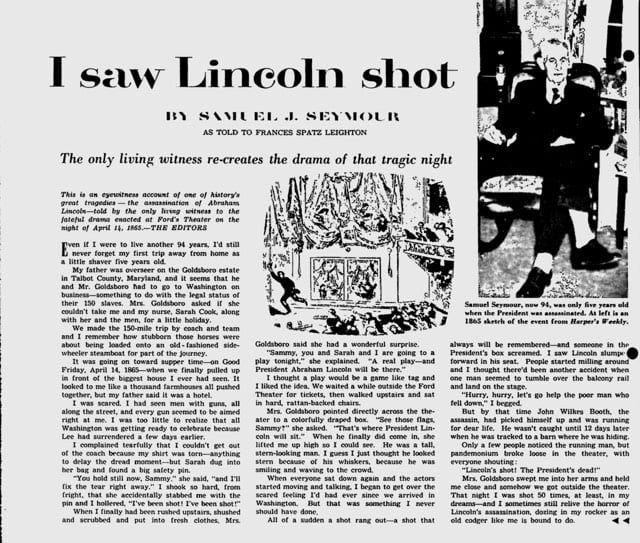
It was going on toward supper time — on Good Friday, April 14, 1865 — when we finally pulled up in front of the biggest house I ever had seen. It looked to me like a thousand farmhouses all pushed together, but my father said it was a hotel.
[…] When I finally had been rushed upstairs, shushed and scrubbed and put into fresh clothes, Mrs. Goldsboro said she had a wonderful surprise.
“Sammy, you and Sarah and I are going to a play tonight,” she explained. “A real play — and President Abraham Lincoln will be there.”
After Lincoln was shot, Seymour saw Booth fall from the balcony and run off.
Newer posts





Socials & More