Wow. Someone is making a video game featuring the original Super Mario Bros worlds but Mario is outfitted with a Portal gun. Watch the demo:
More information on the game’s development is here.
Yes, this is an actual game being developed - it is not a mod of any existing one. It’s coded with L”ove (info at the bottom of the left menu) and will be released for free (so we don’t get stabbed by lawyers)
All the source code of the game will be available after release
The game will have mappacks, which will be downloadable from ingame. Users most likely won’t be able to publish maps directly, but will be able to send them in and we’ll add them for everyone to use.
The primary maps will have a story and some portaly puzzles. What kind, well, we’ll figure that out as we go
Level editor will be embedded in the game so you can edit the level while you play
Original SMB levels and Lost levels will be included
Simultaneous Multiplayer
Based on Super Mario 3, this HTML5 Super Mario game goes on forever. Someone bet Billy Mitchell he can’t finish this game and we’ll never have to hear from him again! (via waxy)
Here’s what playing the original Super Mario Bros would look like from a first-person perspective.
(via devour)
In the Seahawks/Saints game over the weekend, Seahawks running back Marshawn Lynch made an improbable game-winning touchdown run. So, I can’t decide which one of these videos is better. Marshawn Lynch’s Tecmo Bowl Run:
Or Marshawn Lynch as Super Mario in star mode:
In a recent interview for the 25th anniversary of Super Mario Bros., Mario’s baby daddy Shigeru Miyamoto revealed that the infinite 1-up trick was included in the game on purpose but that the minus world was a bug.
“We did code the game so that a trick like that would be possible,” Miyamoto revealed. “We tested it out extensively to figure out how possible pulling the trick off should be and came up with how it is now, but people turned out to be a lot better at pulling the trick off for ages on end than we thought.” What about the famed Minus World? “That’s a bug, yes, but it’s not like it crashes the game, so it’s really kind of a feature, too!”
What if Super Mario Bros had been designed as a typical circa-2010 networked game? It might look a little something like this:

The site’s a little slow right now…check back later if you can’t get the page to load. (via waxy)
Oh, man. Now you can play the original Super Mario Bros game as Link from Zelda, Mega Man, Samus Aran, and others. Really really fun. The only thing that could make this better is if you could play as NHL94’s Jeremy Roenick or Tecmo Bowl’s Bo Jackson. (thx, will)
Might have to dust off the Wii for this one: New Super Mario Bros. Wii.
Features include four-player collaborative play (!!) and something called “demo play”.
The game will also be the first game on the Wii to feature “demo play”, where players will be able to pause the game, let the game complete the level for them, and resume play at any time by unpausing.
In my house, this was called the “give the controller to my 11-year-old cousin and let him show you how it’s done” feature. I both hated and loved that feature. (via object of my obsession)
An examination of gravity in the Super Mario Bros series.
We determined that, generally speaking, the gravity in each Mario game, as game hardware has increased, is getting closer to the true value of gravity on earth of 9.8 m/s^2. However, gravity, even on the newest consoles, is still extreme.
In Super Mario 2, Mario experiences a g-force of 11 each time he falls from a ledge, a force that would cause mere humans to black out. In Madden 2006, the game’s fastest cornerbacks can run the 40 in 2.6 seconds. (via waxy)
Someone made a video overlay of the 134 times it took him to get through one level of hacked version of Mario World. (Note: the original video was taken down so the embed is a similar video.)
Oh, and how that relates to quantum mechanics:
But, we can kind of think of the multi-playthrough Kaizo Mario World video as a silly, sci-fi style demonstration of the Quantum Suicide experiment. At each moment of the playthrough there’s a lot of different things Mario could have done, and almost all of them lead to horrible death. The anthropic principle, in the form of the emulator’s save/restore feature, postselects for the possibilities where Mario actually survives and ensures that although a lot of possible paths have to get discarded, the camera remains fixed on the one path where after one minute and fifty-six seconds some observer still exists.
Some of my favorite art and media deals with the display of multiple time periods at once. Here are some other examples, many of which I’ve featured on kottke.org in the past.
Averaging Gradius predates the Mario World video by a couple years; it’s 15 games of Gradius layered over one another.
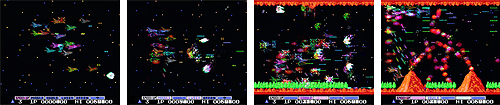
I found even the more pointless things incredibly interesting (and telling), like seeing when each person pressed the start button to skip the title screen from scrolling in, or watching as each Vic Viper, in sequence, would take out the red ships flying in a wave pattern, to leave behind power-ups in an almost perfect sine wave sequence. I love how the little mech-like gunpods together emerge from off screen, as a bright, white mass, and slowly break apart into a rainbow of mech clones.
According to the start screen, Cursor*10 invites the you to “cooperate by oneself”. The game applies the lessons of Averaging Gradius and multiple-playthrough Kaizo Mario World to create a playable game. The first time through, you’re on your own. On subsequent plays, the game overlays your previous attempts on the screen to help you avoid mistakes, get through faster, and collaborate on the tougher puzzles.
Moving away from games, several artists are experimenting with the compression of multiple photographs made over time into one view. Jason Salavon’s averaged Playboy centerfolds and other amalgamations, Atta Kim’s long exposures, Michael Wesley’s Open Shutter Projekt and others. I’m quite sure there are many more.
Dozens of frames of Run Lola Run racing across the giant video screen in the lobby of the IAC building.
The same kind of thing happens in this Call and Response video; 9 frames display at the same time (with audio), each a moment ahead of the previous frame.
Related, but not exactly in the same spirit, are projects like Noah Kalina’s Noah K. Everyday in which several photos of the same person (or persons) taken over time are displayed on one page, like frames of a very slow moving film. More examples: JK Keller’s The Adaption to my Generation, Nicholas Nixon’s portraits of the Brown sisters, John Stone’s fitness progress, Diego Golberg’s 32 years of family portraits, and many more.
Update: Another video game one: 1000 cars racing at the same time. (thx, matt)
Update: More games: Super Earth Defense Game, Time Raider, and Timebot. (thx, jon)
Update: Recreating Movement is a method for making time merge photos (thx, boris):
With the help of various filters and settings Recreating Movement makes it possible to extract single frames of any given film sequence and arranges them behind each other in a three-dimensional space. This creates a tube-like set of frames that “freezes” a particular time span in a film.
How You See It overlays three TV news programs covering the same story. (via waxy)
Update: James Seo’s White Glove Tracking visualizations. The Slinky one is mesmerizing once you figure out what to look for. Seo also keeps a blog on spilt-screen media.
The latest installment of Super Mario has received plenty of notice for its revolutionary style of gameplay. But just as striking is the intricacy of its sound design. One convention of the game is a Pull Star, a floating anchor that Mario can grab with some sort of magical, musical force which, when activated emits a creepy, almost theremin-like wail, wavering just a bit before solemnly sliding down in pitch. This sound is one of those elemental formulas for touching an emotional soft spot. The other day I was playing a level with a series of Pull Stars in succession and my girlfriend implored me to stop, as it was making her sad, and not only because I’m a grown man playing a child’s video game. Here is an example of the Wailing Pull Star (and a taste of the very Vangelis-like score scattered throughout the game).
Also: via Boing Boing Gadgets, footage from a live orchestra scoring session for the game. Mario’s creator, Shigeru Miyamoto sits aside and supervises.
Also also: I noticed that the menu for selecting levels to play is a musical instrument in its own right, allowing the player to create melody with chord changes and everything. It’s a subtle touch.






Socials & More