kottke.org posts about Google
Google is thirteen today…back in 1998 when the site was still hosted at http://google.stanford.edu, Keith Dawson gave the search engine its first online coverage in English on the fondly remembered Tasty Bits From the Technology Front.
This site, one of the few rigorous academic research projects on Web searching, presents a demonstration database — only 25M documents — that already blows past most of the existing search engines in returning relevant nuggets. Google employs a concept of Page Rank derived from academic citation literature. Page Rank equates roughly to a page’s importance on the Web: the more inbound links a page has, and the higher the importance of the pages linking to it, the higher its Page Rank.
This is kind of amazing…you draw a graph and Google Correlate finds query terms whose popularity matches the drawn curve. I drew a bell curve, a very rough one peaking in 2007, and it matches a bunch of searches for “myspace”.
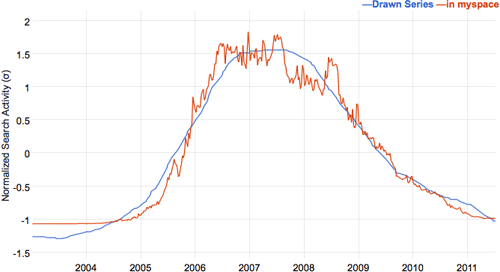
This fits beautifully with the previous post about Vonnegut’s story shape graphs.
Charlie Ayers, former executive chef for Google, once worked alongside a former cook for Elvis Presley and that cook gave him his special recipe for fried chicken. Ayers says it’s “the best southern fried chicken I [have] ever tasted”. The recipe uses Google-sized portions…here’s a recipe converter to scale it down.
Rorschmap is a trippy Google Maps mashup by James Bridle that provides kaleidoscopic views of locations from around the world. Here’s Paris, complete with MegaSeine.
I feel like I’ve heard this before, but in the early days of Google, Sergey Brin ended his job interviews in an unusual manner.
Finally, he leaned forward and fired his best shot, what he came to call “the hard question.”
“I’m going to give you five minutes,” he told me. “When I come back, I want you to explain to me something complicated that I don’t already know.” He then rolled out of the room toward the snack area. I looked at Cindy. “He’s very curious about everything,” she told me. “You can talk about a hobby, something technical, whatever you want. Just make sure it’s something you really understand well.”
I wonder if Mark Zuckerberg asks similar sorts of questions on his walks in the woods.
There’s a serious proposal to build an undersea electrical grid as part of the infrastructure for future offshore wind turbines. David Roberts writes about its importance:
Offshore wind power has significant advantages over the onshore variety. Uninterrupted by changes in terrain, the wind at sea blows steadier and stronger. Installing turbines far enough from shore that they’re invisible except on the very clearest days lessens the possibility of not-in-my-backyard resistance. The challenge is getting the electricity back to land, to the people who will use it…
The Atlantic Wind Connection (AWC) would provide multiple transmission hubs for future wind farms, making the waters off the mid-Atlantic coast an attractive and economical place for developers to set up turbines. The AWC’s lines could transmit as much as six gigawatts of low-carbon power from turbines back to the coast—the equivalent capacity of 10 average coal-fired power plants.
There’s a particular stretch of seabed, a flat shelf between the north Jersey and southern Virginia, that’s geologically and geographically perfect for this. That’s where they’re setting up shop. Power-hungry Google is helping foot the bill.
(via Grist.)
On April 29th, Google is shutting down playback at Google Video. Instead of transitioning everything over to YouTube (which would seemingly make a lot of sense), they’re just shutting it down with two weeks notice. If you’re comfortable with the command line (can’t they make this easier?), you can help archive.org save some of the best of Google Video. (via waxy)
Google has built a quick little app for people trying to locate friends and family in Japan. There are two options: 1) “I’m looking for someone” and 2) “I have information about someone”.
You’ve likely already seen this, but 9-eyes is a better-than-usual collection of images taken from Google Street View.

Over at the New Yorker, Ken Auletta has some insight into why Eric Schmidt is stepping down as Google’s CEO.
Schmidt, according to associates, lost some energy and focus after losing the China decision. At the same time, Google was becoming defensive. All of their social-network efforts had faltered. Facebook had replaced them as the hot tech company, the place vital engineers wanted to work. Complaints about Google bureaucracy intensified. Governments around the world were lobbing grenades at Google over privacy, copyright, and size issues. The “don’t be evil” brand was getting tarnished, and the founders were restive. Schmidt started to think of departing. Nudged by a board-member friend and an outside advisor that he had to re-energize himself, he decided after Labor Day that he could reboot.
He couldn’t. By the end of the year, he was ready to jump on his own.
Why can’t all “tech” journalism be like this? A single article on the topic, three paragraphs, all fact, properly sourced, no opinion, little speculation, no quotes from useless analysts. Reading something this spare and straightforward makes you realize how shitty TC, Mashable, SAI, and rest are.
Eric Schmidt is stepping down as CEO (he’ll remain the Executive Chairman) and Larry Page will become the new CEO in April.
Larry will now lead product development and technology strategy, his greatest strengths, and starting from April 4 he will take charge of our day-to-day operations as Google’s Chief Executive Officer. In this new role I know he will merge Google’s technology and business vision brilliantly. I am enormously proud of my last decade as CEO, and I am certain that the next 10 years under Larry will be even better! Larry, in my clear opinion, is ready to lead.
Sergey has decided to devote his time and energy to strategic projects, in particular working on new products. His title will be Co-Founder. He’s an innovator and entrepreneur to the core, and this role suits him perfectly.
As Executive Chairman, I will focus wherever I can add the greatest value: externally, on the deals, partnerships, customers and broader business relationships, government outreach and technology thought leadership that are increasingly important given Google’s global reach; and internally as an advisor to Larry and Sergey.
Dorothy Gambrell looked up all of the state names on Google and made a map of what the autocomplete suggestions were. Here’s part of it:
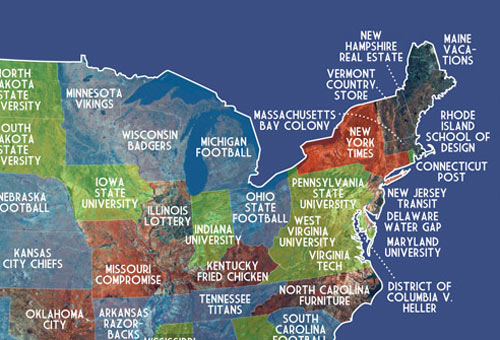
Lots of sports and schools.
The dickwad who threatened his customers as an SEO tactic (detailed here in the NY Times) was arrested on Monday by federal agents.
The merchant, Vitaly Borker, 34, who operates a Web site called decormyeyes.com, was charged with one count each of mail fraud, wire fraud, making interstate threats and cyberstalking. The mail fraud and wire fraud charges each carry a maximum sentence of 20 years in prison. The stalking and interstate threats charges carry a maximum sentence of five years.
He was arrested early Monday by agents of the United States Postal Inspection Service. In an arraignment in the late afternoon in United States District Court in Lower Manhattan, Judge Michael H. Dolinger denied Mr. Borker’s request for bail, stating that the defendant was either “verging on psychotic” or had “an explosive personality.” Mr. Borker will be detained until a preliminary hearing, scheduled for Dec. 20.
Newer posts
Older posts





Socials & More