kottke.org posts about AIGA
I’m sitting in a huge room filled with ~2,000 people at the opening remarks of the AIGA Design Conference and there’s no single other person on Bonjour (formerly Rendezvous) in iChat:
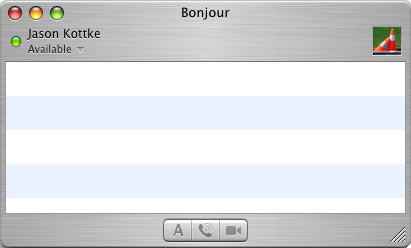
I may be the only person in the entire room with his laptop open. Instead, everyone is listening to the speakers. Like Jeff, I’m torn: is this lack of a back channel a good thing or does the presence of an online component of a conference make the experience more rewarding?
One of the pre-conference events was a talk at Fenway Park followed by a tour of the ballpark. Janet Marie Smith, VP of planning and development for the Sox, kicked things off with how the team (especially the new management) works really hard to preserve the essential character of Fenway while at the same time trying to upgrade the park (and keep it from getting torn down). She talked about the advertisements added to the Green Monster, which was actually not a purely commercial move but a throwback to a time when the Monster was actually covered with ads.
Lots of talk and awareness of experience design…the Red Sox folks in particular kept referring to the “experience” of the park. One of the speakers (can’t recall who, might have been Jim Dow) talked about how other ballparks are becoming places where only people who can afford $100 tickets can go to the games and what that does to the team’s fan base. With Fenway, they’re trying to maintain a variety of ticket prices to keep the diversity level high…greater diversity makes for a better crowd and a better fan base and is quite appropriate for Boston (and New England in general), which has always been an area with vibrant blue collar and blue blood classes.
Janet also referred to the “accidental” design of the park. Like many other urban ballparks built in the late 19th/early 20th centuries, the placement of the streets constrained the design of Fenway and made it rather an odd shape….these days larger plots are selected where those types of restraints are removed. And over time, the game has changed, the needs of the fans have changed, and the fire codes have changed and the park has changed with the times. In the dead ball era, the walls of the stadium weren’t for hitting home runs over; their sole function was to keep people on the street for catching the game for free, so the Fenway outfield ran over 500 feet in right field — practically all the way to the street — where there’s now 30 rows of seats. Jim Holt observed that American butts have gotten bigger so bigger seats are called for. Fire codes helped that change along as well…wooden seats, bleachers, and overcrowding are no longer a large part of the Fenway experience (save for the wooden seats under the canopy).
The design talk continued on the tour of the park. Our guide detailed how ballparks are built around specific ballplayers. Yankee Stadium was the house that Ruth built but it was also seemingly (but not literally) built for him with a short trip for his home run balls to the right field wall. Boston added a bullpen to make the right field shorter for Ted Williams. Barry Bonds does very well at PacBell/SBC/WhateverItsCalledTheseDays Park. And more than that, the design of Fenway also dictated for a long time the type of team that they could field, which had some bearing on how they did generally. Players who played well in Fenway (i.e. could hit fly balls off of the Monster in left) often didn’t do so well in other parks and the team’s away record suffered accordingly.
In preparation for the AIGA design conference[1], I’m looking over the session descriptions and speaker list. The theme for this year is “Design”, which seems a little broad but somehow appropriate given how much design has been taken up by the press (especially the business and tech press) recently as something Important and the design profession may be in need of a little wagon circling to figure out how to effectively explain design to someone who is all fired up about incorporating it into their business process because they read a blurb in Fast Company about Jonathan Ive and the iPod.
My knowledge of and involvement with the AIGA up to this point has been fairly minimal, which either makes me the ideal person (fresh eyes!) or a horrible choice (head up ass!) to cover their design conference. I’m particularly interested in learning how they’ve incorporated the fast-changing disciplines of Web and digital design into the mix. When I was working in Minneapolis as a Web designer in the late 90s, my company got me an AIGA membership, but I never used it because although they were trying to be more relevant to those of us working on the Web, my perception is that the AIGA was still largely a graphic design organization and I was finding more of what I was looking for on Web design sites like A List Apart. Now that the Web design profession has matured (and Web design practitioners along with it), it seems to fit better with where the AIGA is going (and vice versa). After all, design is design, no matter what word you stick in front of it.
So, back to the speakers list, I’m looking forward to hearing from Michael Bierut, Lella and Massimo Vignelli, Steven Heller, Matthew Carter, John Maeda, Peter Merholz and Jesse James Garrett from Adaptive Path, Ze Frank, Stefan Sagmeister, Steff Geissbuhler, Caterina Fake, and Milton Glaser (but no Malcolm Gladwell or Errol Morris, both of whom I swear were on earlier speaker lists), some of whom you may recognize from past mentions on kottke.org. They’ve also added some sessions in response to Hurricane Katrina on design, safety, risk, and disaster management, which is an excellent use of the opportunity of having a bunch of designers in the same place.
If you want to follow along with the complete conference coverage here on kottke.org, here’s the AIGA 2005 page. As I mentioned previously, I’ll be opening up comments on most posts (incl. this one), but will be active in gardening off-topic and trolling comments.
[1] I just realized all these URLs are going to break when the next conference rolls around in two years or so, which is disappointing. Would be nice to have something like http://designconference.aiga.org/2005 that would permanently point to this year’s festivities. Bloggers like permanent links (well, this one does anyway).
From September 15-18, I will be attending the AIGA Design Conference in Boston. As an experiment (for both the AIGA and me), I will be covering the event at their request[1] on kottke.org. I’ll be covering the conference as a blogger, but the easiest way to think about it in terms of a conference is that I’m a speaker[2]…a sort of roving speaker with the readers of kottke.org as the audience and my topic is the conference itself.
As usual, I have no solid plan as to how this is going to work exactly, but I’m looking forward to seeing how the conference goes and adapting accordingly. I’m hoping to provide a moving snapshot of the event so that readers of kottke.org can follow along fairly well without being at the conference. I’ll probably have comments open on most posts so hopefully those reading along at home and those reading along at the conference can have some dialogue, with each little world spilling over into the other a bit.
One other quick thing…if you’re going to be at the conference and plan to blog it, let me know…I’ll definitely be linking to other people’s stuff. I’m sure Design Observer and Speak Up will be covering things pretty well. I’ll also be watching Flickr and del.icio.us for links and photos…I’d suggest tagging relevent entries with aigadc2005 for easy aggregation.
More next week as the conference draws near.
[1] Disclaimer: Kottke.org’s budget for covering out-of-town conferences with costly entry fees is limited, so I’m exploring other ways of gaining access to be able to bring you some interesting content that you might not get otherwise. The AIGA is a curious organization and they’re looking at various ways of using weblogs, so they asked me to come and blog the conference as an experiment. To make it economically feasible for me to be there, they are paying me a small speaker’s honorarium and putting me up in a hotel.
In talking with the AIGA about this, they’ve made it exceedingly clear that I’m to consider myself independent and write whatever I want about the conference, which is pretty much what I intend to do. If I thought the hotel room and honorarium would be a problem w/r/t my objectivity in covering the event, I would have declined them both. The bottom line is that if money were no object (if the conference were free and took place entirely within walking distance of my apartment), I’d want to go and write about it anyway.
[2] Although I will also be appearing on a related panel about blogs, journalism, and design with Steve Heller, Michael Bierut, Armin Vit, and Jen Bekman.
Update: I’ve changed the first paragraph slightly, from “covering the conference as a blogger/journalist” to “covering the conference as a blogger”, which under the circumstances is more accurate. I am not a journalist in this instance or any other.
Results from the Digital Information Design Camp run by MIT Media Lab and the AIGA. They should have worked on their interface/information design a little more…you wouldn’t know that there’s a ton of student work to view by looking at the front page.
AIGA’s Design Annual for 2005. Lots of good work in there; I saw the book design winners on display in NYC last fall.
Newer posts





Socials & More