


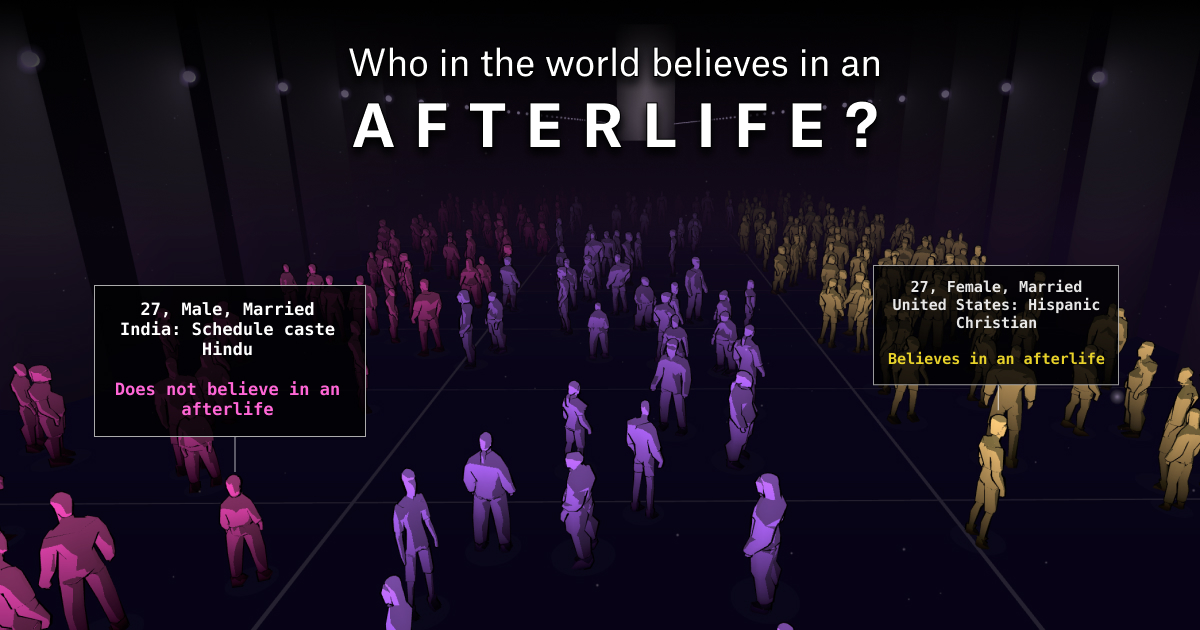
Do you believe in life after death? This is a great interactive piece by Alvin Chang about people’s beliefs about the existence of an afterlife and how those beliefs change over the course of our lifetimes.

Advertise here with Carbon Ads
This site is made possible by member support. 💞
Big thanks to Arcustech for hosting the site and offering amazing tech support.
When you buy through links on kottke.org, I may earn an affiliate commission. Thanks for supporting the site!
kottke.org. home of fine hypertext products since 1998.
Beloved by 86.47% of the web.
Comments 5
thread
latest
popular
I found this engaging and also deeply editorial. As someone who identifies as "not sure" about life after death, I wouldn't agree that I'm a "fence sitter." Nor do I feel that ". . . we're cursed to never know what's on the other side [of death]." Not knowing what happens after we die is not, in my opinion or experience, a curse. That vibe contributes to death anxiety and diminishes an exploratory curiosity. (Edited to add since religious affiliation is part of the study: I'm a life-long religiously active person and an ordained clergy person.)
Chang wrote up a behind-the-scenes on this visualization.
While by no means, The Answer, since it has helped me think about how to be a better human in the present, I've likened the afterlife to a tree that falls in the forest and decays, giving its life back to other organisms and the next generation.
You physically die, but your interactions, your kindnesses (and unkindnesses) and shared ideas, are carried forward by those you influenced to be passed along to the next generation. A variation of objective immortality.
I almost died and went through "the tunnel" to the light. Then I regained consciousness. It helped me feel confidently that there is more to life than our time on earth in physical bodies. I definitely think who or whatever we are lives on in some unknowable way (unknowable while we are constrained to the physical) after our bodies die. There's too much evidence for it, too many experiences and now that I've had my own brief glimpse, I feel like it is more than say, imaginary projection. There's more. We don't know what or why and that is why humility is a core tenet of human knowledge, or should be.
You may be interested in some of the books by Dr. Peter Fenwick, whose studies included research into near-death experiences and other end-of-life phenomena.
If you feel like this comment goes against the grain of the community guidelines or is otherwise inappropriate, please let me know and I will take a look at it.
In order to comment or fave, you need to be a kottke.org member. Check out your membership options.
Note: If you are a member and tried to log in, it didn't work, and now you're stuck in a neverending login loop of death, try disabling any ad blockers or extensions. Or try logging out and then back in. Still having trouble? Email me!