
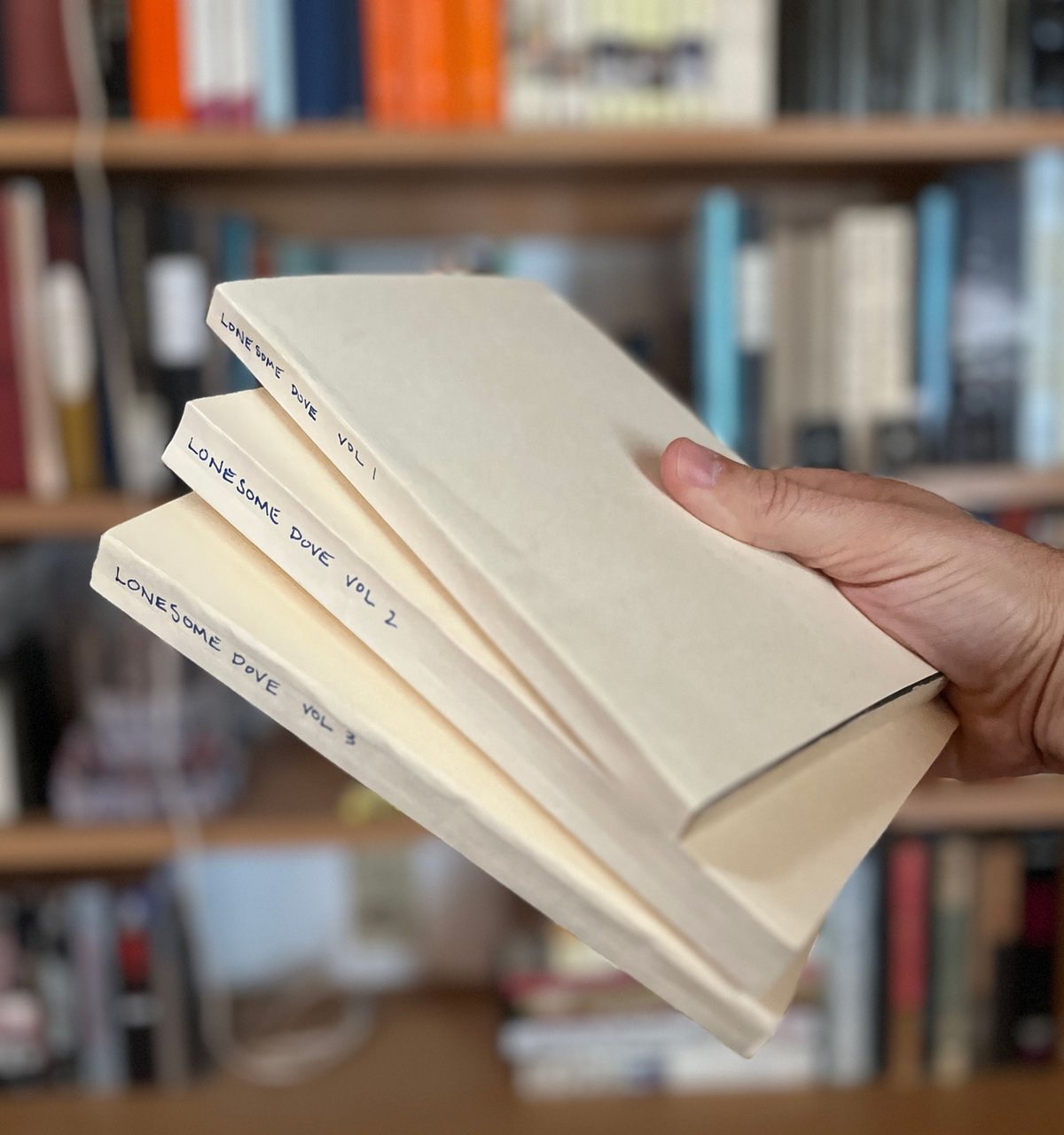
What do you you do when the book you’re reading is too large to carry around? “I would like to recommend you to a practice I call Chop That Book Up Into Reasonable Sizes.”

Advertise here with Carbon Ads
This site is made possible by member support. 💞
Big thanks to Arcustech for hosting the site and offering amazing tech support.
When you buy through links on kottke.org, I may earn an affiliate commission. Thanks for supporting the site!
kottke.org. home of fine hypertext products since 1998.
Beloved by 86.47% of the web.
Comments 25
thread
latest
popular
Oh, this is so great. 😍
About 25 years ago, I saw a friend who worked at Penguin Books take a bread knife to a fat book for precisely this reason. I went on to become a book designer, and this made a big impression because it helped me to see that people who work with books generally see them as practical objects to be used and enjoyed, more than to be revered.
I read The Power Broker, then all seven volumes of In Search of Lost Time, and was starting Infinite Jest. I got really bad tendonitis in the wrist of my left hand due to how I held those tomes.
I should have either been less precious about reading physical books or about keeping them in one piece.
I’m better now but it took months to have full range of motion again without severe pain.
i'm a somewhat old school guy, as in i appreciate that there is value in the way it all was.
That being said, i really don't see the value of a physical book versus an e-ink reader. i see it as part of the portfolio of things that enables us live in smaller spaces. we have thinner TVs, less paperwork, less books, smaller/no stereo, etc.
Everyone should read the way they're comfortable with. For a long time I used an e-ink device (I think a series of three, including the best one available at the time: what I'm about to say is not based on some cheap low-resolution thing).
I thought I loved it. But then I remembered what books were like. What reading was like when not every book looked typographically identical, when not every book had the same paper colour, texture or thickness. I remembered the pleasure of looking at a nicely designed spread, or even just any spread, rather than a single page. I realised I missed sitting down somewhere with a book, not with a machine containing an infinitude of texts, and just reading what was in front of me rather than endlessly looking up words or skipping to something else when I got momentarily bored, which was very often. And I realised that I wanted something that didn't feed details of my reading habits into some techbro database, to be used to train their idiot machine god.
And the too-many-books problem is not really a problem: if you are sure you will re-read it soon, keep it; if not, charity shops exist.
Books which are unwieldy are a problem, in the same way that three-hour movies are a problem. The problem is usually a failure of self-discipline by the author (director), combined with it being financially impractical to publish them in several volumes (with an interval). Cutting them apart is a good solution.
If you ever do want to get back into print books without cluttering up your space, there’s always the library!
One other note, as a sometime book designer: EPUB is a wonky file format, made of HTML and CSS under the hood but with serious and not always intuitive limitations. But at least it lets you translate a book design roughly into a shape that an e-reader can present. Then you feed your EPUB file into Kindle, and it strips away the last of your typography, leaving the reader with another identical blob of words in a system font with system margins and system kerning and system everything else. It’s sort of like an RSS reader in that regard. Everything gets extruded into a single design. I get that some people like that. But not me—I’m a browse-directly-to-kottke.org sicko who wants to see the web design exactly as Jason intended.
I second the library! Although, if you're reading enormous books, that does eliminate the ability to cut them down to a more manageable size.
I do have an e-reader that I use when I travel (or sometimes if I can't sleep so I can read without waking up my spouse). But I love the physical book - looking a few pages ahead to plan when I'm going to stop, putting my finger in the page while I answer a question from my kids, flipping back to a picture or a map over and over. I know I can do those things with an e-reader, but they don't feel the same.
l want to love digital but the relief I feel from not being bathed in emf's right before sleeping is too valuable. It takes the near continuous electronic 'frizz' out of my personal space so that my body can and brain can wind down. I am admittedly 'extra sensorially perceptive', and paper book really helps me downshift. But yes, they are bulky.
Something about the size of a screen just doesn't work for me. A Kindle, or a phone makes the window into a book feel small, to me. A physical book helps me picture the world better.
Yes! And you know which books are always too big? Travel guides. In fact, you probably stopped buying them because of how big they are. Instead you walk around a foreign country just staring at your phone all day. You're on vacation, you silly goose!
But guess what? Cut it up. Carve the Bologna section out of that big ol' Italy book. Fold it in half and stick it in your pocket. The area map usually ends up right on top.
Sure, look stuff up on your phone the day before. But write it in the margin. I know, I know, travel guides are still lame. But you know what's even more lame? Google Maps.
I think that Rick Steves recommended this. It felt very weird the first time, but we did it several times during our peak travel years.
100%! My sweetie was aghast when I started slicing up a travel tome to just keep the sections where we would be traveling, but I just kept thinking that *I* wasn't going to pack and carry all that extra mass around. And I love that Rick Steves is on board; if anyone is going to be precious about books it's the author, and even he thinks it's a practical step!
Horrifying! 😆 (Except for travel guides. I agree with ZZZ, I tear those things up all the time.)
From a 2009 KDO post on How to Read Infinite Jest:
My grandad used to tear out the pages as he read them and toss them in the fire. He said he never needed a bookmark! Meanwhile I read so carefully so I never break the spine of a book.
Uh, get a Kindle?
I’m barely capable of bringing myself to making notes in books in pencil.
This is actually pretty common in Japan (where I lived for 4 years), except the publishers do the cutting for you! I’m guessing it’s because everyone rides trains all the time, but you can get books in tiny format with thin pages, making them light and ultraportable, and they even sell larger books pre-divided into separate sections or acts, nicely boxed together for later archiving on your bookshelf. Such a contrast to the US, which is uniquely obsessed with large, heavy hardcovers. The big tomes you see at American Barnes & Noble bookstores aren’t nearly as popular anywhere else in the world. (I know a smidge about this because I work in publishing.) Publishers have tinkered with more portable formats (ever hear of Bookshots?) but they refuse to catch on. I always wondered why. Maybe it could be as simple as the US being so car centric?
I love this conceptually, but I read library books almost exclusively. Also I like a chonky old tome that lies open on its own so I can knit while I read. Also I have an e-reader for portability, but again, only for library e-books. If I buy a book it's probably one I've already read and wanted to add to my collection. I'm a bit of a cheapskate — why spend money on a book you might not like?
Anyway it's cool how different people are different in how they relate to their things
I understand this but as a book collector, it makes me twitch. Granted my collection is antiquarian and this is about mass market books, but it still makes me twitch.
I have a fair amount of books on Kindle just for sheer convenience, but I love my signed first editions and hard-to-find old paperbacks - not all of which are available as ebooks). So, as a book collector, this absolutely horrifies me (I feel you @KitchenBeard). That said, I can't really argue against it, especially for massive tomes (looking at you, Stephen King's The Stand Complete and Uncut Edition).
I once turned an old upright player piano into a bar, which was an interesting project and it turned out really well. However, I did feel like a completely uncivilized brute when I tore out all of the beautifully engineered piping, piano harp, bellows, and associated mechanisms to make room for booze shelves. I would feel EVEN MORE uncivilized chopping up books, but I recognize that is definitely a me problem.
Plus 1 to physical books and the library.
I love print books, and attended Printed Matter's Art Book Fair at MoMA PS1 in Queens this weekend. What a magnificent display of beautiful books, prints, and zines.
There are many ways to receive information, but for me, nothing is better than a book. I think that as most creative consumption has shifted to movies or TV shows, books have become, for many, holy objects. And I see this as good and bad.
I love that people value their books. But speaking as someone who has designed many, it breaks my heart when I go to people's homes and I see their books are still wrapped in plastic and never opened. That's the opposite of the intention. It's caging a bird. Same goes with a spine that's never been broken.
I deeply love when people make books their own, installing systems of notes and personal wayfinding throughout. I used to be averse to doggy-eared pages, but now that I'm in a book club I use it mark every page I need to find quickly for our future meeting. Tabs, drawings, number sections on the outside of the pages.
I borrowed an idea from DFW's way of grading student work, each pass receiving a different color pen. When I read and then later re-read books, I try to do each pass with a different color pen so that I can have conversations with my ghost. My first pass in blue, my second in black, etc.
As someone who has struggled to stay connected with books, my gratuitous underlines, brackets, and marginalia keep me connected and allow the pages to feel more alive. And as long as this leads to more reading for me or the people who cut books into sections, I think it's good.
@kottke in Japan, big books are usually split into two. My Japanese copy of the Hobbit is two books, for example. I’m not sure why it’s so, but presumably because it’s easier to carry and read a smaller book on the train. I wish we did that in the US—you’d think publishers would be all over that!
Ha! I literally just bought Lonesome Dove. This is great. Has KDO started doing hypertargeting?? :)
If you feel like this comment goes against the grain of the community guidelines or is otherwise inappropriate, please let me know and I will take a look at it.
In order to comment or fave, you need to be a kottke.org member. Check out your membership options.
Note: If you are a member and tried to log in, it didn't work, and now you're stuck in a neverending login loop of death, try disabling any ad blockers or extensions. Or try logging out and then back in. Still having trouble? Email me!