




The World Press Freedom Index at Global 25-Year Low
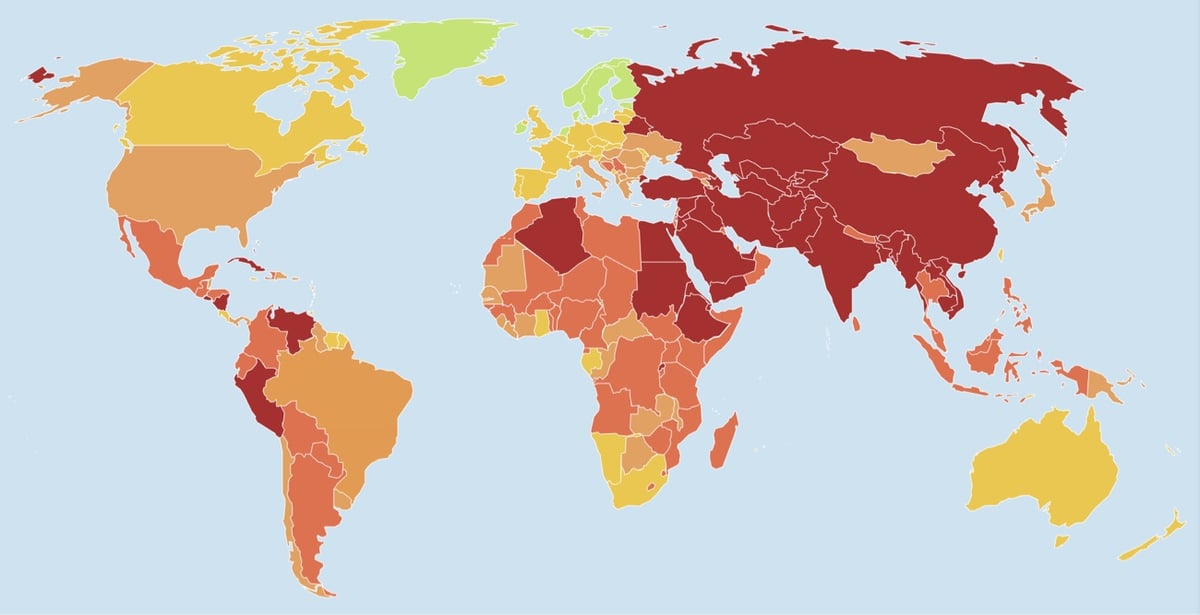
Since Reporters Without Borders started tracking their World Press Freedom Index 25 years ago, the global rating has never been lower than the 2026 score. From a summary of their analysis:
For the first time in the history of the Reporters Without Borders (RSF) World Press Freedom Index, over half of the world’s countries now fall into the “difficult” or “very serious” categories for press freedom. In 25 years, the average score of all 180 countries and territories surveyed in the Index has never been so low. Since 2001, the expansion of increasingly restrictive legal arsenals — particularly those linked to national security policies — has been steadily eroding the right to information, even in democratic countries. The Index’s legal indicator has declined the most over the past year, a clear sign that journalism is increasingly criminalised worldwide. In the Americas, the situation has evolved significantly, with the United States dropping seven places and several Latin American countries sliding deeper into a spiral of violence and repression.
The United States ranks 64th out of 180 countries, a pathetic showing for a country that claims to value the First Amendment:
US President Donald Trump has turned his repeated attacks on the press and journalists into a systematic policy, pushing the US down to 64th place (-7). The detention of Salvadoran journalist Mario Guevara, who was later deported, has contributed to the deterioration of an already tense security environment marked by police violence. The drastic cuts to the US Agency for Global Media (USAGM) workforce had global repercussions, leading to the closure, suspension and downsizing of international broadcasters such as Voice of America (VOA), Radio Free Europe/Radio Liberty (RFE/RL) and Radio Free Asia (RFA) in countries where they were some of the last reliable sources of information.
Some other takeaways from the 2026 report:
Post-Assad Syria has seen the biggest improvement in press freedom of all the countries and territories in the 2026 Index, climbing 36 places in the ranking.
In 2002, 20% of the global population lived in a country where the state of press freedom was categorised as “good.” Twenty-five years later, less than 1% of the world’s population lives in a country that falls under this category.
In some countries, the information space has shrunk over the past 25 years due to political changes and increasingly draconian regimes. This has notably been the case in Hong Kong (140th, -122) since Beijing tightened its control on the territory; in El Salvador (143rd), which dropped 105 places since 2014 and the start of the war on maras, or “gangs”; and in Georgia (135th), which has dropped 75 places as the crackdown on the press has intensified in recent years.
Twenty-five years after the attacks of 11 September 2001 in the United States, expanding the scope of defence secrets and national security has become a means to prohibit coverage of issues of public interest in many countries. This trend, which is particularly prevalent in authoritarian regimes, has also gained traction in democracies and typically goes hand in hand with abusive applications of the law against journalists, notably in the name of combatting terrorism.
(thx, margaret)
Comments 0
If you feel like this comment goes against the grain of the community guidelines or is otherwise inappropriate, please let me know and I will take a look at it.
In order to comment or fave, you need to be a kottke.org member. Check out your membership options.
Note: If you are a member and tried to log in, it didn't work, and now you're stuck in a neverending login loop of death, try disabling any ad blockers or extensions. Or try logging out and then back in. Still having trouble? Email me!