




Coming Soon: Your Professional Decline
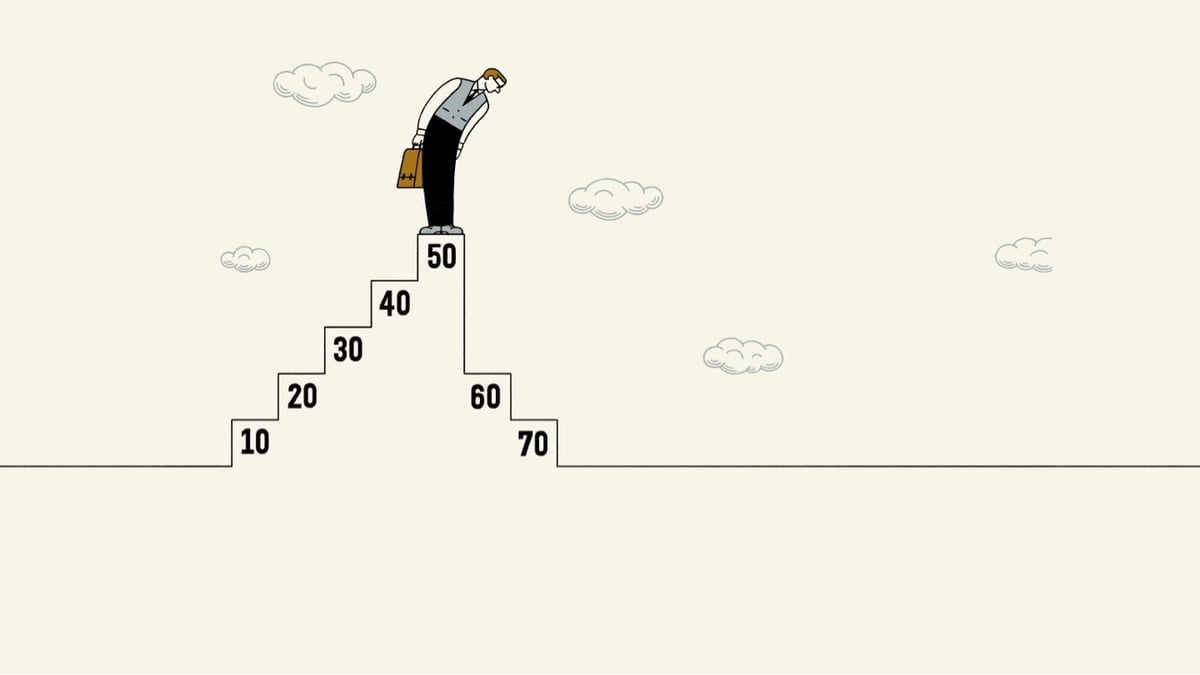
I stumbled across this July 2019 article by Arthur C. Brooks about professional decline and it gave me lots to think about: Your Professional Decline Is Coming (Much) Sooner Than You Think. One of the takeaways is that different stages of your life require different approaches; I liked this anecdote:
Recently, I asked Dominique Dawes, a former Olympic gold-medal gymnast, how normal life felt after competing and winning at the highest levels. She told me that she is happy, but that the adjustment wasn’t easy — and still isn’t, even though she won her last Olympic medal in 2000. “My Olympic self would ruin my marriage and leave my kids feeling inadequate,” she told me, because it is so demanding and hard-driving. “Living life as if every day is an Olympics only makes those around me miserable.”
I wasn’t aware of the formal concept of crystallized intelligence, but I was talking to my therapist last week about exactly this:
A potential answer lies in the work of the British psychologist Raymond Cattell, who in the early 1940s introduced the concepts of fluid and crystallized intelligence. Cattell defined fluid intelligence as the ability to reason, analyze, and solve novel problems — what we commonly think of as raw intellectual horsepower. Innovators typically have an abundance of fluid intelligence. It is highest relatively early in adulthood and diminishes starting in one’s 30s and 40s. This is why tech entrepreneurs, for instance, do so well so early, and why older people have a much harder time innovating.
Crystallized intelligence, in contrast, is the ability to use knowledge gained in the past. Think of it as possessing a vast library and understanding how to use it. It is the essence of wisdom. Because crystallized intelligence relies on an accumulating stock of knowledge, it tends to increase through one’s 40s, and does not diminish until very late in life.
Anyway, the piece is interesting throughout and one I’ll be returning to as I ponder whatever’s next for me.
P.S. I included the illustration by Luci Gutiérrez from the article because I think it perfectly captures the gist of it. That’s me on that 50 stair!
Comments 17
thread
latest
popular
Thanks for this! As someone who will be 49 in a couple months I have most definitely experienced professional decline over the last several years. I find myself unable to keep pace, become easily overwhelmed and simply not get things done on time or at the quality I once was able to.
What is more challenging is the fact that we're expected to do even more with less... at least in the public education sector, but I suspect this is true pretty much anywhere these days.
It's so draining that I am looking for new jobs, but have come to quickly realize no one is looking for a soon to be 50 year old!
Hi, Peter. I gots to say, after 20 years in advertising, I saw a career counselor at 50, started a one-year master's program in education counseling that same year, became an intern at 51, got hired as an adjunct counselor at a community college at 52, landed gigs at three other campuses along the way, became full-time at one of the four at 58.
Now, at 68, I feel some of the same weariness seeping in that I had after 20 years of advertising -- but every day still has a newness and reward.
The years in advertising were fun, and I'm grateful I did that. The years since have been fun, too -- and much more rewarding.
I wish you well on the journey.
I'm more productive now than I was 10, 20, or 30 years ago. Faster results. Quicker focus.
[shrug] I just don't dwell on or discuss my age because that's an immediate prescription for dismissive condescension.
When I was young I was part of an upstart business. We were the crest of a wave, the foamy white bits right at the top of the wall of water. As our business grew we joined the ranks of other successful businesses and we were at the high point of the swell. Now, that we are all in our 50's-60's it feels like we are just coasting in the current behind the wave. Younger fresher faces have picked up the rolls of pushing forward. It seems sort of natural and I'm thankful that I did enough retirement investing to feel good about the ride.
You just succinctly described my entire career as well. I'm only 43 but with two young kids, I have just had to come to terms with the fact that some of the 25 and 30 year olds in our office here are the future, and have not just the energy but the time for it that I don't have at this stage in life.
Arthur Brooks wrote a book on this a few years ago - From Strength to Strength. I only read the Blinkist, so not sure if it offers anything over the article.
I'm hoping I can ask a question of you Jason, and hoping this doesn't come across as rude. I read your last line about what's next for you and I just wondered what else it is you work on. I just read your bio which was very cool, but do you currently do additional work outside this blog?
This concept of fluid and crystallised intelligence really resonated with me. I think I had that fluid intelligence when I was young, but it was a brittle thing and had spiky edges. I'm enjoying growing into the crystalline intelligence more, my experience has softened those spiky edges and brings a very healthy dose of humility.
Not rude at all. I don't do any work outside the blog and at this point I'm probably not qualified to do much of anything else. Or would want to, really.
I’ll be sixty this year and I may be deluding myself, but I feel my best work is yet to come, and the key to that is playfulness. It’s obviously a lot easier to be playful as an artist (as I am) rather than someone who works in law, or accounting (god forbid), or medicine, where a failure could stain or end a career. For me, a failure is just a learning experience (even though it can still bruise my ego). After many years I don’t feel that I really know what I’m doing (which is something a doctor could never say) and if I did ever think I knew what I was doing, that would be when my career would become calcified and predictable. I hope to be playing with ideas and probably failing until the very end.
This is a wild little anecdote in the middle of the story:
This has been rolling around in my mind for a day or two now. Then I ran across this posting by a mathematics-adjacent researcher upon the news of Open AI using a LLM to compete (successfully) in a math competition:
He follows it up with a great analogy about having a special skill that gives you a place and purpose, only for it to be suddenly mass-produced and trivially accessible.
Anyway, it's on Twitter of all places, but worth clicking through all the same: Dave White on Twitter
Reading this as a woman just over 50, I have a different take (brand me a "feminist" if you want, fine). This whole article reads very differently if you're a woman, I think. First, I do rather wonder whether women were included in the studies Brooks cites, as often in research we're left aside (or not there because we're professionally sidelined), plus as the head of AEI I doubt he felt much need to consider this point (though I appreciate the work he's been doing for the Atlantic recently). Second, I think the fallow / teaching period shifts for women. Talented women get sidetracked in their core professional years because they are considered childbearing risks, and if they indeed choose to have children they lay fallow intellectually for a good 20 years. They have to consider their community and spirituality during this time, because even if they're working, they're not generally allowed to be moving much upward unless they are very privileged, and they're often doing thankless and unrewarded tasks (Parent Advisory Council fundraisers and work, for example).
So, just now in my early 50s, when companies are willing to consider me for more senior roles again because I'm not likely to have child responsibilities, can I finally use both my fluid intellgence, along with a lot of crystallized intelligence. I feel my best professional years, while much less ambitious than they could have been had I not been mommy tracked, are still ahead of me, and I'm more than ready to tackle all the challenges. I suspect the phases may well be very different for women.
Lisa, thank you for this thoughtful perspective. When I was reading Brooks' piece, even though it felt very relevant to me, I wondered how broadly applicable his advice would be.
Also, "feminist" is not a dirty word here, brand away!
Totally agree with this. In my 20s I was smart and mouthy -- a combination no one in '90s corporate America appreciated in a girl. In my 30s I was pregnant, nursing, and toddler-chasing -- delightful! but not compatible with my professional ambitions. Once I hit 40, with kids in school, I had my time and body back, and now in my 50s, I'm at peak power -- running a business, mentoring my staff, teaching, writing, etc. Thankfully, the rehabilitation of HRT aligned with my perimenopause, and I feel like I have 10-15 more good years of thought product in me.
Hi Lisa,
The point regarding women's innovative periods is a good one, and a point that has been studied a bit by Petra Moser, an economist at NYU:
http://www.petramoser.net/research.html
For example, in Women in Science. Lessons from the Baby Boom:
This paper uses rich biographical data for 50,000 American scientists, linked with publications, to investigate how children affect women in science. First, we document that mothers have a unique lifecycle pattern of productivity: Publications by mothers decline in their mid 30s, stay low for roughly seven years, and then recover in their late 30s and early 40s. This transient decline is unique to mothers; publications by other scientists peak around their mid 30s.
She has a number of papers focused on the relationship between gender and innovation, but this is the one focused on the age cycle the most.
I'm reminded of the Desiderata...
Go placidly amid the noise and the haste, and remember what peace there may be in silence. As far as possible, without surrender, be on good terms with all persons.
Speak your truth quietly and clearly; and listen to others, even to the dull and the ignorant; they too have their story.
Avoid loud and aggressive persons; they are vexatious to the spirit. If you compare yourself with others, you may become vain or bitter, for always there will be greater and lesser persons than yourself.
Enjoy your achievements as well as your plans. Keep interested in your own career, however humble; it is a real possession in the changing fortunes of time.
...
Take kindly the counsel of the years, gracefully surrendering the things of youth.
Nurture strength of spirit to shield you in sudden misfortune. But do not distress yourself with dark imaginings. Many fears are born of fatigue and loneliness.
...
This is an adaptation from his book Strength to Strength - which is great. After 20+ years in tech marketing I not only felt a slight decline in my abilities in my late 40s but also a major decline in my interest in that career. I career switched into coaching men navigate midlife and this essay is very, very relevant.
It's all about reframing.
If you feel like this comment goes against the grain of the community guidelines or is otherwise inappropriate, please let me know and I will take a look at it.
This thread is closed for new comments & replies. Thanks to everyone for participating!