Entries for March 2018
Leatrice Eiseman, Pantone Color Institute’s executive director, teaches an annual class on trend forecasting and the psychology of color. She joined Pantone after publishing her 1983 book “Alive With Color,” and she created the color clock concept.
Eiseman believes that our reaction to colors “goes beyond the psychological into the physiological” and that colors carry inherent messages that all humans innately understand — the whispers of that “ancient wisdom.” She doesn’t deny the important influence of memory and social factors on color perception, but often, she says, “our response is involuntary, and we simply have no control over it.”
Last October, Eiseman published her 10th book, “The Complete Color Harmony, Pantone Edition,” her boldest statement yet on the psychology of color — and one that might rightly be displayed in the self-help section. Consider a chapter titled, “Personal Colors: What Do They Say About You?” which offers a kind of chromatic horoscope that locates truths not in the cosmos but in the spectrum of visible light.
If you’ve ever wondered how the Pantone Color of The Year comes to be, Bruce Falconer’s exploration of the business of color is the place to start.
N.B. I’m pretty sure lilac will be the next millennial pink, but I’m no expert.
Dr. Stacy Smith, one of the creators of the inclusion rider, spoke at TEDWomen in 2016 about the epidemic of invisibility in Hollywood. She uses hard data to break down how women and minorities are not just underrepresented in film, they’re erased, and just how pernicious this is for all of us.
Storytelling is so important. Stories tell us what societies value, they offer us lessons, they share and preserve our history. Stories are amazing. But stories don’t give everyone the same opportunity to appear within them, particularly not stories compartmentalized in the form of American movies.
Dr. Smith and her team have done more than 30 investigations over the past ten years on diversity in entertainment. Follow the Annenberg Inclusion Initiative at @inclusionists.
[Hello gang. I am off this week and am very pleased that my pal Chrysanthe Tenentes will be taking over while I’m gone. We haven’t caught up in awhile, so I’m eager to learn what she’s thinking about these days and what she’s been working on. Welcome, Chrysanthe! And I’ll see the rest of you rascals next week. -jason]
Longtime reader, first time guest editor here…I’ve been mostly behind the scenes working on content strategy and other editorial projects the past few years but you may know me from Brooklyn Based, where I was co-founder, Foursquare, where I was an early hire, or The Shed story salon, which I run with friends in Brooklyn. I’m currently on the west coast, consulting for a few clients and about to launch LA IS OK. I’m on Twitter and most things as eqx1979, which is a reference to the alternative radio station I listened to in high school (heart you forever WEQX) and that Smashing Pumpkins song that I apparently liked enough to use in my ICQ screen name that then became all my screen names.
But enough about me, let’s get back to the links! I’m very much looking forward to spending the week with you all.
Howl’s Moving Castle is my favorite Miyazaki movie, and maybe my favorite movie, outright; I wrote a little bit about why in this essay.
Every frame of the film is magnificent, as these layouts help to show (I’m only including one, from one of my favorite scenes, plus the finished version; there are more at the Ghibli Collector Tumblr).
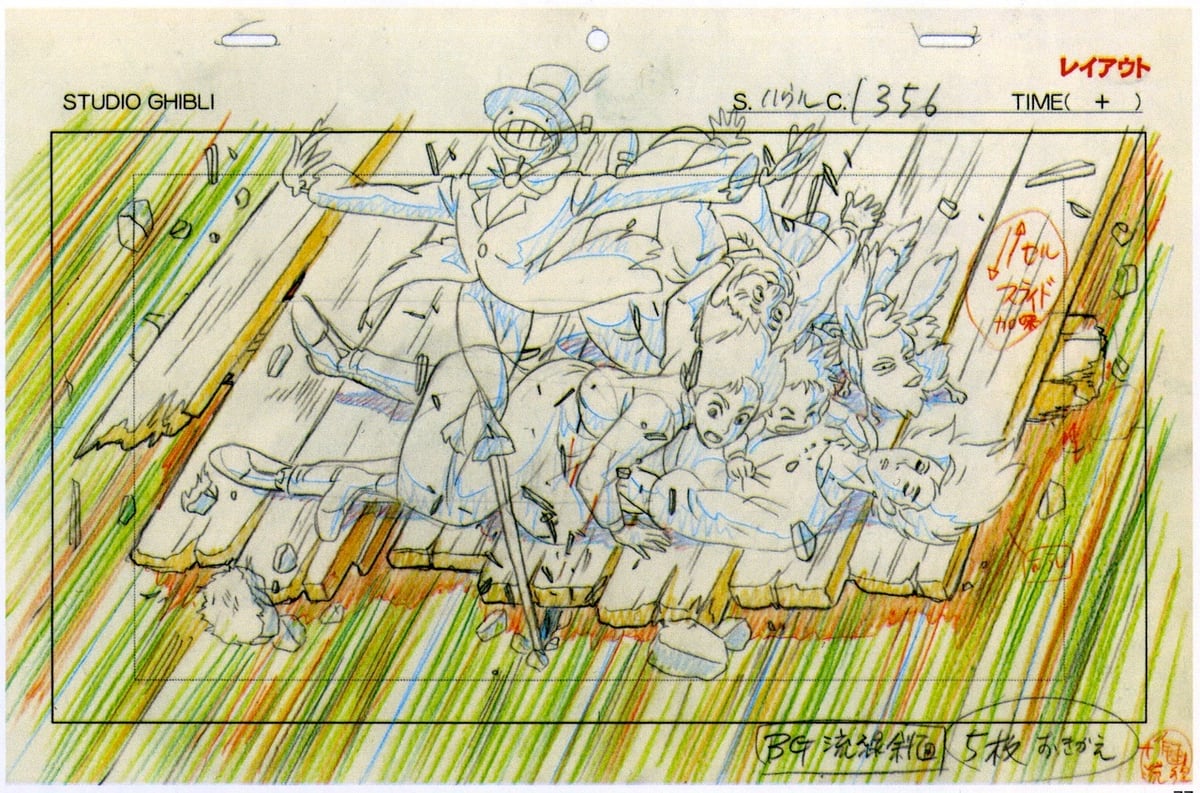

(Via Thomas Houston.)
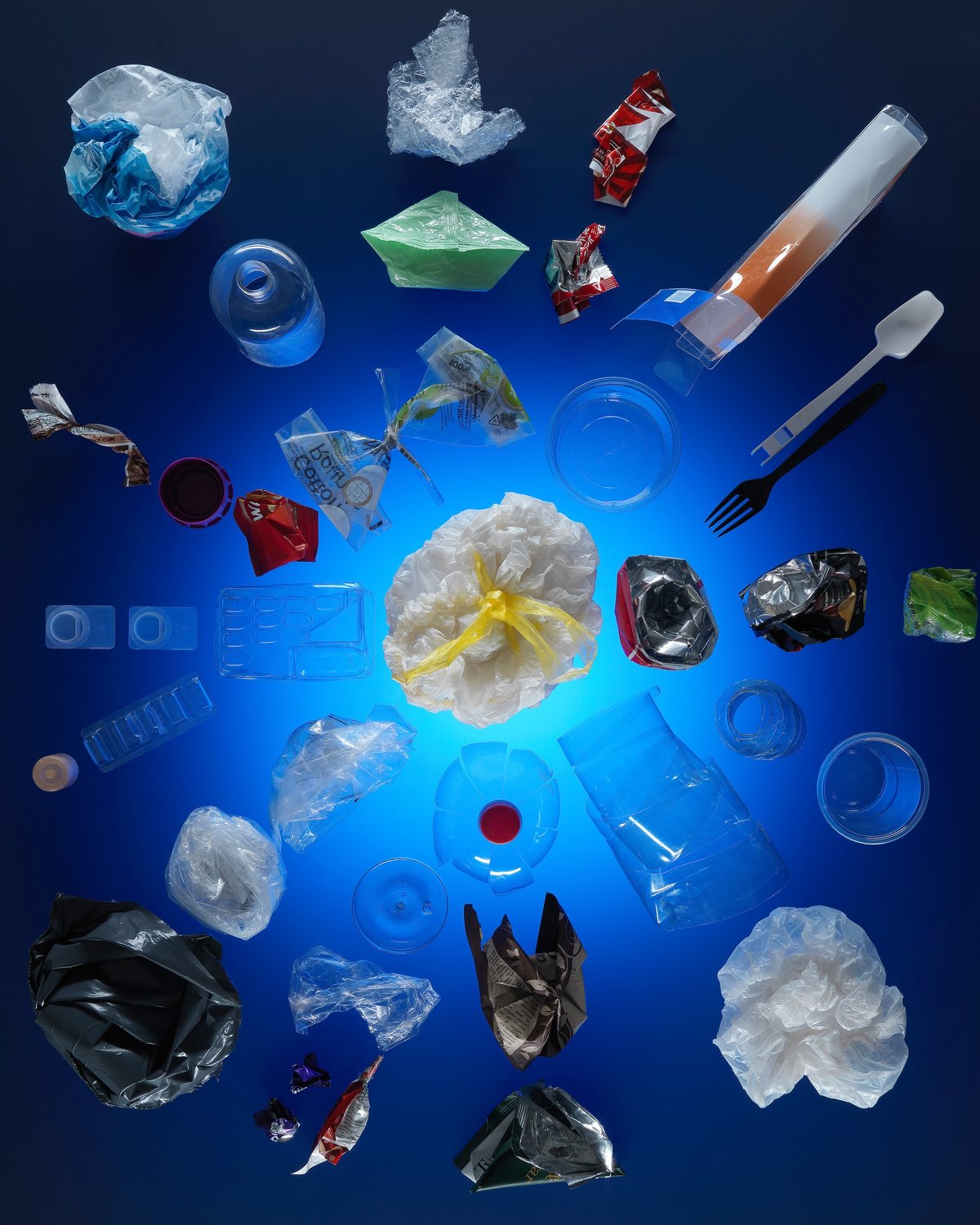
The Guardian asked four writers to try to minimize their use of plastic and keep a diary of how much they used over a week. To no one’s surprise, it’s difficult to avoid plastic altogether, but I suspect anyone would be stunned at just how much of it there is.
Before going to bed I wash my face with micellar water (which comes in a plastic bottle), use an interdental tooth brush (plastic), and take out my monthly contacts (plastic). I’ve barely done anything today, but the pile in the corner of the kitchen is getting bigger. On day two, the plastic onslaught continues; now I’m looking for it, I see it everywhere. Thanks to a cold, I go through multiple plastic-wrapped packets of tissues. A pizza delivery arrives with unnecessary plastic cutlery and a plastic-wrapped chocolate bar. I get my (acrylic) nails done, receive some clothes from Asos which come in plastic packaging, as does the ink for my printer…
Five days in and I’m amazed to realise how much I have accrued, from the Amazon delivery which arrives wrapped in bubbles and film, to the balloons we blow up for my flatmate’s birthday (latex, not plastic, but very much single use). The morning after her party, the flat is full of plastic cups, straws and bottles; soon thrown away in several plastic bin bags. I need some help; I speak to Andrew Pankhurst, a consumer campaigns manager from Zero Waste Scotland. He takes a look at my diary and has a few tips, from sharing printer cartridges with flatmates to putting a recycling bin in the bathroom. Could I possibly remove plastic from my everyday life?
This reminds me of something materials scientist Deb Chachra told me once: that as petroleum gets harder and harder for us to find economically, we might start to worry less about peak gasoline than we do about peak plastic.
Jerry and Marge Selbee were a semi-retired couple in rural Michigan who ran a convenience store. Among their biggest sellers were lottery tickets. One day, Jerry realized that if you only played on certain “roll-down” days (when a four-out-of-six winner would get part of a five-out-of-six prize, and so on), the odds weren’t just better for players; they were positive. You just had to buy a lot of tickets.
Lottery terminals in convenience stores could print only 10 slips of paper at a time, with up to 10 lines of numbers on each slip (at $1 per line), which meant that if you wanted to bet $100,000 on Winfall, you had to stand at a machine for hours upon hours, waiting for the machine to print 10,000 tickets. Code in the purchase. Push the “Print” button. Wait at least a full minute for the 10 slips to emerge. Code in the next purchase. Hit “Print.” Wait again. Jerry and Marge knew all the convenience store owners in town, so no one gave them a hard time when they showed up in the morning to print tickets literally all day. If customers wondered why the unassuming couple had suddenly developed an obsession with gambling, they didn’t ask. Sometimes the tickets jammed, or the cartridges ran out of ink. “You just have to set there,” Jerry said.
The Selbees stacked their tickets in piles of $5,000, rubber-banded them into bundles and then, after a drawing, convened in their living room in front of the TV, sorting through tens or even hundreds of thousands of tickets, separating them into piles according to their value (zero correct numbers, two, three, four, five). Once they counted all the tickets, they counted them again, just to make sure they hadn’t missed anything. If Jerry had the remote, they’d watch golf or the History Channel, and if Marge had it, “House Hunters” on HGTV. “It looked extremely tedious and boring, but they didn’t view it that way,” recalled their daughter Dawn. “They trained their minds. Literally, they’d pick one up, look at it, put it down. Pick one up, put it down.” Dawn tried to help but couldn’t keep pace; for each ticket she completed, Jerry or Marge did 10.
Naturally, of course, the couple hits trouble when they shift their game to Massachusetts and bumps up against a group of MIT students who have the same idea. Hijinks ensue.
Arika Okrent is one of my favorite writers. She’s a linguist who specializes in breaking down experientially rich but conceptually knotty problems in language for a lay audience. For the last few years she’s been writing for Mental Floss — see “The Evolution of ‘Two’,” this short essay on Plains Indian Sign Language, or especially her series of YouTube videos, of which the bit on irregular verbs up top is one.
Anyways, now she’s contributing to Curiosity, and one of her first essays is on the history and structure of that most irregular and polysemic of English verbs, “to be.”
Most verbs stay basically the same in different grammatical roles. “Walk” looks like “walks” and “walked.” But the word “be” looks nothing like the word “am,” which looks nothing like the word “were.” This unusual circumstance came to be over thousands of years and can be traced back to an ancient ancestor of English.
That ancestor had three different verbs that gave rise to the different forms. “Am” and “is” go back to one of them. “Be,” “being,” and “been” go back to another verb meaning “to become” or “grow.” “Was” and “were” go back to yet another verb meaning “remain” or “stay.” Over thousands of years, these concepts and forms coalesced into a verb with a single identity, but hundreds of specific meanings.
Peter Neff is part of a team drilling ice cores from glaciers in Antarctica to look at how the climate has changed. But after they’ve done their work, they have a little fun dropping chunks of ice down the bore holes to make really cool noises (sound on, headphones recommended).
Oh, that *peeewwww* as it hits the bottom! See also the wonderful sounds of black ice skating, an incredible photo of the black ice covering an Antarctic lake, and “Whumph”: the sound of settling Antarctic snow.
In the latest installment of Nerdwriter, Evan Puschak explains why Francisco Goya’s painting Saturn Devouring His Son is so disturbing, not only from the standpoint of the subject matter but also the circumstances surrounding its creation.
I am especially fond of Art History Nerdwriter because the first video of his I ever watched was on Jacques-Louis David’s The Death of Socrates. I’ve been a fan ever since.
Check out these army ants building an ant bridge across a gap that suddenly widens:
Army ants have tiny brains and no one’s in charge. So how do they organize themselves into building bridges? They rely on their strength in numbers and simple rules.
To see how this unfolds, take the perspective of an ant on the march. When it comes to a gap in its path, it slows down. The rest of the colony, still barreling along at 12 centimeters per second, comes trampling over its back. At this point, two simple rules kick in.
The first tells the ant that when it feels other ants walking on its back, it should freeze. “As long as someone walks over you, you stay put,” Garnier said.
This same process repeats in the other ants: They step over the first ant, but — uh-oh — the gap is still there, so the next ant in line slows, gets trampled and freezes in place. In this way, the ants build a bridge long enough to span whatever gap is in front of them. The trailing ants in the colony then walk over it.
See also How many stupid things become smart together.
(via fairly interesting)
The area of a circle. I love this…showing the geometric representations of abstract math formulas can greatly improve understanding.
In his short film Dance Dance, director Thomas Blanchard represents all four seasons by showing flowers blooming, submerged in water that freezes over, burning, and shrouded in clouds of colorful inks. I could have watched the flowers freezing over part for many more minutes. (via colossal)
Newer posts

.jpg)
Socials & More