



Eyebeam’s Fundrace site gets a nice writeup
Eyebeam’s Fundrace site gets a nice writeup in the NY Times.

This site is made possible by member support. 💞
Big thanks to Arcustech for hosting the site and offering amazing tech support.
When you buy through links on kottke.org, I may earn an affiliate commission. Thanks for supporting the site!
kottke.org. home of fine hypertext products since 1998.
Beloved by 86.47% of the web.
Eyebeam’s Fundrace site gets a nice writeup in the NY Times.
OS X browser Camino releases 0.8 beta, more than a year after the last version.
Fantastic one-pager on the London Tube map with tons of links.
Why Athletes Pee on Their Hands, does urine really toughen the skin?.
Anil is moving to San Francisco. I don’t know why 6A wants to close their New York “office”, but oh well.
New David Sedaris book out soon, “Dress Your Family in Corduroy and Denim”.
Who knew O’Reilly’s Programming Perl could be so stimulating?. Not really that safe for work. (Update: Removed link to a porn site.)
On my way to lunch the other day, I noticed a new exhibit at the Annex of the NY Transit Museum in Grand Central: New York: The Ride, Subway Cartoon and Cover Art from The New Yorker. That’s two of my favorite NY things together, so I swung by for a look today. It’s a tiny exhibit and takes only 5-10 minutes of your time, but if you’re in the vicinity, it’s worth the effort. Here’s my favorite piece, Hell: The Fifth Avenue Entrance by Mick Stevens:
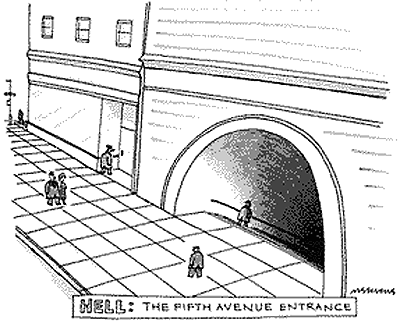
Here’s the description of the exhibit:
Throughout the years, cartoons and cover art from The New Yorker have brilliantly captured this city, its hopes and aspirations, its people and their foibles, and their daily routines. Subway humor has been a staple of The New Yorker since the magazine’s 1925 inaugural issue.
While offering an entertaining survey of subway satire from the 1920s to the present, the exhibition also explores changing perceptions of the subway over the course of nine decades. Original artwork, reproductions of The New Yorker covers and cartoons, and original magazines, whose subject matter is the subway system and the people who ride it, are on view.
The exhibit continues through July 18.
Jane Jacobs on The Greening of the City. Urban ecology is on the rise; I heard a similar talk about animals in the city at Poptech last year.
Nice article on how Mail.app’s spam filtering works. It’s all about the LSI, yo.
Chicagoist, a new Chicago-centric blog by the Gothamist gang, is currently in beta. Don’t much care for the name…
Recent results suggest that our universe is at least 78 billion light years across.
Frontend Editing for MovableType. I’ve been doing this for more than a year now and always meant to write it up…but now I don’t need to.
Designs for Working, a New Yorker acticle by Malcolm Gladwell from a few years ago, draws parallels between good office design and the ideas in Jane Jacobs’ The Death and Life of Great American Cities:
The task of the office, then, is to invite a particular kind of social interaction—the casual, nonthreatening encounter that makes it easy for relative strangers to talk to each other. Offices need the sort of social milieu that Jane Jacobs found on the sidewalks of the West Village. “It is possible in a city street neighborhood to know all kinds of people without unwelcome entanglements, without boredom, necessity for excuses, explanations, fears of giving offense, embarrassments respecting impositions or commitments, and all such paraphernalia of obligations which can accompany less limited relationships,” Jacobs wrote. If you substitute “office” for “city street neighborhood,” that sentence becomes the perfect statement of what the modern employer wants from the workplace.
Jacobs’ book is pretty much a must-read for anyone constructing environments for social interaction (cities, offices, software, restaurants, libraries, etc.).
Photo gallery of new Koolhaas-designed Seattle Public Library.
The New Yorker has rediscovered itself through timely news reporting.
101 Ways to Save Wired. An oldie from the Stating the Obvious archive.
Do Penis Enlargement Pills Work?. Penis enlargement blogger concludes that pills (when combined with exercise) do work; he got 1.1 inches bigger in 16 weeks.
Morgan Spurlock, writer/director of Super Size Me documentary, is writing a weblog on Indiewire.
My dream of distributing couch potato behavior has been realized by Simon Thornton: Sending Live Television Via iChat. Simon says:
However, if you just so happen to be someone that has purchased an analogue video -> DV (firewire) converter box in the past, such as the Formac Studio, you might be suprised to learn that when it’s plugged in it is presented to the Mac (and specifically the iChat application) as a perfectly valid firewire input device. In other, shorter, easier, words: you can use your converter box to stream live video from something - oooh, let’s just say your Sky Digibox for example - to someone else using iChat anywhere else in the world. If you happened to have one of the outputs of your Sky box (it has two) connected up to the inputs of your converter box, you might see how this could work.
Fantastic. No wonder the entertainment companies want all sorts of DRM built into everything.
Yesterday was a wonderful day to be in New York City. After a warm, sunny walk through Central Park (you can rent small remote control sailboats at the Conservatory Water!), we went over to the Whitney to take in the 2004 Biennial. While I didn’t like many of the individual pieces, the show as a whole was worth seeing, if only to check the pulse of the contemporary art world.
I’d love to point you at some of the pieces I enjoyed, but of course the Biennial Web site is in Flash, rendering individual artist biographies and artworks unlinkable. I know artists have a fear of functionality, but you’d think they could make an exception in this case. Anyway, I dug up a link to one of my favorite pieces from the show, Hamburger Hill by Barnaby Furnas. The bullets tear his Civil War-inspired paintings apart in straight lines — looks just a bit cubist to me — flattening several minutes of action into one still frame. Wonderfully active, vibrant, and visceral.
The New Yorker: did Rumsfeld’s orders lead to the abuse at Abu Ghraib?.
PulpFiction is a new Mail.app-like newsreader for OS X. Now available for purchase; does filters, labels, AppleScript, Atom, flags, etc.
In response to concerns by their customers (as well as non-customers, Slashdot readers, and pretty much anyone with a blog and an opinion), Six Apart has modified the pricing structure for the Personal Edition of Movable Type 3. A couple of quick thoughts on this:
1. Six Apart is listening to their customers. Based on the specific concerns of their customers, they updated their pricing in just two days time. That Six Apart has sincerely listened to their customers in the past and continues to do so as a quickly growing company seeking to sustain itself is worth some goodwill on our part toward 6A. Many other companies wouldn’t have bothered.
2. The tiered personal pricing still doesn’t make sense. Mena writes:
Our best explanation for the tiering is that we feel a personal user who sets up weblogs for 50 of his friends should pay more for a license than one who uses only one weblog for himself.
Someone hosting 50 people should pay more, but that should be handled as a non-personal situation on a case-by-case basis. What I feel is happening instead is that 6A is offloading a business problem of theirs that concerns only a small portion of their user base (i.e. the folks hosting 50 friends on one install) to all of their customers. Because of a few potential offenders, customers have to deal with pricing tiers, definitions of weblogs and users, keeping track of how many active weblogs and users they have, upgrading their licenses when they add authors or weblogs, etc. We shouldn’t have to do that. I don’t want to get out my credit card every time I want to add a guest author to my weblog. Do I get a refund if I purchase a 13 weblog/13 author license but 10 of those authors and 7 of those weblogs are inactive after 90 days?**
The solution is to make it as straightforward as possible for customers. In addition to the free version (1 author, 3 weblogs), offer the Personal Edition for $70-$100 for unlimited weblogs and authors with the condition that too many (10? 20?) “weblogs for friends” will be considered non-personal use of the software and will be subject to extra fees. That way, the customer’s ownership of the product is vastly simplified and the burden of dealing with the non-personal use of the Personal Edition shifts back to 6A where it belongs.
** The license states that after 90 days of inactivity, weblogs and authors don’t count toward the pricing limits.
Jason Zada raves about a new kind of green screen for video/film work.
Dumb Slashdot thread on MT new pricing structure. Sometimes I think the Web’s primary function is aggregating stupidity.
Trailer is out for The Incredibles, Pixar’s new movie. Looks, um, incredible
In all the hullabaloo about Six Apart’s new pricing structure for Movable Type (check out the announcement from Mena — with what has to be a record 373 Trackbacks — for some idea of what people are whining about), the best and most concise comment I’ve seen comes from Dave Winer today:
Yesterday we saw people complain about spending $60 for a big useful piece of software like Movable Type. I paid $60 for a cab ride in Geneva. A good dinner is $100. A hotel room $150. You want the software, find a way to help companies like Six Apart instead of making them miserable. You’ve now got the tools to communicate. Use them well. Use them better.
The bottom line, as Dave suggests, is that MT 3.0 is worth charging money for. Period. The fact that it was free up until now is largely irrelevant…except that for 2 1/2 years Six Apart has provided people with a very powerful, flexible piece of software for free and will continue to do so in the future. Those bastards!
The one thing I do think 6A got wrong is the pricing structure for personal users. Tiered pricing of software based on the number of users was designed to make sure large companies paid more for software than did small companies…so that a company like Wal-Mart pays $3 million for a database application for 20,000 users and a smaller company like Nantucket Nectars pays $30,000 for the same software with 250 users. The same pricing structure doesn’t make sense for personal users. I know they priced it that way so that someone can’t install MT and then host weblogs for 50 of their friends. I can understand that…that seems like an abuse of the “personal” license to me.
But in my case, I have 10 weblogs and 22 authors on my MT install. All of those weblogs are primarily mine except for one group weblog (which is not public at this time). All of the weblogs can be found on one domain (no subdomains), although some are password-protected. Most of the authors in the system are part-time…they aren’t actively posting to weblogs nor will they in the future, but they need to remain in the system to retain authorship of their posts. By my reckoning, I’m one person using MT in a exclusively personal manner to maintain one Web site. But looking at the pricing chart, there’s not even an option on there for me and the highest option they do offer is $190 for 9 users and 10 weblogs. How much would 22 authors (and counting…) cost me? $250? Or would I have to move to a commercial license for $700?
Why not make the personal edition a flat fee of ~$60 for unlimited users and weblogs (in addition to the free version with 1 author/3 weblogs)? Here’s the reasoning. Tiered personal use (per above) doesn’t make much sense. Trust that people using the personal edition will use it in a personal way. The guy offering 50 of his friends MT weblogs on subdomains isn’t going to pay for MT, not what you want him to pay anyway. If people start using it in that way, suggest an upgrade to the non-personal edition might be appropriate. If they refuse, they weren’t going to pay you anyway.
In exchange for lowering the price on the high-end, you get community goodwill and, more importantly, you get people using your software in a freewheeling way. When people, particular the power users that will be attracted to MT, have the freedom to use your software however they wish (and not having to choose, for instance, between paying $50-$90 extra and not having guest authors on their site or not starting that extra weblog to keep track of the books they’ve been reading), you get a picture of what your software is really for. And since MT is ultimately the backend for TypePad (a for-pay service), that knowledge is valuable. My feeling is that susidizing freewheeling personal use of MT is an investment that will pay off handsomely in the future.
In the meantime, I’ve got options. My copy of MT (v2.63, for which I donated $45) isn’t any less flexible or powerful than it was yesterday. It works just fine for my current needs, it will continue to work well into the foreseeable future, and I remain a satified customer of Six Apart.
Six Apart has released a developer edition of MT 3.0 ahead of the official release.
Google’s new groups do have Atom feeds; here’s the one for the alt.fan.tarantino group. Thx, Steve.
New version of Google Groups adds mailing lists to the Usenet archives. Maybe each group should have a RSS/Atom feed?
Instead of eating lunch today, I skipped it to fight hunger and donated the money I would have spent to City Harvest (I rounded up to $10). Not that it was that simple. I had good intentions this morning in deciding not to eat at noontime, but then my stomach weighed in with something along the lines of, “but…you’re hungry, stupid.” To appease my appetite, I devised a seemingly clever plan: I would both eat and donate.
However, upon further reflection, that seemed like cheating. The idea behind Skip Lunch Fight Hunger Day is to go hungry so someone else may eat, not to just donate money. So, I ended up skipping that second lunch as well and donated $20 to City Harvest: $10 for the original skipped meal and another $10 for the meal I tried to sneak past my conscience. Luckily I stopped thinking about planning — and subsequently donating the necessary funds for — further lunches or I could have put quite a dent in my bank account by the time dinnertime rolled around.
French man authors a 233 page book without any verbs. “The verb is like a weed in a field of flowers. You have to get rid of it to allow the flowers to grow and flourish.”
Fendi Juke Box bag designed to carry some of Karl Lagerfeld’s 40 iPods.
Google PR is already editing stuff written on the official Google Blog. That was quick.

Socials & More