kottke.org posts about sports
My pal Mouser is in Kazakhstan and took a bunch of photos of kids doing parkour on the beach. This shot is my favorite.
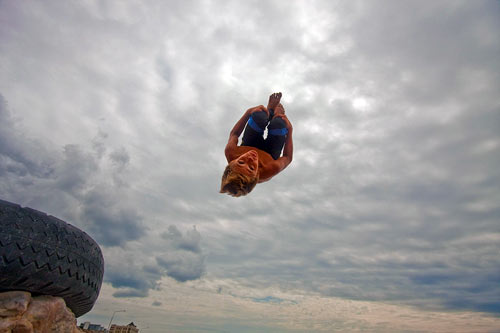
Will parkour eventually join soccer as one of the world’s most egalitarian sports? You don’t even need a homemade ball to play, just stuff to jump over, through, and off. The whole world’s a course.
Immaculate innings are those innings in baseball games where the pitcher strikes out all three batters with nine pitches. It’s only happened 42 times in the history of the game. David Archer is tracking the frequency of such innings; they are getting more common.
As one friend pointed out, the best explanation for the increase in recent decades appears to be the advent of the modern reliever, especially the flame-throwing, one inning closer (more immaculate innings have been thrown in the 9th inning* (eight) than in any other inning), though starters — such as Burnett — have also been throwing them with impressive frequency.
Update: See also three-pitch innings. (via noah brier)
It’s a bummer that Alec Wilkinson’s article on free diving isn’t available online (except for NYer subscribers)…it’s fascinating and right up the alley of the relaxed concentration/deliberate practice enthusiast. One of the two divers profiled uses a technique called attention deconcentration to govern her body and mind as she dives.
To still the unbidden apprehensions that might interfere with her dive — what she describes as “the subjective feeling of empty lungs at the deep” — Molchanova uses a technique that she refers to as “attention deconcentration.” (“They get it from the military,” Ericson said.) Molchanova told me, “It means distribution of the whole field of attention — you try to feel everything simultaneously. This condition creates an empty consciousness, so the bad thoughts don’t exist.”
“Is it difficult to learn?”
“Yes, it’s difficult. I teach it in my university. It’s a technique from ancient warriors — it was used by samurai — but it was developed by a Russian scientist, Oleg Bakhtiyarov, as a psychological-state-management technique for people sho do very monotonous jobs.”
I asked if it was like meditation.
“To some degree, except meditation means you’re completely free, but if you’re in the sea at depth you will have to be focussed, or it will get bad. What you do to start learning is you focus on the edges, not the center of things, as if you were looking at a screen. Basically, all the time I am diving, I have an empty consciousness. I have a kind of melody going through my mind that keeps me going, but otherwise I am completely not in my mind.”
I found only one other reference online to attention deconcentration, an article on free diving written by Natalia Molchanova herself. In it, she talks about the three types of attention deconcentration: visual, aural, and tactile.
Rising from the depth, it is important to constantly scan your condition to prevent shallow water black-out, which can occur without any discomfort sensations. Somatic attention deconcentration appears to be extremely useful in this situation. Somatic AD implies attention distribution on the whole volume of the body and allows noticing tiny changes of organism state.
There is one more kind of AD — aural attention deconcentration. It is not so effective in the water, but it helps preparing to the dive and not to be distracted by judge’s countdown.
It’s interesting that both the attention deconcentration and flow techniques are designed to get the practitioner to basically the same place (i.e. ready to perform difficult tasks) from opposite directions.
Somewhat related, a reader (thx, martin) recently sent in a link to The Game, a mind game with an unusual objective:
The Game is an ongoing mind game, the objective of which is to avoid thinking about The Game itself. Thinking about The Game constitutes a loss, which, according to the rules of The Game, must then be announced. How to win The Game is not defined in the rules; players can only attempt to avoid losing for as long as possible. The Game has been described alternately as pointless and infuriating, or as a challenging game that is fun to play.
Update: Sad news. Natalia Molchanova failed to surface after a dive in the Mediterranean Sea and is presumed dead.
Update: Wilkinson wrote about Molchanova’s presumed death shortly after she disappeared.
It was so hot in New York City last week — HOW HOT WAS IT? — it was so hot that the first event of the Midtown Games was held in a fountain on 50th St.: a 50m freestyle swim.
Friday, August 14th at 1pm marked the opening event of the Midtown Games: Olympics, and was attended primarily by the city’s punch-drunk, heat-stroked interns. With the blare of a foghorn the crowd closed in like a shield, trumpets sang out “Eye of the Tiger” and five swimmers in Speedos and caps leapt into the burbly water of a decorative fountain to swim its 50 metres or so in elegant racing style.
Sam Arbesman has a proposal for a new football rule: coaches get one time-in per season.
The possibility of a sudden time-in would loom large in every coach’s mind at the most tense points in the game, introducing just enough concern and uncertainty to make the game different. Timeworn clock-management strategies would no longer be a given. And yet, for the average viewer on a Sunday, the game on the field would still be your father’s football.
At the track and field world championships in Germany this evening, Usain Bolt set another world record in the 100-meters: 9.58 seconds, besting his previous record of 9.69. Can he go under 9.5?
Update: Here’s the race in HD. It’s a lot closer than the Olympic final…Gay was really hauling as well. The Times reports that the 0.11 seconds Bolt shaved off the record was the largest difference since the advent of electronic timing in 1977.
Update: More on the 100 meter record. If you look at a graph of the 100 meter records (and here), Bolt’s time looks even more impressive…he broke the record more than it’s ever been broken.
But second off, you can also see that Usain Bolt is running much faster than humans ought to be running right now. This should give you an inkling of just how special these performances we’re seeing from him are. We shouldn’t be seeing times like this until the 2030s. Which means, honestly, that it ought to take around 30 years for someone else to come along and break his record.
Even Michael Johnson was impressed.
And then, of course, Bolt went out and broke his own record in the 200 meters, a record which seemed untouchable at the Olympics last year and he beat it by 0.11 seconds. Here’s the video in HD.
(thx, newley, @holgate, and david)
Unsurprisingly, the MLB teams currently drawing the most benefit from the lessons of Moneyball are those with lots of money operating in big markets.
Well, of course, the big-market teams figured it out. They hired their own Ivy League consultants. They bought even better computers. Walks is only one tiny aspect in it … but who leads the American League in walks this year? The New York Yankees. Last year? The Boston Red Sox. The year before that? The Boston Red Sox. And so it goes. Now, six years later, it seems to me that the small-market teams are really grasping and trying to find some loophole, some opening that will allow them to win in this tough financial environment.
After 20 years in the NHL, Jeremy Roenick has decided to retire from the league. Topping the list of Roenick’s off-ice achievements are two items related to the God-like status of the then-Chicago Blackhawks center in NHL 94.
Baseball historian Bill James makes a compelling argument that steroids will eventually become an accepted aspect of sports (and society as a whole) and that baseball players who are now more or less banned from entering the Hall of Fame (though not officially) will eventually be elected to Cooperstown.
If we look into the future, then, we can reliably foresee a time in which everybody is going to be using steroids or their pharmaceutical descendants. We will learn to control the health risks of these drugs, or we will develop alternatives to them. Once that happens, people will start living to age 200 or 300 or 1,000, and doctors will begin routinely prescribing drugs to help you live to be 200 or 300 or 1,000. If you look into the future 40 or 50 years, I think it is quite likely that every citizen will routinely take anti-aging pills every day.
How, then, are those people of the future — who are taking steroids every day — going to look back on baseball players who used steroids? They’re going to look back on them as pioneers. They’re going to look back at it and say “So what?”
(via hello typepad)
Yesterday he ran 200m in 19.59s on a wet track with a headwind, winning by an absurd margin. (via biancolo)
If I ever write a book, it might have something to do with the two minds that govern creative expertise: the instinctual unconscious mind (the realm of relaxed concentration) and the thinking mind (the realm of deliberate practice). The tension between these two minds is both the key to and fatal flaw of human creativity. From the world of sports1, here’s Rockies pitcher and college physics major Jeff Francis describing the interplay of the minds on the mound:
Even though I do understand the forces and everything, there’s a separation when I’m pitching. If I throw a good pitch, I know what I did to do it, but there has to be a separation between knowing what I did and knowing why what I did helped the ball do what it did, if that makes any sense at all. If I thought about it on the mound, I’d be really mechanical and trying to be too perfect instead of doing what comes naturally.
But you don’t need to be a physics major to wrestle with the consequences of the conflict between the two minds. After an injury and subsequent surgery, Francis’ instinctual mind works to protect his body from further injury:
Francis repeatedly pulled the ball back in preparation to throw. But as he flashed his arm forward, his hand would, mind unaware, bring the ball back toward his ear rather than at full extension. It was his body essentially shortening the axis of his arm to decrease the force on his shoulder, protecting him from pain. And Francis could not stop it.
After his 10th pitch and first muffled groan of pain, he stopped.
“It’s hurting you?” Murayama said.
“Yeah,” Francis said.
“I can tell. You’re getting out ahead of your arm. Slow down, stay back a little more.”
“Does it look like I’m scared to throw a little?”
“Are you scared?”
“Not consciously.”
To fully recover and regain his former effective pitching motion, Francis will utilize his thinking mind to retrain his unconscious mind through deliberate practice to ignore the injury potential. (thx, adriana)
[1] Most of the examples I’ve cited over the years deal with sports, mostly because professional athletes are among the most trained, scrutinized, studied, and optimized creative workers in the world. For a lot of other professions and endeavors, the data and scrutiny just isn’t as evident. ↩
Ben Fry just updated his interactive salary vs performance graph that compares the payrolls of major league teams to their records. Look at those overachieving Rays and Marlins! And those underachieving Indians, Mets, and Cubs!
Flip Flop Fly Ball is a marriage of baseball fandom and an enthusiasm for infographics. While not strictly baseball, this comparison of the sizes and shapes of sports balls is a favorite.
The distribution of point differentials at the end of NBA basketball games shows that a tie is more than twice as likely as either team winning by one point. A possible simple explanation from the comments:
1. Teams down by 2 late are most likely to take a 2 point shot, while teams down by 3 will most often take a 3 point shot. The team’s choices make ties a likely outcome.
2. A Tie is a stable equilibrium, while other scores aren’t. If a team leads with the ball, they will be fouled, preventing the game from ending on that score. IF a team has the ball with a tie, they’ll usually be allowed to wait and take the last shot, either winning the game or leaving it as a tie.
Update: This study about golf putting seems to have something in common with the overtime finding.
Even the world’s best pros are so consumed with avoiding bogeys that they make putts for birdie discernibly less often than identical-length putts for par, according to a coming paper by two professors at the University of Pennsylvania’s Wharton School. After analyzing laser-precise data on more than 1.6 million Tour putts, they estimated that this preference for avoiding a negative (bogey) more than gaining an equal positive (birdie) — known in economics as loss aversion — costs the average pro about one stroke per 72-hole tournament, and the top 20 golfers about $1.2 million in prize money a year.
In an interview with the New Yorker about basketball and his new book, The Book of Basketball, Bill Simmons offers up his take on how players skipping college impoverishes the NBA.
The lack of college experience also means that you probably have less of a chance to have a conversation with a Finals player about English lit or political science. For instance, if you’re a reporter, maybe you don’t ask for thoughts from modern players on the Gaza Strip or Abdul Nasser, or whether they read Chuck Pahlaniuk’s new book. These guys lead sheltered lives that really aren’t that interesting. Back in the seventies, you could go out to dinner with three of the Knicks — let’s say, Phil Jackson, Bill Bradley, and Walt Frazier — and actually have a fascinating night. Which three guys would you pick on the Magic or Lakers? I guess Fisher would be interesting, and I always heard Odom was surprisingly thoughtful. I can’t come up with a third. So I’d say that the effects are more in the “didn’t really have any experiences outside being a basketball player” sense.
Newer posts
Older posts





Socials & More