kottke.org posts about art school
I always learn so much from Evan Puschak’s videos about art. In this one, he takes a look at the work of Mary Cassatt, who, unlike many of her male peers, used the flattened perspective of Impressionism to reveal the thoughts and feelings of her subjects.
Like Manet, she’s dispensing with traditional modeling and perspective. In fact, her choice of a mirror as background is a brilliant way to literally and figuratively foreground the deceptive nature of perspective. Like Degas, she’s exploring the changing effects of artificial light on flesh and fabric. And she’s experimenting with off-kilter viewing angles.
But Cassat isn’t just adopting these techniques for the sake of it. She’s putting them to work in service of her deeper interest in psychology. She realizes that by not allowing the viewer to get drawn into the narrative space opened up by perspective, this new style of painting actually makes it possible to depict the subtle psychology of everyday life, a psychology uncontaminated by allegory or sentimentality. The trick was to combine the immediacy of Manet’s methods with a meticulous observation of posture, gesture, expression, and activity.
I know I probably say this every time I post videos like this, but I wish I’d gotten into art & art history earlier than I did. Channels like Behind the Masterpiece are so good at making this stuff come alive and their Brief History of Japanese Art scratches my recent interest in Japan itch quite nicely. I was lucky to see some of the pieces from the video on my Japan trip last fall, including the Big Buddha in Kamakura, hand scrolls, sumi-e, and so many woodblock prints. (via open culture)

Ah, this is awesome: Great Art Explained is one of my favorite YouTube channels and there’s a book version coming out in the fall.
Art can be thrilling, and resonate on a deep personal level. It is how you view the work, place it in context and understand its history that makes an artwork truly come alive.
A fresh approach to a classic subject, James Payne’s no-nonsense analysis sheds new light on 30 masterpieces from around the globe and reveals what makes them truly timeless works of art.
Each chapter delves into not only the art itself but also the artist’s life, as well as the work’s place in their wider oeuvre; in other words, what makes it “great.”
You can preorder Great Art Explained from Bookshop or Amazon.
In a collaboration with the National Gallery of Art, Evan Puschak made a video about 16th-century Dutch artist (and all-around polymath) Joris Hoefnagel, who painted some of the first dedicated and detailed images of insects in the world. His paintings were so accurate that if he’d lived 200 years later, you would have called him a naturalist.


I love how some of the caterpillars in the last image are crawling along the “frame” of the painting — that strikes me as a modern flourish.
From The Marvelous Details of Joris Hoefnagel’s Animal and Insect Studies:
These watercolors served as sources for a series of 52 prints engraved by Hoefnagel’s teenage son, Jacob. That series, Archetypes and Studies, offered the earliest printed images of dozens of species.
The relatively cheap prints enabled little beasts to multiply and crawl out into the world. They inspired a broader interest and study of nature which continues today.
Some of Hoefnagel’s insect images are on display at the NGA in the Little Beasts exhibition, which runs through Nov 2, 2025.
The fantastic art history YouTube channel Great Art Explained has a great two-episode series on Jackson Pollock.
In Part One of my film I look at how, post World War Two, the art scene shifted from Paris to New York. How America was searching for “The Great American painter”, and why he is so loved and hated at the same time. I look at just what Abstract Expressionism means, how we can “read it”, and I look at the myths surrounding Pollock and modern art itself. I also look at his influences ranging from Mexican sand Painting, to the Regionalist art movement, to Picasso and the modernists.
In Part Two of my film I look at how fame affected Jackson Pollock, and how alcohol destroyed his relationships. I look at the science behind why we are so affected by his work, and I also look at a lesser known story, of how art became an unlikely player in the Cold War and the global contest of ideas. How Abstract Expressionism was enlisted as an unknowing agent in a shadowy propaganda war, bankrolled by the CIA, to sell the story of freedom… and capitalism.
Curator James Payne’s Great Art Explained channel is one of YouTube’s gems. For his latest video, he takes a look at Leonardo da Vinci’s mural The Last Supper and explains what makes it such an unusual, impressive, and revolutionary work of art. Here’s how the main part of the video begins:
Milan, 1494: Leonardo da Vinci was an exceptional man, and everyone who met him described him as a genius. And yet, he was now 42 years old — a middle-aged man in an era when life expectancy was 40 — And he still hadn’t produced anything that would be considered a masterpiece by his contemporaries. Many of his works were unfinished or in private collections, there were no great public works that people could see, no architectural marvels and no distinguished altarpieces for cathedrals. Nothing that could be considered worthy of his potential.
Then, he was asked to paint a wall.
I found the discussion of how Leonardo’s knowledge of theatre — he was charged with “creating lavish plays and pageants for the Duke of Milan” — informed his work on The Last Supper particularly interesting. You’ll never see this painting the same way again after watching this video.
It’s been awhile since I’d checked in on one of my favorite YouTube channels, Great Art Explained. In the past year, curator James Payne has done videos on Duchamp, Manet, Magritte, and that one painting by Caspar David Friedrich (you know the one). But this one, on Vincent van Gogh’s final painting, particularly caught my attention:
The mystery of what [his final painting] was and where it was painted would take over a century to solve, and that was only thanks to a worldwide epidemic. What it means is that we now have a deeper insight into what van Gogh’s final last hours were like — before his tragic death.
“Barbaric.” A “nightmare of vulgarity.” “Monstrous.” “A violent mess.” “The work of a madman.” Those are just some of the reactions that Henri Matisse’s Dance received after its public debut in 1910. In this video, Evan Puschak shares How Matisse Revolutionized Color In Art with this painting and other Fauvist work.
Perhaps the most prominent part of the most well-known painting of Henry VIII (a now-lost work by Hans Holbein the Younger) is the giant codpiece poking through the male-heirless king’s tunic. Evan Puschak analyzes the painting and fills us in on what makes this a particularly effective work of 16th-century propaganda.
Puschak had some fun with this one…I lol’d at “triple dick”, which under no circumstances should you google (like I did) at work or really anywhere else. Although, “triple dick art history” did lead me to this interesting piece on “ostentatio genitalium”:
Ostentatio genitalium (the display of the genitals) refers to disparate traditions in Renaissance visual culture of attributing formal, thematic, and theological significance to the penis of Jesus.
This bit got me laughing again:
…these Renaissance images shock us because they are so frequently ithyphallic: Christ has risen, but not in the way we have come to expect.
Traditionally, the subjects depicted in Western art were either religious or rich — wealthy patrons paid for paintings of themselves or of their religions. As Evan Puschak explains in this brief video essay, that began to change in the 16th century as revolution, reformation, and the development of a merchant class shifted who was worthy of depiction and who could pay.
On their YouTube channel, Art21 hosts a treasure trove of video profiles of artists like Amy Sherald, Olafur Eliasson, Chris Ware, Christian Marclay, Anish Kapoor, Kara Walker, Barbara Kruger, Julie Mehretu, and Sally Mann.
This is excellent — what a resource. (via colossal)
I have to admit that as much as I love Evan Puschak’s Nerdwriter videos, I did not have high hopes for his latest video on John Singer Sargent, a painter I didn’t know a lot about and assumed, mostly based on his name (ugh, I know), that he was some fusty 19th-century painter who was not as interesting as the Impressionists. What a pleasant surprise to discover, right from Puschak’s expertly concise show-don’t-tell opening, that I am Sargent’s newest fan.
Everywhere you look in this painting you see his supremely confident looseness, a kind of painting you maybe wouldn’t think to associate with a realistic representation of the world. And yet that’s exactly the final effect — a realism that is somehow more true than finely detailed painting.
Realism through impressionism? Sign me up. Stay curious, friends…you never know what interesting new (or old!) thing you’re going to discover next.
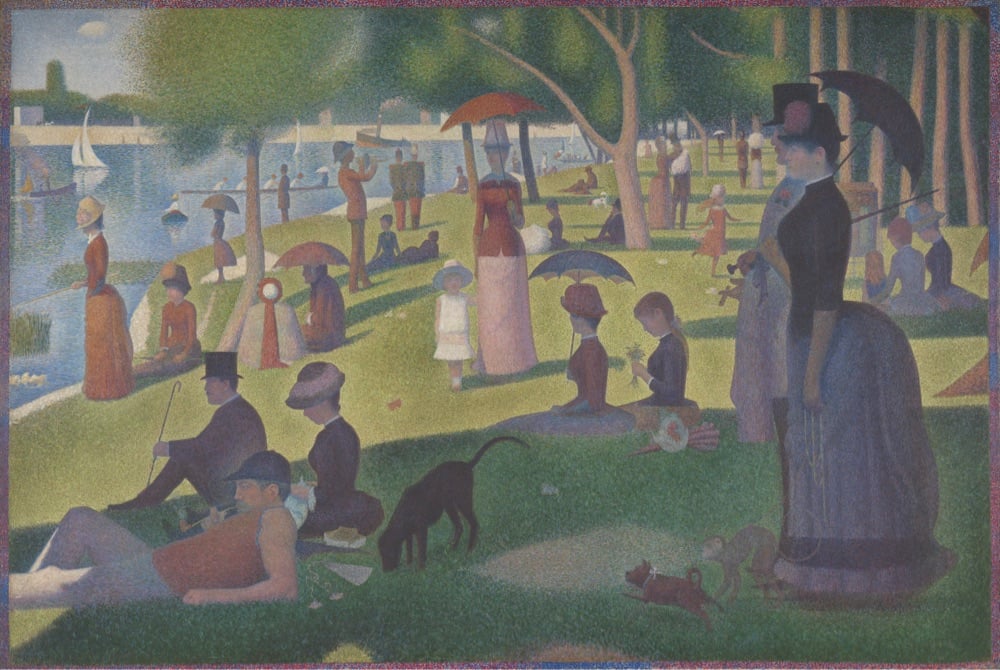
Say what you will about The Algorithms, but YouTube’s reliably informs this art history lover of every new episode of Great Art Explained and for that I am grateful. This latest episode is about the pointillist masterpiece by Georges Seurat, A Sunday on La Grande Jatte. I had a chance to see this painting in person last summer at The Art Institute of Chicago — spent quite a bit of time looking at it from all angles and distances — so this episode was the perfect accompaniment to that visit.
The lack of narrative means we really should look to the artist’s obsession with form, technique and theory — which is practically all he wrote about — and not to meaning or subject matter - which he didn’t write about at all. The painting is really his manifesto. His protagonists don’t have faces or body language, neither a history nor individuality. They are reduced to a hat, a corset, or a pet. They are just characters in his frieze. They exist only to give perfect balance to the composition.
Some paintings are designed for the viewer to “empathise with” but Seurat keeps us at arm’s length. We are not invited to “participate” in the promenade, and their psychological distance is clear. Both with their neighbors, and with us. It was ancient art that Seurat looked to — of Egypt and Greece. He once said that he “wanted to make modern people move about as they do on the Parthenon Frieze”, and placed them on canvases organized by harmonies of colour. It is what makes the painting so intriguing.
From Behind the Masterpiece, a whirlwind summary of evolution of Western art movements, from prehistoric art to the Renaissance to Romanticism to Impressionism to Cubism and beyond. 23 minutes seems like the sweet spot for this kind of thing: any shorter and there wouldn’t be time to give the viewer a sense of each movement but if it were 40 minutes, perhaps many fewer people would be enticed to watch. (via open culture)
This is another great episode of James Payne’s Great Art Explained on the work of Claude Monet, specifically the massive water lily canvases he completed before his death, created as “a war memorial to the millions of lives tragically lost in the First World War”.
Claude Monet is often criticised for being overexposed, too easy, too obvious, or worse, a chocolate box artist. His last works, the enormous water lily canvasses are among the most popular art works in the world.
Yet there is nothing tame, traditionalist, or cosy about these last paintings. These are his most radical works of all. They turn the world upside down with their strange, disorientating and immersive vision.
Monet’s water lilies have come to be viewed as simply an aesthetic interpretation of the garden that obsessed him. But they are so much more.
These works were created as a direct response to the most savage and apocalyptic period of modern history. They were in fact conceived as a war memorial to the millions of lives tragically lost in the First World War.
I’ve seen these paintings at the Musée de l’Orangerie — amazing to see them exactly the way in which the artist intended them to be seen.
See also Film of Claude Monet Painting Water Lilies in His Garden (1915) and Monet’s Ultraviolet Vision.
Older posts




Socials & More